Amid the escalating tensions in the West Asia region, an Indian-flagged merchant vessel was attacked in the Red Sea. While condemning the incident, Yemen’s internationally recognised government condemned the incident and blamed the Houthis for the attack.
As per Indian shipping minister Sarbananda Sonowal, the cargo vessel, MSV Faize Noore Oliya, capsized and sank after being hit by a “projectile” near Yemeni waters.
The vessel, which had a 14-member crew comprising 13 Indian nationals and one Yemeni citizen, was rescued in a joint operation by the Yemeni navy and coast guard.
Also Read | ‘Deeply worrisome’: India condemns attack on ship in Red Sea
Houthis behind ‘terrorist attack,' says Yemen
After the Indian ministry of external affairs raised its concerns regarding the attack, Yemen's government stated that militant group Houthis were responsible for the capsizing.
{{/usCountry}}After the Indian ministry of external affairs raised its concerns regarding the attack, Yemen's government stated that militant group Houthis were responsible for the capsizing.
{{/usCountry}}In a statement, Yemen's ministry of foreign affairs, as part of the internationally recognised government, condemned the “Houthi terrorist attack” on merchant vessel.
"The Ministry of Foreign Affairs stresses that this attack is part of a continuing pattern of crimes and assaults perpetrated by the Houthi terrorist militia, ranging from targeting cities, bombing airports and oil facilities, disrupting exports, and depriving the Yemeni people of vital sources of income thereby exacerbating the humanitarian catastrophe resulting from the Houthi coup to threatening ports and maritime navigation in the Red Sea, the Bab al-Mandab Strait, and the Gulf of Aden, as well as jeopardizing economic and commercial interests in a manner that undermines regional security and stability," reads the statement.
The ministry also stated that the establishment of the multinational defensive maritime coalition, led by Saudi Arabia, "represents a strategic initiative whose importance continues to grow amid escalating maritime threats."
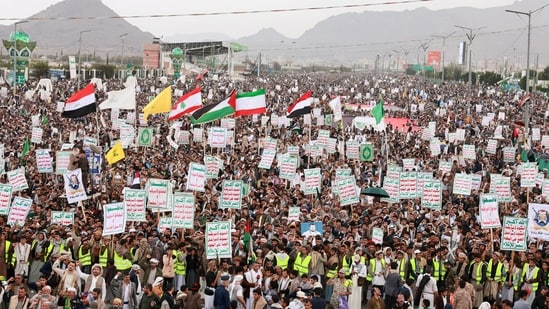
Who are the Houthis?
The Houthis, formerly known as Ansar Allah, are a Shia Islamist political and military organisation. The group emerged in Yemen in the 1990s as a champion for the country's Shia Muslim minority, the Zaidis.
The Houthis have declared themselves a part of Iran's "Axis of Resistance", along with Hezbollah in Lebanon and Hamas in the Gaza Strip. This axis was formed with the aim of reducing the influence of the United States, Israel and the wider West in the West Asia region.
In the early 2000s, the Houthis launched a series of rebellions against long-time authoritarian president, Ali Abdullah Saleh, as they sought greater autonomy for Sa'dah Governorate in northern Yemen.
During the Arab Spring, an uprising in Yemen forced Saleh out of office, and Abdrabbuh Mansour Hadi took over.
However, during Hadi's presidency, the Houthis continued their rebellion and seized control of Saada and then the Yemeni capital of Sanaa, leading to the start of the Yemeni civil war in 2014.
Also Read | ‘Hit sensitive target’: Yemen’s Houthis claim drone strike on Saudi Arabia’s Najran airport
The Houthi takeover also resulted in Hadi and his government resigning. However, after Hadi fled Sanaa, he rescinded his resignation, which ultimately resulted in the militant group forcing the president to flee the country to neighbouring Saudi Arabia. After crossing the border, Hadi was not allowed to return to Yemen and declared president in exile.
Since 2015, Houthi rebels have worked towards taking control of the nation and pushing out the internationally recognised government of Yemen.
The militant group has also found itself in conflict with Saudi Arabia, which leads the Gulf coalition to tackle the rising rebellion.
Despite a truce in 2022 with Saudi Arabia, the civil war continues to push Yemen into a worsening humanitarian crisis, and as tensions escalate in West Asia, the Houthis have emerged as key players in the Gaza War and now the US-Iran war.