
 E-Paper



China bars envoy from entering court to watch Australian’s trial
The high profile trial of Yang Hengjun, 56, an Australian-Chinese writer charged with espionage by China, started on Thursday, two years after he was picked up from an airport by Chinese authorities.


China firmly rejects Canberra’s attempts to intervene in the trial of detained Australian writer Yang Hengjun, the foreign ministry said on Thursday, hours after the Australian envoy was denied entry inside a Beijing court where the author’s case was being heard.
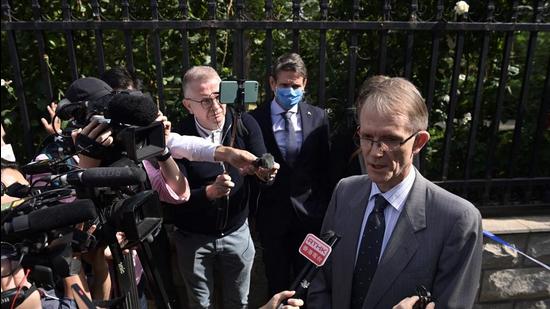
Graham Fletcher, the Australian ambassador to China, was stopped from entering the heavily-guarded Beijing No 2 Intermediate People’s Court as the court began hearing Yang’s case.
The high profile trial of Yang, 56, an Australian-Chinese writer charged with espionage by China, started on Thursday, two years after he was picked up from an airport by Chinese authorities.
A popular blogger, Yang had written spy novels until he was picked up from Guangzhou airport in 2019.
Yang faces a possible death sentence if found guilty of having “endangered national security” while the minimum sentence is three years.
“Unfortunately, we have just been denied entry to the court. The reason given was because of the pandemic situation but the foreign ministry has also told us it is because it is a national security case therefore, we are not permitted to attend it,” agency reports quoted Ambassador Fletcher as saying outside the court.
“This is deeply regrettable and concerning and unsatisfactory. We have had long standing concerns about this case, including lack of transparency, and therefore have concluded it is an instance of arbitrary detention,” he said.
Responding to questions on the case, Chinese foreign ministry spokesperson, Zhao Lijian said China firmly opposes Australia’s unreasonable interference with China’s handling of cases according to law and gross interference in China’s judicial sovereignty.
Zhao added that China has lodged solemn representations with Australia about the case.
Rights groups have spoken out against Yang’s detention and trial.
“Yang Hengjun has been detained on totally baseless allegations that he is a spy, and the Chinese authorities must ensure that his trial meets international fair trial standards. The charges against Yang appear to be a politically motivated prosecution for articles he wrote that were critical of the Chinese government. This is an outrageous attack on his right to freedom of expression,” the head of the rights group Amnesty International’s China Team, Joshua Rosenzweig, said.
Australian-Chinese, Cheng Lei, a high-profile business anchor for CGTN, a state television channel, disappeared in August last year, and a month later, was accused of espionage.
Yang’s arrest and the reluctance on China’s part to release details about it is one among several reasons for the souring of ties between Beijing and Canberra.
Earlier this May, China had “indefinitely” suspended all activity under a China-Australia economic dialogue mechanism, seen as part of increasingly strained diplomatic ties between Beijing and Canberra.
Like with the US, Beijing-Canberra ties have been soured by more than one reason; the strains first appeared in 2018 when Australia became the first country to publicly ban Chinese tech giant Huawei from its 5G network.
Beijing was furious in 2020 when Australia became one of the first countries to call for an independent investigation into the origins of the novel coronavirus, which started from the central Chinese city of Wuhan in late 2019.


