E-Paper



China Creates World’s No. 1 Shipbuilder, Driven by Rivalry With U.S.
In a $16 billion merger, Beijing is looking to counter President Trump’s moves to rebuild American shipyards.


 Prefer HTon Google


A $16 billion merger of two state-controlled shipbuilders in China is set for completion this week, creating the world’s biggest shipbuilder while the U.S. searches for a path back into the business.
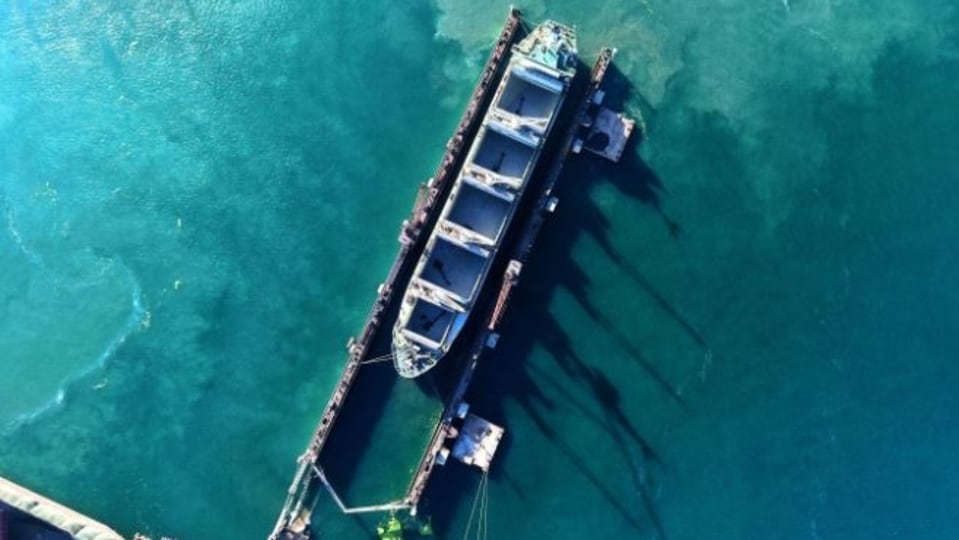
American shipbuilders are playing catch-up after decades of maritime-industry decline, though President Trump’s ambitious plans to revive American shipbuilding have hit snags recently. In the shorter term, Trump’s threat to impose higher fees on ships made in China is giving South Korean and Japanese rivals an opening to win back market share.
The Chinese champion is called China State Shipbuilding, or CSSC. This week it is scheduled to absorb its merger partner, China Shipbuilding Industry, and take the sole listing on the Shanghai Stock Exchange after regulators recently approved the deal.
The merged company hopes to use its bulk to cut costs and help it ride out industry turmoil brought on by Trump’s moves.
The two companies were originally one and split up in 1999, when the government wanted to promote competition. These days, Beijing is looking to consolidate state-led companies in sensitive industries, particularly those connected with the military.
CSSC’s main business is commercial, but it is also an important contractor for the Chinese navy. The company it is absorbing designed and built China’s first homegrown aircraft carrier, the Shandong.
The company said the merger will allow it to better fulfill the navy’s need for advanced equipment.
“This is a key milestone in China’s long-term push to dominate global shipbuilding,” said Matthew Funaiole, an analyst at the Center for Strategic and International Studies in Washington.
Together, the companies accounted for almost 17% of the global market last year, based on new-orders data from Clarksons Research. The merged company’s combined order book will total more than 530 vessels and 54 million deadweight tons, the most in the world, with an annual revenue of around $18 billion, based on the latest annual reports.
“It strengthens Beijing’s ability to execute its military-civil fusion strategy,” Funaiole said. “Commercial and naval production are increasingly integrated, sharing technology, talent and infrastructure.”
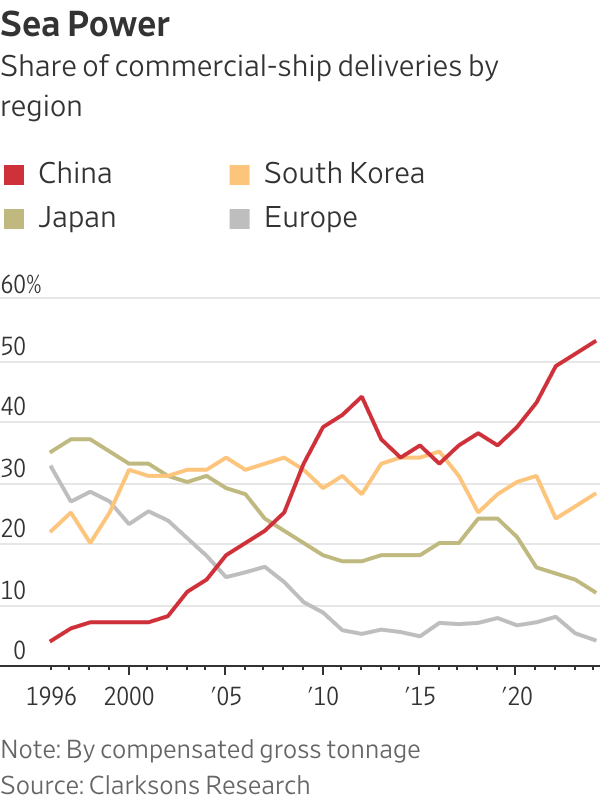
Beijing set its sights on dominating the shipbuilding industry decades ago, and now Chinese shipbuilders make up more than half of the global market. China-built ships accounted for about 55% of global tonnage last year, compared with less than 0.05% for the U.S., data from the United Nations show. China possesses 232 times the shipbuilding capacity of the U.S., according to the U.S. Navy.
But recent data suggest China is facing rougher times because the prospect of U.S. port fees on Chinese-made ships has prompted owners to look at non-Chinese shipyards. In addition, Trump’s tariffs and countries’ focus on domestic supply chains have raised the specter of less global trade overall, meaning fewer ships would be needed to carry goods.
Singapore-listed Yangzijiang Shipbuilding, China’s biggest private yard, received orders for 14 ships worth $540 million in the first half of 2025, compared with 126 vessels worth $14.6 billion for all of last year. Clarksons data show global new ship orders fell 48% year on year in the first half of 2025.
Yangzijiang said the sector faces “macroeconomic uncertainties and geopolitical tensions.”
Meanwhile, smaller rivals in Japan are looking to reclaim market share after decades of being pushed into a corner by lower-cost Chinese and South Korean rivals.
Imabari Shipbuilding President Yukito Higaki, who is also head of the Shipbuilders’ Association of Japan, said in June that the country aimed to raise its market share to 20% by 2030 from around 9% currently. The association is “uniting Japanese ship and vessel companies under an ‘All Japan’ strategy to counter China and South Korea,” he said.
Japan commanded around half of all shipbuilding output in the 1990s.
A proposal in June from Japan’s ruling Liberal Democratic Party calls for extensive subsidies for local shipyards to protect national security, including a $6.7 billion public-private fund. “If we fail to act now, Japan risks losing its shipbuilding industry entirely, as Europe and the United States did,” the party said.
China won’t give up easily, said Kenneth G. Huang, a professor at the National University of Singapore who studies Chinese state-owned enterprises. “Shipbuilding is a core capability that China wants to build,” he said, “and the rivalry with the U.S. is going to push them to upgrade faster.”
Write to Clarence Leong at clarence.leong@wsj.com and Costas Paris at costas.paris@wsj.com