
 E-Paper



China’s lunar probe sends first panoramic image of moon’s dark side
The far side has been observed many times from lunar orbits, but never explored on the surface. It is popularly called the “dark side” because it can’t be seen from Earth and is relatively unknown, not because it lacks sunlight

 Prefer HTon Google


China on Friday announced that the Chang’e-4 mission, the first-ever probe to land on the moon’s dark side, was a “complete success” as it transmitted images back to earth through a special relay satellite.
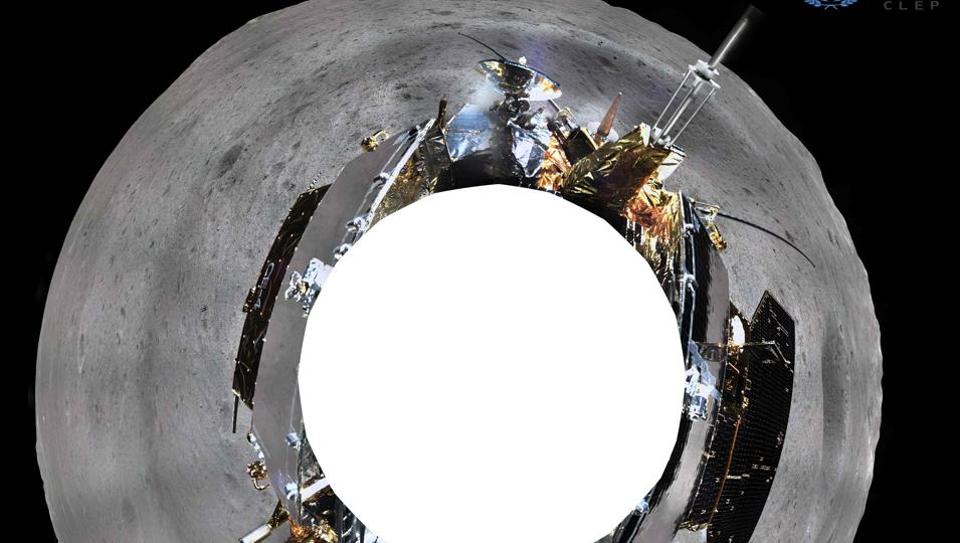
With the assistance of the relay satellite Queqiao (Magpie Bridge), the rover Yutu-2 (Jade Rabbit-2), the lander of the Chang’e-4 probe took photos, China National Space Administration (CNSA) said.
The scientific instruments aboard the probe worked well, and the images taken by the probe and the detection data have been sent back to ground control, it said.
This is the first time an attempt was made to explore the far side of the moon. Since the moon’s revolution cycle is the same as its rotation cycle, the same side always faces Earth. The other face, most of which cannot be seen from Earth, is called the far side or “dark side” of the moon, not because it is dark, but because most of it is uncharted.
Images sent back from first-ever probe to soft-land on moon’s far side show it surrounded by lots of craters of different sizes, which posed a great challenge for future exploration of the lunar rover Yutu-2.

The probe, comprised of a lander and a rover, touched down at the preselected landing area at 177.6 degrees east longitude and 45.5 degrees south latitude in the Von Karman Crater in the South Pole-Aitken (SPA) Basin on the far side of the moon on January 3.
China announced Friday that the Chang’e-4 mission, was a “complete success”.
The CNSA on Friday released several images taken by the Chang’e-4 probe transmitted back via the relay satellite Queqiao.
One of the published images is a 360-degree panorama which was pieced together from 80 photos taken by a camera on the lander after the rover drove onto the lunar surface, according to Li Chunlai, deputy director of the National Astronomical Observatories of China and commander-in-chief of the ground application system of Chang’e-4.
“From the panorama, we can see the probe is surrounded by lots of small craters, which was really thrilling,” said Li.
One of the craters close to the rover Yutu-2 has a diameter of about 20 meters and a depth of about 4 meters. The rugged terrain will pose great challenges for planning the route of the rover, said Li.
Compared with the landing site of the Chang’e-3, which was sent to the Sinus Iridum, or the Bay of Rainbows, on the moon’s near side, fewer rocks can be found in the area surrounding Chang’e-4, indicating the landing area of Chang’e-4 might be older, state-run Xinhua news agency quoted Li as saying.
He said the Chang’e-4 landed at an altitude of nearly minus 6,000 meters. The deepest region on the moon, where there is an altitude of minus 9,100 meters, is about 700 kilometers to the south of the probe.
“The information from the depths of the moon will be one of our focuses in the exploration,” said Li.
The CNSA also released a video of the landing process of the Chang’e-4, which was produced by processing more than 4,700 pictures taken by a camera on the probe.
The video, lasting about 12 minutes, shows the probe adjusted its altitude, hovered and avoided obstacles during the descent process.
“From the video, we can see more dust was thrown up when the Chang’e-4 touched down on the far side of the moon compared with the landing of Chang’e-3, which indicates that the lunar dust at the landing area of Chang’e-4 is thicker than the region where Chang’e-3 landed,” said Zhang Hongbo, chief designer of the ground application system of Chang’e-4.
“The thicker dust shows that the lunar regolith in the region has undergone longer space weathering, which also gives strong evidence of the region being older. We will conduct comparative research between the landing areas of Chang’e-3 and Chang’e-4,” Li said.


