
 E-Paper



China, US gear up for first Xi-Biden virtual summit as Taiwan looms
China’s position and concerns over US policies on Taiwan will likely top the discussion agenda when Chinese President Xi Jinping meets US counterpart Joe Biden during a virtual summit on Tuesday.


China’s position and concerns over US policies on Taiwan will likely top the discussion agenda when Chinese President Xi Jinping meets US counterpart Joe Biden during a virtual summit on Tuesday.
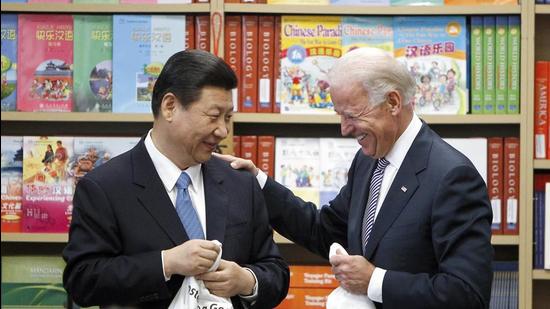
Chinese state-controlled media said on Monday that Beijing will ask Washington to “step back” on its policies and statements on the self-ruled and democratic island, which China claims as a breakaway region.
The situation in Afghanistan, bilateral trade, nuclear proliferation and cybersecurity are likely to be discussed during the talks.
The meeting will be the first one-on-one meeting between Xi and Biden via video link, the first since Biden took office in January. The two leaders have had two phone conversations, in February and September.
On Saturday, state councillor and foreign minister Wang Yi told US secretary of state, Anthony Blinken that “…any connivance of and support for the ‘Taiwan independence’ forces undermines peace across the Taiwan Strait and would only boomerang in the end”.
The Chinese foreign ministry on Monday said China “…firmly opposed the wrong words of US secretary of state Antony Blinken about the Taiwan region, which are against the consensus reached between China and the US when the two countries established diplomatic ties”.
“The US should abide by the One-China principle and the three China-US joint communiques, the important consensus and political foundation of the two countries,” ministry spokesperson, Zhao Lijian said.
Zhao said currently “…Sino-US relations are at a critical crossroads. This video meeting is a major event in Sino-US relations as well as in international relations”.
Zhao said Xi and Biden will have a candid and in-depth exchange of views on strategic issues related to the future of China-US relations and important issues of mutual concern.
For China, however, the issue of Taiwan is likely to top the talks’ agenda. “The Taiwan question is the ultimate red line of China…In order to reduce the risk of a strategic collision between China and the US, the latter must take a step back from the Taiwan question and show its restraint,” the Global Times wrote in an editorial on Monday.
“However, the two sides are unlikely to reach any consensus on this question as there is still strong motivation inside the US government to continue playing the Taiwan card, which is seen as one of Washington’s most useful leverages,” Xin Qiang from the Centre for American Studies at Shanghai’s Fudan University told the Global Times.
It is likely that Xi would impress upon Biden that Beijing is resolved to “realise national reunification in the foreseeable future no matter the cost”, another editorial in state-run China Daily newspaper said.
Reuters quoted experts saying China’s emphasis on Taiwan amid other friction points reflects its reluctance to be drawn into armed conflict with the US unnecessarily, despite its recent words and actions, including sending an unprecedented number of planes into Taiwan’s air defence zone.
“Chinese leaders are aware that China has not completed its modernisation and still faces many challenges in its domestic economy,” Li Mingjiang from the S. Rajaratnam School of International Studies in Singapore told Reuters.
Besides fraught ties over a range of issues from trade ties to human rights and transparency over the origins of Covid-19 pandemic, Tuesday’s Xi-Biden meeting will take place in the backdrop of rapid developments in Afghanistan.
In September, Xi had told Biden during a phone conversation that the US’ China policy has resulted in serious difficulties in bilateral ties and runs counter to the fundamental interests of the two countries and the common interests of the world.


