
 E-Paper



Chinese PLA’s new expansion plans on Bhutan
The Bhutanese rulers have been sensitised at the highest level and have been asked to prepare for a military contingency plan

 Prefer HTon Google


After Ladakh and the South China Sea, the People’s Liberation Army (PLA) is poised to open another front against Bhutan, with a build-up in western and central part of Kingdom in a bid to settle the border on terms favourable to China in the forthcoming 25th round of boundary talks, people familiar with the matter said,
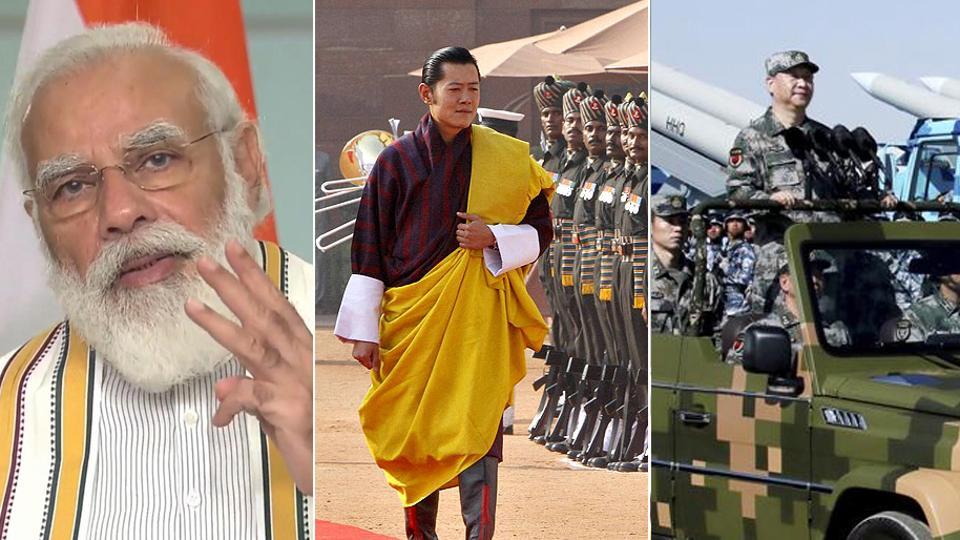
While Thimpu has been sensitised at the highest levels about the PLA threat, the people added, Beijing will likely use PLA transgressions and encroachments in central Bhutan for a possible trade-off on already encroached areas and claims in the western part of the kingdom in the forthcoming negotiations.
Bhutan is central to India’s national security as the country lies next to the Siliguri corridor and any territorial compromise made by Bhutan will have an adverse impact on Indian defences in the area. Although India helped Bhutan Hold its own against PLA during the 73-day stand off at Doklam plateau in 2017, the Chinese army has not stopped testing the armies of the two close allies in the area, the people, in India’s military, diplomatic and security establishment said, speaking on condition of anonymity.
Chinese territorial claims in Bhutan include 318 sq km in the western sector and 495 sq km in the central sector. Continuing with its expansionist polices under the grab of peaceful coexistence, the PLA is continuing to construct roads, build and improve military infrastructure and intimidate the miniscule Royal Bhutan Army through aggressive patrolling and denial of access, the people explained.
According to diplomats based in Thimpu and New Delhi, since the 2017 Doklam stand-off, PLA has intruded into five areas of western Bhutan and laid claim to a new boundary that extends approximately 40 km inside Bhutan, to the east of Chumbi Valley. It has methodically built up infrastructure, improved defences, constructed roads, tracks, helipads for troop movement and last mile logistics.
In true Middle Kingdom style, PLA patrols on August 13 and 24 crossed the main stream of Torsa nullah (Dolong Chu) into south Doklam and asked Bhutanese herders to vacate the area near Raja Rani lake in which they were grazing their livestock. The basic idea behind the PLA move is to force both India and Bhutan to agree that China’s boundary extends to Gyemochen on Jhampheri ridge rather than on the Sinche la -Batang La axis, the true alignment of the trijunction. This is exactly what PLA was attempting to do in 2017, when it was stopped by the Indian Army.
According to national security planners, PLA has increased surveillance in north Doklam by installation of surveillance cameras and continues aggressive military technical upgradation on the Chinese side of the contested plateau. Thimphu has asked the Royal Bhutanese Army to prepare for a reaction plan by deploying additional troops in order to prevent PLA from coming south of Torsa nullah or unilaterally alter the disengagement lines agreed to by Beijing in Doklam in 2017.
The PLA expansionist plans are not limited to western Bhutan. In June , China raised an objection against Bhutan’s Sakteng Wildlife Sanctuary (SWS) Project on the contention that it was located in a disputed border area. Spanning some 750 sq km, the sanctuary is located in the eastern Trashigang Dzongkhag of Bhutan, bordering India and China. This new claim may draw India again into The contest since the Sakteng Wildlife Sanctuary abuts Arunachal Pradesh which China claims as its territory.
The development came as a surprise to Bhutan. China had never before claimed the land of the Sakteng Wildlife Sanctuary or, for that matter, any land in eastern Bhutan, analysts said. Even more puzzling, Beijing had not mentioned the region during 36 years of diplomatic talks that the two sides have held to resolve their boundary differences. Naturally, the Bhutanese government strongly opposed the Chinese claim questioning the sovereignty of Bhutan. While rejecting the claim of China, Thimpu has also conveyed that the Sakteng Wildlife Sanctuary is a sovereign territory of Bhutan and Not disputed. China’s Foreign Ministry, however, has a different perspective and made an official declaration that “the boundary between China and Bhutan has never been delimited. There have been disputes over the eastern, central and western sectors for a long time”.
It is notable that the Chinese stand emerged in early June — at a time when Beijing was involved in a series of military standoffs along its Line of Actual Control (LAC) with India in Ladakh. China’s new territorial claim in eastern Bhutan indicates Beijing’s intent and its sudden territorial claim reinforces the expansionist narrative that the country has now embarked on under Xi Jinping.


