E-Paper



Climate action will offer stability in new world disorder: UN Climate chief
UN climate chief Simon Stiell calls climate action as a vital tool for global security and prosperity that can help deliver stability in an unstable world

 Prefer HTon Google


UN Climate Chief Simon Stiell on Thursday said climate action can deliver stability in an unstable world as Turkiye begins preparations to host COP31 in Antalya, in November.
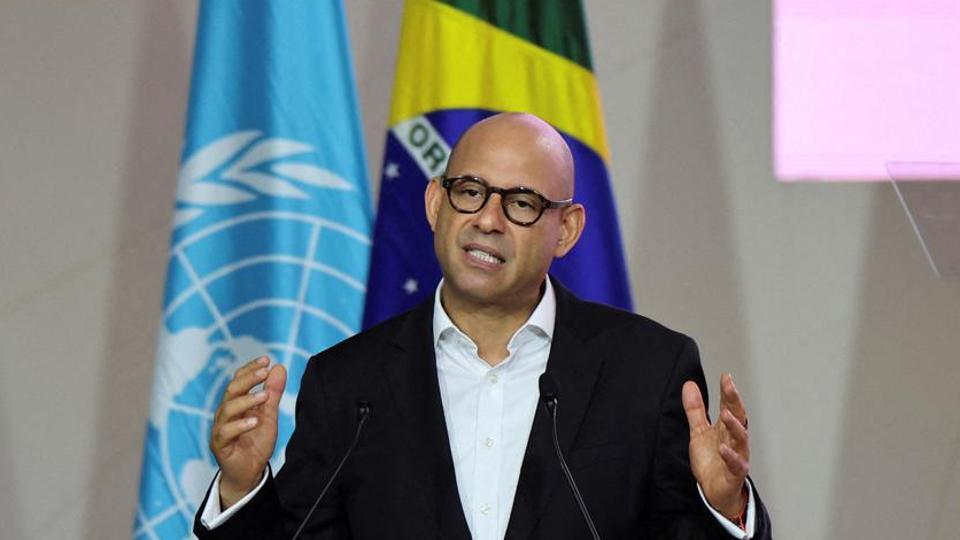
“We find ourselves in a new world disorder. This is a period of instability and insecurity. Of strong arms and trade wars. The very concept of international cooperation is under attack,” Stiell said.
He further said that renewables are the clearest, cheapest path to energy security and sovereignty which can shield countries from shocks unleashed by wars and trade turmoil.
Last month, US President Donald Trump signed a presidential memorandum directing the United States to withdraw from 66 international organisations and treaties, including the United Nations Framework Convention on Climate Change and the Intergovernmental Panel on Climate Change.
This would mean the US, world’s largest historical polluter, will now have withdrawn completely from the global climate change mitigation agreement and scientific assessment of climate change.
Stiell said on Thursday that the US can return to the convention and Paris Agreement.
Also Read: Trump directs US withdrawal from 66 organisations, including UN Climate Convention
“That door remains open. I don’t want to speak to any country specifically but the economics is absolutely clear. Renewables are the cheapest, cleanest mode of energy production. They are cheaper than coal. We are all very aware of what science is telling us in terms of fossil fuel generated pollution and impacts on lives and livelihoods. No country is immune,” he said responding to a question during a press conference in Istanbul.
Stiell further said that climate action can be divided into three eras.
“In the first, we uncovered the problem. But instead of responding, we argued over its scale. In the second, we started to get serious about solutions. And during this era, together we built the Paris Agreement. That didn’t solve the climate crisis – but it changed our course,” Stiell said.
In the decade since Paris, clean energy investment has increased tenfold – from two hundred billion dollars to over two trillion dollars a year. In 2025, amidst all the economic uncertainty and gale-force political headwinds, the global transition kept surging forward, he said. During the second era, “clean energy investment kept growing strongly, and was more than double that of fossil fuels. Renewables overtook coal as the world’s top electricity source,” he said.
“From those determined to use their power to defy economic and scientific logic, and increase dependence on polluting coal, oil and gas – even though that means worsening climate disasters and spiralling costs for households and businesses. Those forces are undeniably strong. But they need not prevail,” Stiell said while adding that the third era of climate action would be the era of implementation.
“This is an era to speed-up and scale-up. It must start with a relentless focus on delivering – or even exceeding – the targets agreed in the first global stocktake, in 2023,” he said.
At COP28 UN Climate Conference in Dubai, countries agreed to doubling energy efficiency and tripling clean energy by 2030; transitioning away from all fossil fuels, in a just, fair and orderly manner and strengthening resilience and reducing vulnerability.
“By the second global stocktake, in 2028, we must be on track to meet those commitments.
So that countries come to COP33 confident of a robust response that delivers not just survival but strength: Boosting resilience, growing economies, and slashing emissions. Committing to new and stronger targets that science demands,” Stiell said.
Then Stiell went on to explain how the era of implementation can be ushered in–first, by rapidly scaling up a pipeline of projects globally that get us to current targets, by match-making between countries, finance and the private sector – to secure partnerships, agreements and projects that translate into real-world results at scale.
“Those skilled in the art of deal-making are already seizing the huge opportunities on offer. This approach is generating massive investment flows, leveraging the market-driven momentum that’s already transforming global energy systems irreversibly. Those stepping back from climate leadership are simply giving this goldmine of new jobs and wealth to competitor economies,” Stiell said.
Second– hyper-charging the flow of finance is key, so every country can seize the vast benefits of climate action, and build climate resilience to protect their peoples and ensure countries have the support they need to deliver in full on their National Adaptation Plans and Nationally Determined Contributions.
“That means lowering the cost of capital, and securing a massive surge in the quantity and quality of climate finance, especially for developing countries. Multilateral Development Banks will be crucial to provide more finance, bring in the private sector, produce better data, and continue to reform,” Stiell added.
Third– ambitious coming together in coalitions of the willing. This includes creating roadmaps to transition away from fossil fuels and halt deforestation.
“Fourth, we must continue to evolve our own work for this new era: Moving our process ever closer to the real economy, for faster implementation, delivering more benefits for billions more people. I have convened experts to advise on this, fully respecting that this is a Party-driven process,” Stiell said.
He added that the UN will keep working with leadership in Brazil, Türkiye, Australia and - from next year - Ethiopia, towards a successful second global stocktake in 2028.
“Whether, in today’s fractured geopolitics, climate cooperation can keep delivering the major step-up needed. My unequivocal answer is: yes. Why? Because it is indisputably in every nation’s self-interest. Climate action delivers on the top day-to-day concerns of citizens everywhere,” he said.