E-Paper



COP29 Presidency launches Baku Global Climate Transparency Platform
HT has reported that developed and developing parties have divergent views on how much climate finance should be delivered and who should provide it


Azerbaijan, the COP29 Presidency, on Tuesday launch the Baku Global Platform for Climate Transparency, aimed at promoting mutual trust and confidence in climate action.
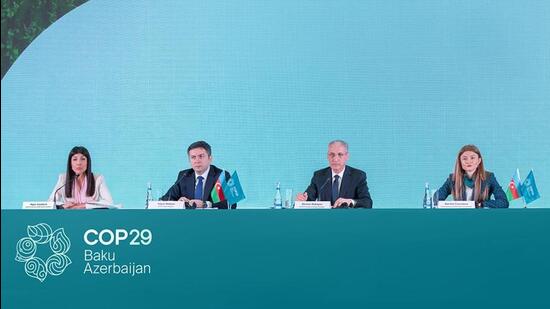
“The BTP is designed to build mutual trust and confidence among parties, support developing countries in preparing and finalising their Biennial Transparency Reports (BTRs), encourage universal participation in the Enhanced Transparency Framework (ETF), and advance the transparency agenda beyond COP29,” a statement from COP29 said.
Under the Enhanced Transparency Framework, parties to the Paris Agreement are required to submit biennial transparency reports every two years, with the first submission due by December 31, 2024.
BTRs are supposed to include information on national inventory reports (NIR), progress towards NDCs, policies and measures, climate change impacts and adaptation, levels of financial, technology development and transfer and capacity-building support, capacity-building needs and areas of improvement.
Sumit Prasad, Programme Lead, Council on Energy, Environment and Water (CEEW) said this report demands all countries to report more granularly and detailed information than before on climate actions as well as support.
"Countries have to submit their first Biennial Transparency Report under the Paris Agreement by the end of this year. This report demands all countries to report more granularly and detailed information than before on climate actions as well as support; hence, it sheds light on how they are flaring against national commitments. While internationally, it is an essential pillar on which negotiations rest towards holding countries accountable, domestically, these also highlight challenges and learning to inform policy", Prasad said.
"Given that developing countries are at different starting points in terms of their capabilities to be able to complete their first Biennial Transparency report, the Baku Global Climate Transparency Platform is a unique platform which would bring different actors who could support countries towards better understanding their climate actions and help them prepare their first Biennial Transparency Report", Prasad added.
HT has reported that developed and developing parties have divergent views on how much climate finance should be delivered and who should provide it.
HT reported on Sunday that a draft document on the new climate finance goal, to be negotiated at the UN Climate Conference COP29 in November, indicates developing countries expect contributions in the trillions from developed nations for climate change mitigation efforts.
HT also reported that setting a new climate finance goal will be the primary agenda at the annual UN climate meeting when it convenes for this year in Baku, Azerbaijan.
Also Read: UN draft: Developing nations expect trillions for climate mitigation efforts
The current goal has a floor of $100 billion annually after 2025. The Arab group expects developed countries to mobilise $1.1 trillion annually to developing nations from 2025 through 2029, providing a minimum of $441 billion per year. The African group calls for developed countries to jointly mobilise $1.3 trillion annually by 2030, with an aggregate goal of $6.5 trillion.
The United States, however, has not specified a number or timeline. It expects contributions from all sources, including “contributing parties,” and proposes “a goal of investing USD [X] trillion globally in climate action by [timeframe] from all sources” — leaving those specific details up for discussion.
The US and other wealthy nations have attempted to blur the distinction that finance should flow from developed to developing countries, as specified in the United Nations Framework Convention on Climate Change (UNFCCC) principles — instead, they are pushing emerging economies to contribute.
The transparency platform may help understand what developed and developing nations are doing domestically to mitigate climate crisis and whether their actions are according to what they promised.
The BTP, created in collaboration with the UNFCCC, will bring together parties and stakeholders to provide support in the preparation and submission of BTRs by developing countries, which are key in making progress on transparency this year, as the Parties implement the ETF.
“In its first phase, the BTP will focus on enabling the delivery of BTRs in 2024, with its second phase to focus on serving as a platform for targeted support for the implementation and universal participation in the ETF, ensuring the continuation of the initiative to track the progress made by parties through 2024 and beyond,” the COP29 Presidency said.
Over the coming months, the COP29 Presidency will host a series of regional workshops on transparency across Eastern Europe, the South Caucasus and Central Asia, Africa, Asia-Pacific, Latin America, and the Caribbean. It will also convene the Global Transparency Dialogue during the 79th session of the United Nations General Assembly (UNGA) in New York.
“Transparency is important to the COP29 Presidency’s efforts to enhance ambition and enable action. Effective Biennial Transparency Reports (BTRs) can serve as valuable benchmarks for assessing our progress on climate initiatives. It is a cornerstone of our collective efforts on climate change and is fundamental for building mutual trust and confidence among Parties, highlighting areas for further progress, and inspiring us to pursue greater ambition,” said Yalchin Rafiyev, COP29 lead negotiator in a statement.
“Biennial Transparency Reports – BTRs – help to shine a light on progress. They tell us if the machinery is working, how it is performing, whether we are reaching our Paris Agreement goals,” UN Climate Chief Simon Stiell said in June.