
 E-Paper



From key face in Iran's Islamic Revolution to face on burning posters: Who is Ayatollah Ali Khamenei?
Ayatollah Ali Khamenei, 86, assumed the post of Iran Supreme Leader in 1989 after Khomeini’s death

 Prefer HTon Google


Iran’s Supreme Leader Ayatollah Ali Khamenei is currently facing growing unrest within the country, as well as threats from outside, particularly from US President Donald Trump, amid massive protests that initially erupted over sharp rises in food prices but have since turned into anti-government demonstrations.
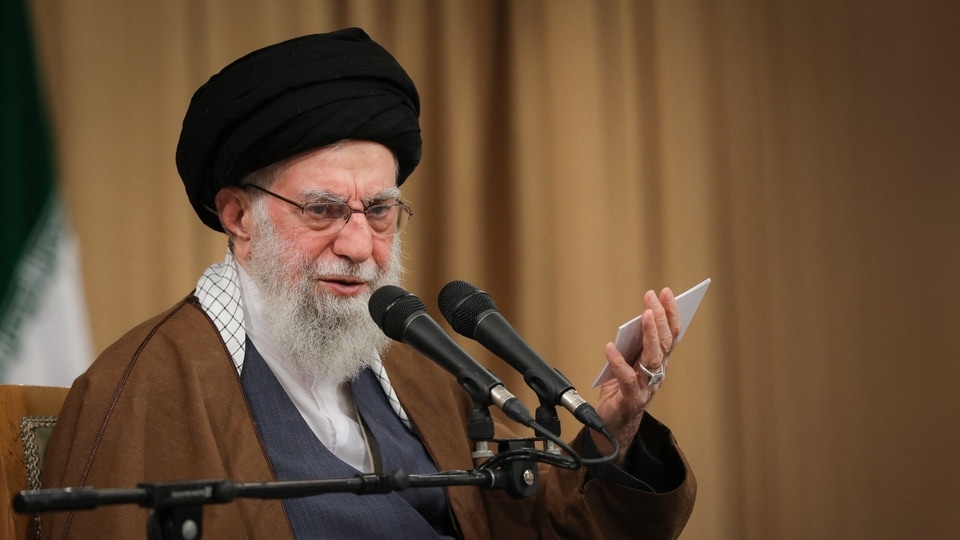
Protesters have been taking to the streets across Iran for 13 days. Their movement seeks an end to the clerical system that has been in place since the 1979 Islamic Revolution, which ousted the Shah (king), Mohammad Reza Pahlavi, as popular cleric Ruhollah Khomeini took over as the Shia Muslim-majority country’s first Supreme Leader.
Amid the attacks on Iran by the US and Israel, Khamenei's residence was a key target. Satellite images from the strikes show the Ayatollah's house damanged, with many of his relatives reported dead. Earlier today, US President Donald Trump took to social media to announce that Khamenei has been “killed” in the joint US-Israel operation.
While Trump has confirmed the Islamic Republic leader's death, several Iranian reports have stated otherwise. The United Nations has also stated that it cannot confirm the Ayatollah's death, despite the US President's statement.
Follow live updates related to Iran protests here.
Ayatollah Ali Khamenei, now 86, assumed the post in 1989 after Khomeini’s death.
Here is all you need to know about Ali Khamenei:
Who is Ayatollah Ali Khamenei
Ali Khamenei was born on April 19, 1939, in Iran’s Mashhad to Sayyed Javad Khamenei, an Islamic scholar.
When he was four years old, Khamenei and his elder brother were sent to maktab, the traditional primary schools of that period, to learn the alphabet and the Quran. He later moved to a newly set-up Islamic school to continue his studies, according to his official biography.
At the age of 18, he planned a pilgrimage to the shrines in Iraq. He travelled from Iran to Najaf in 1957 but returned in 1958 after his father wished that he continue his higher religious education in the holy city of Qum.
In 1962, while studying in Qum, he became part of the circle supporting Imam Khomeini, who was opposing the “pro-American, anti-Islamic policies” of the Shah’s rule, the biography said. It quoted Khamenei as saying that his early awareness of Islamic views and the need to confront the Shah’s “despotism and his British supporters” began when he was 13.
Khamenei was arrested for the first time in 1963. He spent one night in custody after travelling to Birjand to spread Khomeini’s views. Later that year, after protests broke out in June following Khomeini’s arrest, Khamenei was arrested again and taken to Mashhad, where he remained in prison for 10 days.
In 1967, he went into hiding after believing that the now-eliminated SAVAK, the Iranian secret police and intelligence service, was closely monitoring him, his biography further said. In 1975, agents of the security service allegedly forced their way into his Mashhad home and arrested him for the sixth time.
Key face of Islamic Revolution
Khamenei returned to Mashhad in 1978 as political unrest grew, a period that would eventually lead to the establishment of the Islamic Revolution and the Shah’s ouster. Before the first Supreme Leader returned to Iran, an Islamic Revolutionary Council was set up, and Khamenei was appointed as one of its members, the biography noted.
Before he took over as Supreme Leader in 1989, Khamenei held several positions, including President of the country in 1981 after the death of Mohammad Ali Rajai, making him the first cleric to hold the post.
That same year, he reportedly survived an assassination attempt at Abuzar Mosque in Tehran when a tape recorder placed near him exploded while he was addressing worshippers, leaving his right arm badly injured.
He was re-elected President in 1985 for a four-year term. In 1989, Ayatollah Khomeini selected Khamenei as his political successor. Khomeini died that year.
Khamenei has served as the Supreme Leader of Iran since then.
Ayatollah Ali Khamenei after he became Supreme Leader
After assuming power, Khamenei strengthened a system of rule led by the or Shiite or Shia Muslim clerics. This move strengthened his standing among hardliners as an authority seen as beyond challenge, second only to God.
At the same time, Khamenei expanded the power of the Revolutionary Guard, turning it into the main force in Iran’s military and internal politics. The Guard controls the country’s most elite units and manages Iran’s ballistic missile programme, the Associated Press reported.
When Khamenei came to power, Iran was emerging from a long and damaging war with Iraq that had left the country weakened and cut off. Over the next three decades, he reshaped Iran into a more powerful state that built influence across the Middle East.
However, his rule of more than three decades has also brought repeated challenges.
The first serious test to his authority came from a reform movement that won control of parliament and the presidency soon after he became Supreme Leader. The reformists called for stronger powers for elected leaders.
After the reform movement failed, the Revolutionary Guard and other security bodies moved to shut down repeated protest waves.
Large protests spread across the country in 2009 over claims of vote-rigging. As economic sanctions led by the US took a toll, protests over prices and other related issues followed in 2017 and 2019.
In 2022, fresh nationwide protests broke out after a woman called Mahsa Amini died following her arrest by police for not wearing her mandatory headscarf properly. Hundreds of people were killed as the protests were put down, and many more were detained.


