
Sign in

PM Oli floats an ‘Emergency’ plan to keep his chair intact, Prez is non-committal

Nepal PM Oli wants to declare a health emergency but there are many who are not in favour.

Updated on: Jul 9, 2020, 15:42:27 IST
Hindustan Times, New Delhi | By
Share
Share via
  • facebook
  • twitter
  • linkedin
  • whatsapp
Copy link
  • copy link

Political crisis continues unabated in Nepal with Prime Minister K.P. Sharma Oli meeting President B.D. Bhandari to ostensibly discuss the implementation of health emergency in the country to contain the spread of Covid-19 infection in the Himalayan nation. The declaration of health emergency will also give respite to the Prime Minister who is facing staunch opposition within his own party for lop-sided foreign policy.
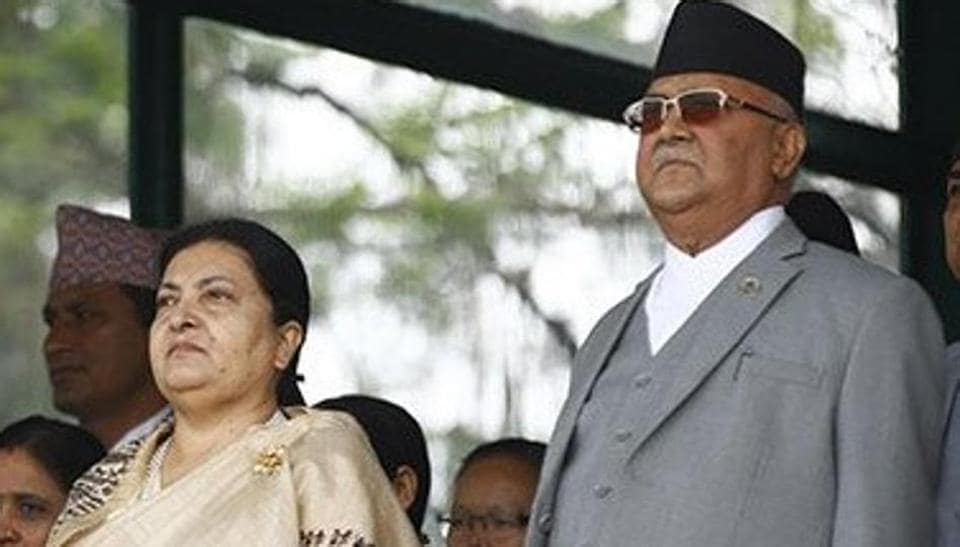
Nepal Prime Minister KP Sharma Oli, who is struggling to retain power, recently discussed the feasibility of declaring a health emergency, ostensibly to contain spread of Covid-19 infection (Twitter)

According to sources, President Bhandari was non-committal towards the imposition of health emergency. Instead asked the PM to ensure that political differences between leaders are settled through discussions. The powerful Nepalese Army is also not in favour of deploying troops for health emergency.

While PM Oli is again scheduled to meet Nepalese Communist Party Co-Chairman P.K. Dahal today to resolve political differences, the former has made it very clear that he will not put in his papers under any circumstances even if it leads to splitting of the party. The two NCP Co-Chairs had more than two hours of discussions yesterday but without any result. A meeting of the standing committee of the party is scheduled tomorrow with majority of members against PM Oli but the passing of any resolution requires signatures of both Oli and Dahal. In case the resolution passes through the standing committee, it goes to central committee, where again PM Oli supporters are in a minority.

ALSO WATCH | India-Nepal tussle: Oli govt forced to defer new map claiming Indian territory

While the “galla (war chest) and gaddi (power)” games are on in Kathmandu, adding to fuel to fire is the Chinese Ambassador to Nepal Hou Yanqi who is putting pressure on NCP leaders to settle their differences towards a status quo. One of the senior most NCP leaders in a meeting with Hou asked her whether the Chinese Communist party would allow dissensions against PM Oli in the party simmer or it would lead to action. He made it very clear to her that the NCP would remain strong even without PM Oli.

Hou’s actions in Kathmandu, which go beyond the diplomatic brief, have invited serious criticism in Nepalese independent media as it clearly shows the depth of Chinese penetration in the Himalayan Kingdom. Even though the NCP party proclaims to follow Mao’s ideology in the past, majority of their leaders are democrats at heart and firm believers in Hindu rituals.

It is because of the Chinese power play in Kathmandu and PM Oli’s political ambitions, political crisis will continue in Nepal. It is loss of power not spread of coronavirus that is of main concern of PM Oli now.

  • Shishir Gupta
    ABOUT THE AUTHOR
    Shishir Gupta

    Shishir Gupta is Executive Editor at Hindustan Times and one of India's top journalists covering national security, strategic affairs, foreign policy and geopolitics. Over the past three decades, he has extensively reported on India's military, diplomatic and security landscape, covering every major conflict and national security challenge, from the 1999 Kargil War and the 2020 East Ladakh standoff to Operation Sindoor in 2025. He has also covered major terror attacks, including the IC-814 hijacking, the 26/11 Mumbai attacks and the 2025 Pahalgam terror strike, along with numerous Pakistan-backed terrorist incidents in the Kashmir Valley and across India. He has reported on national and state elections for more than three decades. A recognised authority on strategic affairs, Gupta has covered India's nuclear programme since the Pokhran-II (Shakti series) tests in May 1998 and has written extensively on global nuclear issues, Indian diplomacy and the country's expanding global outreach. He has also reported widely on international conflicts and terrorism, with a special focus on the Indian subcontinent. Gupta has interviewed Prime Minister Narendra Modi more than four times, including Modi's first interview with the print media after becoming Prime Minister in May 2014. His other interviews include three with the Dalai Lama, as well as conversations with Benjamin Netanyahu, Amit Shah, Yogi Adityanath, S. Jaishankar, Nirmala Sitharaman and Piyush Goyal. He is the author of Indian Mujahideen: The Enemy Within (Hachette, 2011) and Himalayan Face-off: Chinese Assertion and Indian Riposte (Hachette, 2014). He was awarded the Chevening-Wolfson Joint Scholarship at Wolfson College, University of Cambridge, UK, in 1998 and participated in the International Visitor Leadership Program (IVLP) of the US State Department in 2006. He received the Ben Gurion Prize from Israel in 2011 and the K. Subrahmanyam Prize for Strategic Studies in 2015 from the Manohar Parrikar Institute for Defence Studies and Analyses (MP-IDSA). Since 2024, he has hosted Point Blank, Hindustan Times' weekly YouTube show on global geopolitics.Read More

Get the latest World News, breaking headlines and global updates from the US, UK, Pakistan, Bangladesh, Russia and other countries. Follow major international events on Hindustan Times.