
 E-Paper



India delivers 20,000 litres of pesticide to Iran to fight locust swarms
This was the second consignment of Malathion, a 95% ultra-low volume pesticide, supplied to Iran under a government-to-government locust control programme. India supplied the first consignment of 20,000 litres of Malathion to Iran in June 2020.


India has delivered 20,000 litres of the pesticide Malathion to Iran via the strategic Chabahar port to help mount a coordinated regional response to the threat posed by swarms of desert locusts.
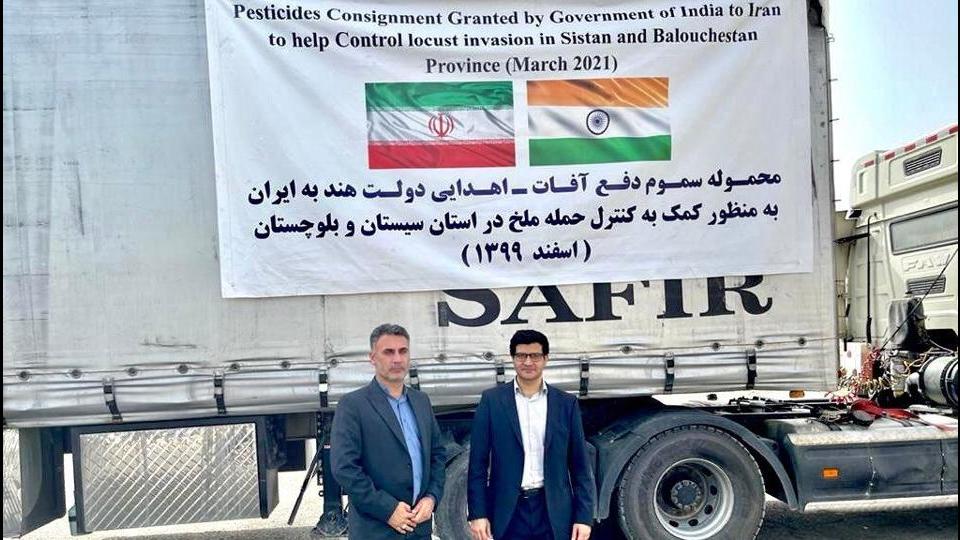
This was the second consignment of Malathion, a 95% ultra-low volume pesticide, supplied to Iran under a government-to-government locust control programme, the external affairs ministry said on Thursday.
The consignment was handed over to Iran’s Plant Protection Organization on March 18.
Last year, India had approached Iran and Pakistan for a coordinated regional response to the threat of desert locusts. “It was in this context that Iran had requested the supply of pesticides. There was no response from Pakistan,” the external affairs ministry said.
India supplied the first consignment of 20,000 litres of Malathion to Iran in June 2020.
Iran is using the pesticide to control locust populations in Sistan-Balochistan and South Khorasan provinces, people familiar with developments said on condition of anonymity.
The proposal for a coordinated response was made by India against the backdrop of swarms of the destructive pests making their way to Indian states such as Rajasthan after breeding and maturing in Iranian provinces and Pakistan’s Balochistan province.
Iran witnessed its worst locust invasion of the past 25 years in 2020.
Afghanistan, Iran and India signed a tripartite agreement on developing Chabahar port and setting up a trilateral transport and transit corridor in 2016. India then set up India Ports Global Limited to operate Shahid Behesti terminal at Chabahar.
Since the Indian firm began operations in December 2018, the port has handled 123 vessels, 13,752 containers and 1.8 million tonnes of cargo. There has also been an increase in the average monthly calls by merchant vessels, and 110,000 tonnes of wheat and 2,000 tonnes of pulses have been shipped to Afghanistan through the port.


