Dairy production in India began as far back as in the 3rd millennium BCE and may have been a factor behind sustaining the Indus Valley Civilisation, according to findings from a team of Canadian and Indian researchers.
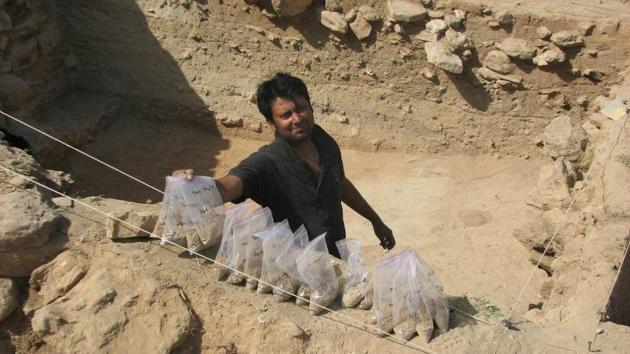
The study, published in the journal Nature, was led by Kalyan Sekhar Chakraborty, a postdoctoral researcher at the University of Toronto Mississauga, and dates dairy production to 2500 BCE. “This is the first time it’s been proved scientifically that dairy production was in place in the Indus Valley civilization in 2500 BCE, and the earliest known evidence of dairy production,” Chakraborty said in an interview.
The results were based on molecular chemical analysis of residue in shards of pottery found at the archaeological site of Kotada Bhadli, a rural settlement located in Gujarat. Of the 59 samples studied, 22 showed the presence of dairy lipids. Through a process called stable isotope analysis, the researchers were also able to identify the type of ruminant used for dairy, and concluded that these were cattle, like cows and buffalo, rather than goats and sheep.
The availability of dairy production may have helped sustain such ancient societies, as Chakraborty explained, “This would have allowed the accumulation of a surplus of animal protein, without affecting the number of animals in your herd.” He said the level of production meant that this was “definitely beyond household consumption.”
{{/usCountry}}The availability of dairy production may have helped sustain such ancient societies, as Chakraborty explained, “This would have allowed the accumulation of a surplus of animal protein, without affecting the number of animals in your herd.” He said the level of production meant that this was “definitely beyond household consumption.”
{{/usCountry}}Chakraborty is with the Department of Anthropology at the university, and the study also involved Prof Heather Miller of the same department and Prof Greg Slater of the School of Geography and Earth Sciences at McMaster University in Hamilton, Ontario. The Indian participants in the research were Prof Prabodh Shirvalkar of the Department of Ancient Indian History and Culture and Archeology at Deccan College Postgraduate and Research Institute in Pune, who excavated the archaeological settlement, provided the samples, site photographs, and background information of the region, and Yadubirsingh Rawat of the State Department of Archeology and Museum in Gandhinagar, Gujarat.
Chakraborty pointed out such research was complex because it was simpler to identify animals used for meat from cut marks on their bones, but “uses like dairy are generally invisible.” This was the first time such scientific analysis was used in India for this purpose. The type of vessels used pointed to the milk being processed rather than being used raw.
Chakraborty’s interest in this project started in 2010 as he started excavating this rural site and became interested in applying chemistry to archaeology, especially since food habits were “embedded” in such material.
He now intends to take the research forward, in this case further back into time to analyse even older remnants from Indus Valley settlements, potentially as far back as when animals were first domesticated.