
 E-Paper



‘Insane X-ray’ shows tapeworm larvae inside human body. What mistake of the patient led to this?
The patient’s condition, identified as cysticercosis, was caused by larval cysts of taenia solium (pork tapeworm) after consuming raw or undercooked pork.

 Prefer HTon Google


A shocking image of calcified parasites lodged in human soft tissue has gone viral on X, shared by US doctor Sam Ghali, who described the scan as one of the “most insane X-rays” he has ever encountered. He noted that the patient’s trunk was filled with countless oblong densities, resembling an “internal hail storm.”
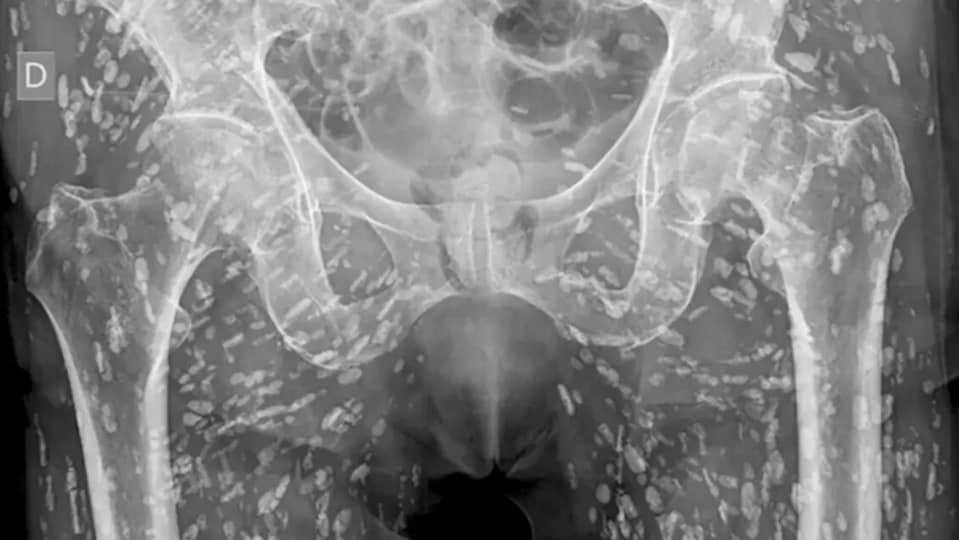
He identified the condition as cysticercosis, caused by larval cysts of taenia solium, commonly referred to as the “pork tapeworm”. The unnamed patient reportedly developed cysticercosis after consuming raw or undercooked pork.
Sharing advice on January 20, Ghali wrote on X, “Always do your best to keep clean, wash your hands, and never, ever, under any circumstances eat raw or undercooked pork.”
The taenia solium parasite enters the human body when its larval cysts are ingested. The eggs later mature into adult tapeworms in the gut over 5 to 12 weeks.
However, Ghali clarified that eating the parasite doesn’t directly cause cysticercosis. He explained, “The life cycle begins with a human consuming raw or undercooked pig, and then that person becomes infected with the worms in their GI tract and passes the eggs along to another unfortunate human who then consumes them.”
Cysticercosis
Cysticercosis is an infection caused by the larval stages of the parasitic cestode, Taenia solium, affecting both humans and pigs. It occurs when infectious eggs, shed in the feces of a human tapeworm carrier, are ingested. The condition often spreads through faecal contamination, typically due to improper handwashing or consuming water tainted with faeces.
Cysticercosis can only occur when the eggs are ingested through fecal-oral transmission. Sam Ghali noted that the cysts can travel throughout the body, and in this particular case, they had infiltrated the musculature and soft tissues of the patient’s hips and legs.
“What happens is they lodge here, and over time, they calcify. And that gives them this classic appearance known as rice grain calcification,” Ghali explained.
He said that the cysts generally pose no immediate risk in areas like the muscles or soft tissue. Ironically, the X-ray revealing the calcified cysts was only conducted because the patient had fallen and broken a bone.
However, significant dangers arise when the cysts reach the brain and calcify, causing neurocysticercosis. This condition can lead to severe neurological issues, including confusion, headaches, seizures, and, in some cases, death.
According to the World Health Organization, quoted by the New York Post, approximately 2.8 million people are infected with Taenia solium annually, with cases most commonly reported in Asia, South America, and Eastern Europe.


