
 E-Paper



ISRO's satellite images show Myanmar earthquake catastrophe | See pics
ISRO's recently released images offer a stark view of the Myanmar earthquake devastation from space.

 Prefer HTon Google


The Indian Space Research Organisation (ISRO) has released satellite images that captured the devastation caused by the powerful 7.7-magnitude earthquake that struck Myanmar last week.
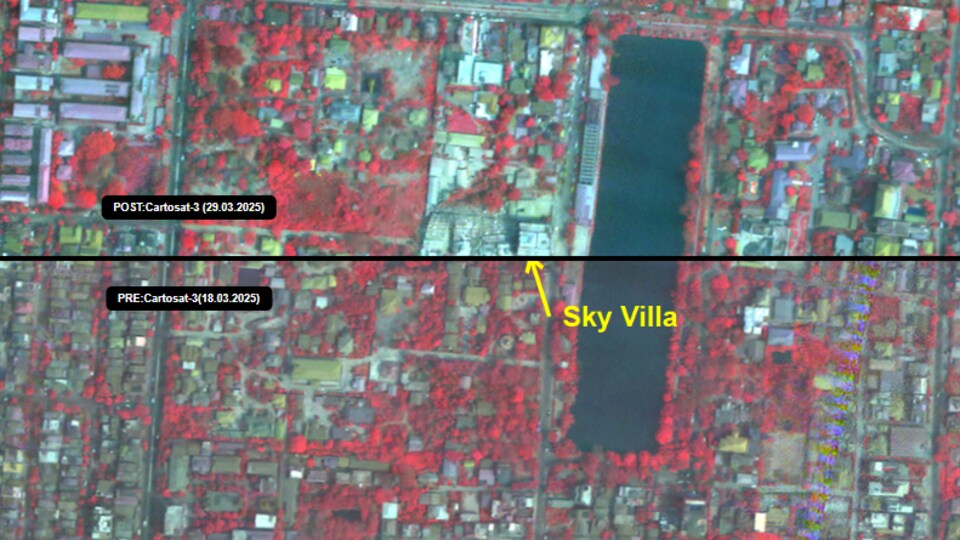
As per the images, taken with the help of ISRO's Cartosat-3 satellite, the earthquake led to massive destruction not just in Myanmar but also in its adjoining countries.
The Cartosat-3’s advanced imaging capabilities give high-resolution photos at a precision of fewer than 50 centimetres from an altitude of 500 kilometres.
Also Read | Sunita Williams reveals India visit, ISRO collaboration plan: 'My father's home country'
The recently released images offer a stark view of the earthquake catastrophe from space, highlighting the collapse of critical infrastructure, and historic landmarks and the widespread damage to cities.
What do ISRO satellite images show?
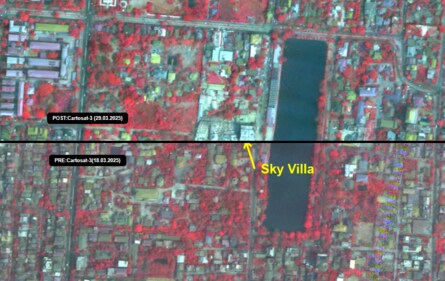
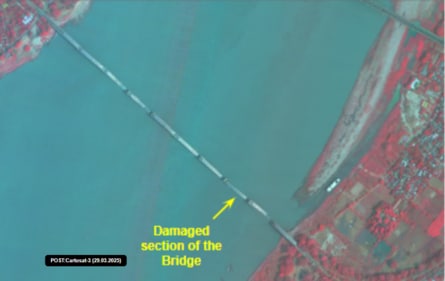
The most horrific destruction was seen around the Ava Bridge spanning the Irrawaddy River, the Mandalay University, as well as the collapse of the Ananda Pagoda, a UNESCO-recognised cultural heritage site.
"Significant damage to infrastructure in Mandalay city was observed, with major landmarks such as Sky Villa, Phayani Pagoda, Mahamuni Pagoda and Ananda Pagoda, University of Mandalay and several others suffering either complete or partial damage. In Sagaing city, damage was observed in the Ma Shi Khana Pagoda, along with several monasteries and other buildings," the ISRO said in a statement.
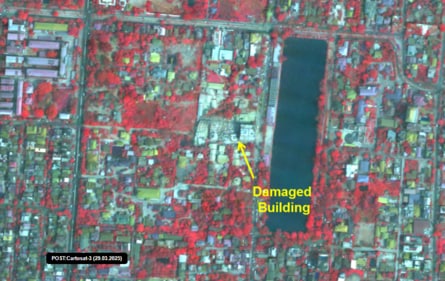
The satellite images also show cracks in the surrounding floodplains, showing signs of liquefaction, which happens when saturated soil loses its stability under seismic shaking.
The Ma Shi Khana Pagoda, along with several monasteries and buildings, was damaged.
The ISRO’s assessment also revealed that the convergent boundary of the Indian and Eurasian tectonic plates makes it highly susceptible to earthquakes.
Also Read | Punjab: Explore new horizons in space, ISRO chairman tells youth
The Indian Plate is constantly moving northward toward the Eurasian Plate at a rate of approximately 5 cm per year, which leads to the release of accumulated tectonic stress, often resulting in large earthquakes.
In its post-disaster analysis, ISRO also emphasised the significance of rapid satellite-based assessments in disaster management.
Myanmar Earthquake: Over 2,000 dead
ISRO noted that an earthquake of magnitude 7.7 struck Myanmar on March 28, followed by a strong aftershock of magnitude 6.4.
The epicentre is located at 22.013° N 95.922° E at a depth of 10 km near the Sagaing-Mandalay border. It further said that the epicentre of the quake was located near Mandalay, Myanmar's second-largest city, which experienced severe damage.
Also Read | Myanmar earthquake: Chinese men caught stealing documents from building collapse site in Bangkok
The death toll from Myanmar’s biggest earthquake in a century reached 2,056 with the end of a critical 72-hour rescue window, and aid efforts remained hampered by an ongoing civil war.
More than 3,900 were injured, and nearly 270 people are still missing after the 7.7-magnitude earthquake struck Myanmar’s second-largest city of Mandalay and neighbouring regions.


