
 E-Paper



Mars had an ocean, sandy beaches 3 billion years ago, scientists say
Evidence suggests Mars once had an ancient ocean, with data from China's Zhurong rover revealing coastal deposits beneath the surface.

 Prefer HTon Google


Scientists have uncovered compelling evidence suggesting Mars once hosted an ancient ocean. Data from China’s Zhurong rover, published in the 'Proceedings of the National Academy of Sciences (PNAS)', reveals beach deposits buried beneath the Martian surface, strengthening the hypothesis that water once played a major role in shaping the Red Planet.
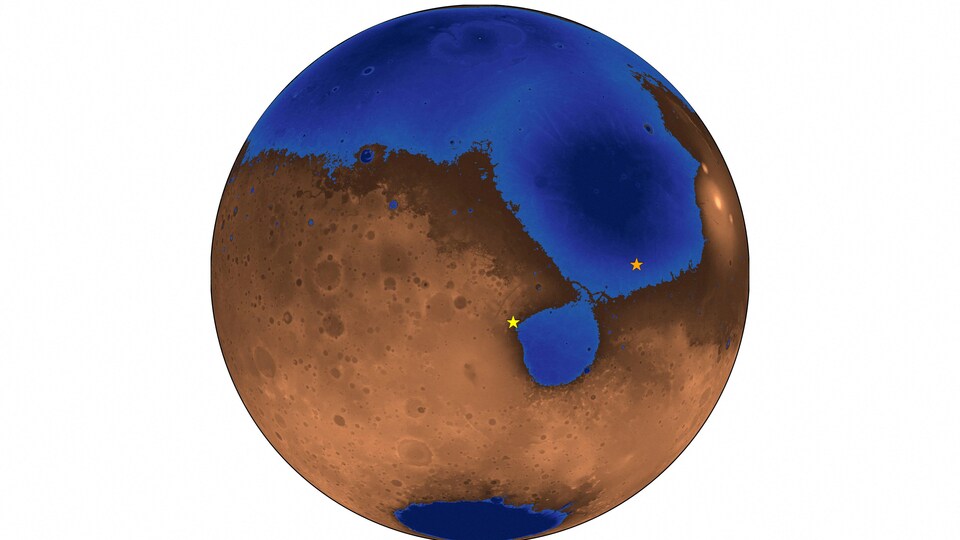
Since NASA’s Mariner 9 orbiter captured images of water-sculpted landscapes on Mars in the 1970s, scientists have debated the extent and duration of Martian water. Recent research confirms that water existed on Mars as far back as 4.5 billion years ago, with ice still present beneath the surface today. However, the burning question remains: Did Mars once have vast oceans?
A research team led by Jianhui Li of Guangzhou University in China, alongside American scientists, has provided strong evidence that an ancient Martian ocean covered parts of the planet’s northern hemisphere. By analyzing below-ground imaging data from the Zhurong rover, they have identified sedimentary formations indicative of ancient coastal deposits.
Zhurong’s martian mission
Named after a mythical god of fire, the Zhurong rover was launched in 2020 by the China National Space Administration and operated from 2021 to 2022. It landed in Utopia Planitia, a vast impact basin spanning 3,300 km in diameter. Scientists believe this region once contained a large body of water.
Zhurong explored an area near ridges thought to be ancient shorelines. Using ground-penetrating radar, the rover scanned 100 meters beneath the surface, uncovering a series of reflective layers extending at least 30 meters deep. These layers dipped toward the basin, mirroring the way sediments accumulate in oceanic environments on Earth.
Key findings
The study’s analysis indicates that the buried structures closely resemble coastal sediments on Earth, suggesting they formed along the margins of an ancient ocean. The researchers ruled out alternative explanations such as volcanic activity, wind-blown sand dunes, or river deposits, concluding that the structures are consistent with tidal and wave processes.
Dr Benjamin Cardenas of Penn State University, a co-author of the study, emphasized the significance of these findings. “A beach is an interface between shallow water, air, and land. These environments are believed to have played a crucial role in the emergence of life on Earth,” he explained. “If Mars had similar conditions, it raises exciting possibilities about past habitability.”
The team also discovered that the shoreline appeared to shift over time, suggesting that the ocean persisted for an extended period. Cardenas noted, “The beach likely grew at least 1.3 km northward into the ocean, which implies stable water conditions for a significant duration.”


