
 E-Paper



Mike Pompeo urges diplomacy in standoff over Mediterranean gas
“Increased military tensions help no one but adversaries who would like to see division in transatlantic unity,” Pompeo said after talks with Cypriot President Nicos Anastasiades.

 Prefer HTon Google


US Secretary of State Mike Pompeo on Saturday called for a diplomatic solution to the confrontation between Greece and Turkey over energy reserves in east Mediterranean waters, saying ongoing military tensions between two NATO allies only serve the alliance’s foes.
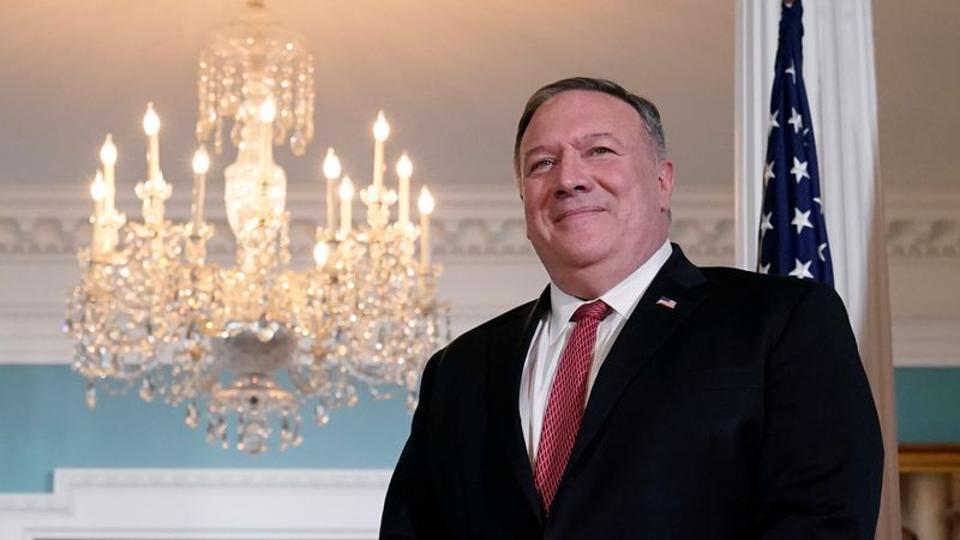
“Increased military tensions help no one but adversaries who would like to see division in transatlantic unity,” Pompeo said after talks with Cypriot President Nicos Anastasiades.
Pompeo said President Donald Trump has already spoken with his Turkish counterpart Recep Tayyip Erdogan and Greek Prime Minister Kyriakos Mitsotakis in hopes of ending the standoff.
Greek and Turkish warships have been staring each other down in recent weeks as Turkish research vessels and drill ships continue searching for hydrocarbons in waters where Greece and Cyprus claim exclusive economic rights.
So far, three sizable gas discoveries have been made inside Cyprus’ exclusive economic zone where energy companies including Total of France, Italy’s Eni and ExxonMobil are licensed to carry out hydrocarbons searches.
EU members Greece and Cyprus have accused Turkey of violating international law and have been trying to rally fellow bloc members to impose tougher sanctions against Turkey.
Turkey, which doesn’t recognize Cyprus as a state, insists it has every right to prospect in those waters and is doing so to defend its rights and those of breakaway Turkish Cypriots on ethnically divided Cyprus to a potential mineral bounty.
“We remain deeply concerned by Turkey’s ongoing operations, surveying for natural resources in areas where Greece and Cyprus assert jurisdiction in the eastern Mediterranean,” said Pompeo, repeating Washington’s support for Cyprus’ right to exploit hydrocarbon deposits in its territorial sea and exclusive economic zone.
Cyprus has been divided into a Greek-Cypriot south and a Turkish-occupied north since a 1974 invasion by Turkey in response to a coup seeking to unite the island with Greece. A breakaway state in the north is recognized only by Turkey.
The US top diplomatic also repeated that any potential hydrocarbon wealth should be shared equitably between Greek Cypriots and Turkish Cypriots.
Anastasiades said he fully supported Washington’s position that regional disputes should be resolved through dialogue “and not by gunboat diplomacy.” The Cypriot president repeated his government’s offer to either negotiate with Turkey directly on marking maritime borders or taking the issue to the International Court of Justice.
Pompeo’s lightning visit to Cyprus also aimed to affirm Washington’s active engagement in tumultuous region just four days after Russian Foreign Minister Sergey Lavrov pitched Moscow’s offer to help ease tensions during his trip to the island nation.
Reminiscent of a Cold War-era rivalry, the visits by Pompeo and Lavrov to Cyprus underscored a renewed interest in a region where Moscow’s footprint has grown larger due to its military involvement in neighboring Syria.
“Security cooperation matters all the more as we see nations that don’t share our values trying to obtain footholds in the region,” said Pompeo.
Cyprus has tried to leverage its geographic proximity to the Middle East by striving to bolster relations with the US while at the same time maintaining strong ties with Moscow on whose support it counts on in the United Nations.
Pompeo said US-Cyprus relations “have never been better,” but repeated to Anastasiades Washington’s concerns over Russian money laundering activities in Cyprus as well as ports of call Russian warships make at Cypriot ports.
The centerpiece of closer Cyprus-US links was last year’s congressional approval of the Eastern Mediterranean Energy and Security Partnership Act that underscores US support for an energy-based partnership between Greece, Cyprus and Israel.
Under the Act, the US is providing Cyprus with funding for military training and has partially lifted an arms embargo that was enacted 33 years ago to prevent a possible arms race harming peace talks. The lifting of the embargo was made possible after Washington waived a requirement that Cyprus cease to offer refueling and other port services to Russian warships.
“We know that all the Russian military vessels that stop in Cypriot ports are not conducting humanitarian missions in Syria,” Pompeo said.
The move — as well as US officials accusing Russia of playing a “very destabilizing role in the region” — angered Moscow, with Lavrov accusing Washington of using “divide and rule” tactics to drive a wedge between Russia and countries in the region.


