
 E-Paper



'More Indians in 5 years…': Australia sees anti-immigration rallies, govt condemns them for ‘spreading hate’
A promotional flyer for ‘March for Australia’ said: “This isn’t a slight cultural change – it’s replacement plain and simple.”

 Prefer HTon Google


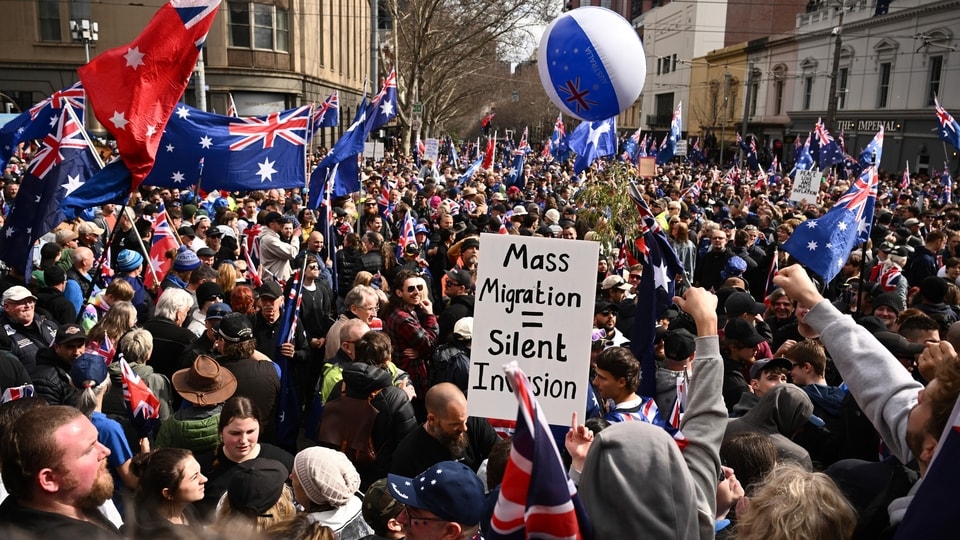
Thousands of Australians joined anti-immigration rallies across the country, including its most populous city Sydney, on Sunday, even as the government said these ‘March for Australia’ events were spreading racism, hatred and were linked to neo-Nazis.
Promotional material for the ‘March for Australia’ rallies included flyers that pointed specifically towards Indian-born residents, who form over 3% of Australia's total population, with their numbers having doubled from 2013 to 2023 to reach around 8.5 lakh (845,800 as per latest census).
The flyer said: “More Indians in 5 years, than Greeks and Italians in 100… This isn’t a slight cultural change – it’s replacement plain and simple.”
A pre-event Facebook post carried the promotional material talking about Indians, among other things:
The March for Australia website says mass migration has “torn at the bonds that held our communities together”. The group said on X that it wants to do what mainstream politicians “never have the courage to do”. that is, "demand an end to mass immigration".
The group claims no political affiliation and describes itself as “a grassroots, organic effort to unite Australians around a common cause ending mass immigration”.
“Recent claims have been made by various groups attempting to take ownership of March For Australia or attach their own agendas to it. We wish to make it clear: the organisers are not members of, nor acting on behalf of, any other group," it posted recently.
Data says Australia is largely a country of immigrants; around half its people are either born overseas or have a parent born overseas, according to a Reuters report.
Minister says these rallies are ‘about spreading hate’
The centre-left Australian government condemned the March for Australia events. Murray Watt, a senior minister in the Labor government, told Sky News TV: “We don't support rallies like this that are about spreading hate and that are about dividing our community”, adding that these events were "organised and promoted" by neo-Nazi groups.
March for Australia organisers did not immediately respond to a request for comment about the neo-Nazi claims, Reuters said.
The Australian Council of Social Service, meanwhile, released a statement said it respects the right to peaceful assembly “but we reject in strongest terms all forms of racism, fascism, hate speech and bigotry”.
Its CEO Cassandra Goldie said, "Australia's diversity is a great strength, not a threat… There is no place in Australia for ideology that targets people because of who they are, where they come from or what they believe.
The shadow attorney general, Julian Leeser, said there may be, at these events, people of goodwill who want to change policies, but they needed to be careful of the company they keep.
“I’ve seen some of the material for that particular protest and I’m really concerned about the anti-Indian sentiment that is being expressed and some of the antisemitic undertones of some of those protests,” he said.
How many and who are attending rallies
Reports said 5,000 to 8,000 people had assembled for the Sydney rally.
There was a counter-really nearby by the Refugee Action Coalition. “Our event shows the depth of disgust and anger about the far-right agenda of March For Australia", a coalition spokesperson said in a statement. Organisers said hundreds attended that event.
In the capital Canberra, a crowd of a few hundred gathered at a lake with a view of Parliament House across it.
A March for Australia rally was held in central Melbourne, too, and police officers used pepper spray on demonstrators.
Bob Katter, the leader of a small populist party, was attending a March for Australia rally in Queensland, a party spokesperson said. He had earlier threatened a reporter for mentioning his Lebanese heritage.
In Sydney, March for Australia protester Glenn Allchin said, “It’s about our country bursting at the seams and our government bringing more and more people in… Our kids struggling to get homes, our hospitals, we have to wait seven hours, our roads, the lack of roads."
The Nazi salute and the display or sale of symbols associated with terror groups is illegal in Australia specifically after a law was made last year in response to a string of antisemitic attacks.


