
COP31 president Murat Kurum on Saturday urged countries to “act responsibly” and reach a compromise, as the UN climate talks in Türkiye’s Antalya went past their scheduled close with no agreement on fossil fuels or adaptation finance.
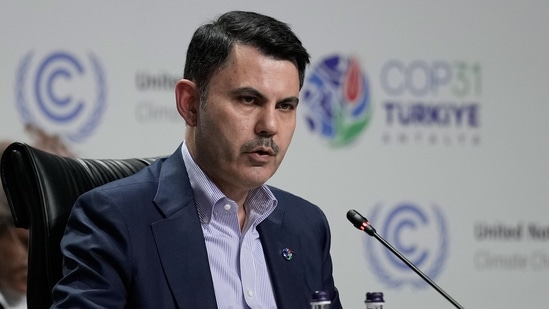
“I call on everyone to act responsibly ... Getting bogged down in individual words and expressions and undermining this process serves no one’s interests,” Kurum, who is also Turkey’s environment minister, told reporters, AFP reported.
EU warns against a weak agreement on fossil fuels
Suggested For You
The European Union’s representative indicated the divide ran deep as on Saturday. “Clearly there’s no compromise yet,” EU climate commissioner Wopke Hoekstra told reporters when asked about fossil fuels and carbon capture technology. “It’s better to have no deal than to have a bad deal.” The bloc has warned that the current draft “risks turning this climate COP into a fossil summit”.
COP31 was scheduled to end at 6pm on Friday, November 20. It can formally close only when the gavel comes down on an agreement among nearly 200 countries, and talks are now likely to stretch into Sunday and possibly Monday. As of 7.30pm local time on Saturday, the deadlock remained unbroken.
{{/usCountry}}COP31 was scheduled to end at 6pm on Friday, November 20. It can formally close only when the gavel comes down on an agreement among nearly 200 countries, and talks are now likely to stretch into Sunday and possibly Monday. As of 7.30pm local time on Saturday, the deadlock remained unbroken.
{{/usCountry}}The main disputes are over references to fossil fuels and a $120 billion annual adaptation finance target sought by developing countries. Both were in the first draft of the summit’s cover decision, released on November 16, but were dropped from the second draft on Thursday.
Also read: COP31: From climate ambition to business value
India opposes explicit references to fossil fuel phase-out
India has opposed explicit fossil fuel language. Ahead of COP31, Union environment minister Bhupender Yadav had said India would not support a phase-out of fossil fuels or a roadmap towards one. India has also been named in a separate dispute over science.
On finance, the removal of the $120 billion target angered developing countries. “We didn’t come here to beg,” Ghana’s environment minister Zanetor Agyeman-Rawlings said, according to AFP.
Countries are also split over how to respond to the world missing the 1.5°C warming goal set under the Paris Agreement. The latest draft expressed “deep concern” over the breach but dropped an earlier call to bring warming back below 1.5°C as soon as possible this century, AFP reported.
The presidency is expected to keep pushing its “35x35” electrification target, under which electricity would meet 35% of global final energy demand by 2035. It remains unclear whether this will be a voluntary pledge or an obligation. “Electrification is the key to transitioning away from fossil fuels,” said Chris Bowen, Australia’s climate minister, who is chairing the negotiations.
Also read: Talks go into overtime as COP31 deal remains elusive
Expert flags lack of clarity on fossil fuels and climate finance
Aarti Khosla, director of Climate Trends, told HT the debate had increasingly narrowed to electrification and carbon capture, utilisation and storage (CCUS), which critics call a costly, underperforming technology pushed to sideline pledges to phase out fossil fuels.
“For two weeks, the presidency and the parties did not focus on the negotiating text. Substantive elements only came into focus towards the very end. Even then, the text was robbed of any clear reference on fossil fuels, adequate support for just transition, and clarity on a process to discuss finance,” Khosla said.
“The test now is whether the final outcome can restore balance between ambition, equity and means of implementation.”
Explore More
ABOUT THE AUTHOR
Jasjeev Gandhiok is an Assistant Editor with Hindustan Times, where he covers environment, climate change, the clean energy transition and wildlife at the National Bureau. Gandhiok has over a decade of experience in journalism and is based in Delhi. He has reported extensively on Delhi and the National Capital Region (NCR). This includes the region's air pollution woes, a polluted Yamuna and on urban wildlife still thriving in the region. He joined HT in October 2021. Prior to that, he had five-year stint at The Times of India in Delhi, where he also covered Delhi, with a focus on environment and wildlife. Gandhiok has covered some recent events around the Capital too, ranging from the farmers' protests, the northeast Delhi riots and the CAA-NRC protests, reporting from the ground on all of these. He also travels across the country to report on how environment and climate change impact everyday life, while also writing on endangered species. His reports in 2019 on toxic leachate from Delhi's landfills led to the National Green Tribunal (NGT) taking suo motu cognisance and ultimately asking the state government to start bio-mining to flatten and remove all three landfills in the capital. He also closely tracks the implementation of government policies on climate, renewable energy and environmental protection. His focus remains on impactful, public-interest journalism which explains how environmental decisions affect people's everyday lives.