
 E-Paper



Will the European Union’s next member come from the north?
Iceland mulls EU return amid security fears, while Norway debates membership as Arctic tensions and Russia’s war reshape northern Europe politics


 Prefer HTon Google


Iceland is on the edge of Europe. It rises where two continental plates meet in the north Atlantic; tourists flock to see its snow-shrouded volcanoes and steaming geysers. Mining companies, lured by cheap geothermal energy, have built vast smelting plants on the coast. In Reykjavik, the capital, Iceland’s flag flaps next to that of Greenland, its closest neighbour. The city hall hoisted it in February, after President Donald Trump tried to bully Denmark into handing the territory to America.

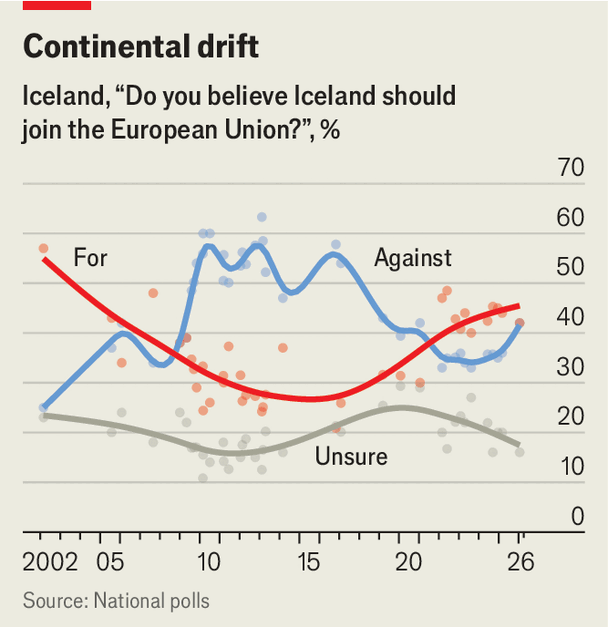
Europe’s northern periphery has a complicated relationship with the European Union. Britain and Greenland are among the few places that have left it. Iceland and Norway never joined. But that could change. On August 29th Iceland’s government plans to hold a referendum on restarting accession talks. Norway’s opposition wants a vote on whether to join.
Attitudes have shifted, especially since Russia invaded Ukraine in 2022 (see chart). Most Icelanders want to restart the accession process. Those who support joining the EU outnumber those who oppose it, though lots are undecided. In Norway the majority of voters are still Eurosceptic. But support for joining is above 30%; during the 2010s it was usually below 20%.
In Iceland, old arguments for joining have been reheated. It would let Icelanders join the euro and ditch the small, volatile krona. It would also give them a say over the bloc’s rules. Iceland, Norway and tiny Liechtenstein are all in the European Economic Area (EEA). They adopt swathes of EU rules, with little influence over how they are made, in exchange for access to the single market. This can leave them wrong-footed by rules drafted in Brussels.
Nor does the EEA guarantee unfettered trade with the EU. Last year the bloc imposed tariffs on ferroalloys, metals that Iceland and Norway produce in huge quantities. EEA membership, which puts them outside the customs union, did not protect them. Grimur Grimsson, an Icelandic MP, repeats an old chestnut: “If you’re not at the table, you’re on the menu.”
Russian and Chinese ambitions in the Arctic worry Icelanders. Home to fewer than 400,000 people, Iceland is especially vulnerable. It is NATO’s only member without an army. America’s disregard for its allies (and its president’s designs on Arctic territory) have not helped. At the World Economic Forum in Davos Mr Trump confused Greenland with Iceland four times. The incoming American ambassador has joked that Iceland could become an American state. He later apologised.
“The Greenland issue showed how valuable EU membership is for Denmark,” says Thorgerdur Katrin Gunnarsdottir, Iceland’s foreign minister. Being part of the bloc would make it harder to coerce the country with economic threats, such as those Mr Trump made against Denmark and its allies during the Greenland crisis.
The EU is willing to restart the talks. Iceland made swift progress when it first applied in 2009. By 2012 it had closed 11 out of 35 “chapters” in the bloc’s accession process. Montenegro, another accession candidate, took 13 years to do so. But the island will negotiate hard. During the cod wars of the 20th century, its coastguard cut the nets of British trawlers to keep them from its waters. Iceland’s leaders want to keep control of their fisheries. That would require the EU to compromise.
Some Eurocrats, having held firm against bespoke deals during Brexit, will be loth to grant one to another north Atlantic island. But leaders eager to revive the enlargement process may feel differently. Donald Tusk, Poland’s prime minister, has suggested the bloc should be more flexible to ease Iceland’s accession.
Euroscepticism remains a force at home. Settled by rebellious Vikings more than 1,000 years ago, Iceland values its independence. Gudrun Hafsteindottir, the leader of the opposition Independence Party, calls accession talks “pointless”. She thinks the EU would eventually make Iceland adopt all its rules.
Unlike Norwegians, who voted narrowly against joining the bloc in 1994, Icelanders have never been asked about the EU in a referendum. That made it possible for a right-wing government to end the talks in 2013. Pro-EU Icelanders hope the vote will send MPs a message. If they succeed, Norwegians will watch closely to see what deal Iceland gets. “Power to the people,” says Thorgerdur. “Let the people decide.”
To stay on top of the biggest European stories, sign up toCafé Europa, our weekly subscriber-only newsletter.


