
Sign in

‘No obvious end’ to West Asia war: France foreign minister amid Modi-Macron peace efforts

France's foreign minister Jean-Noel Barrot visited Lebanon and Israel this week as the US-Israel war on Iran has widened to enguld almost the entire West Asia

Updated on: Mar 20, 2026, 18:33:33 IST
Written by
Share
Share via
  • facebook
  • twitter
  • linkedin
  • whatsapp
Copy link
  • copy link

France's foreign minister Jean-Noel Barrot has said he does not see an obvious end to the conflict in the Middle East (or West Asia), while stressing that France and its allies would continue to try and find a lasting solution.
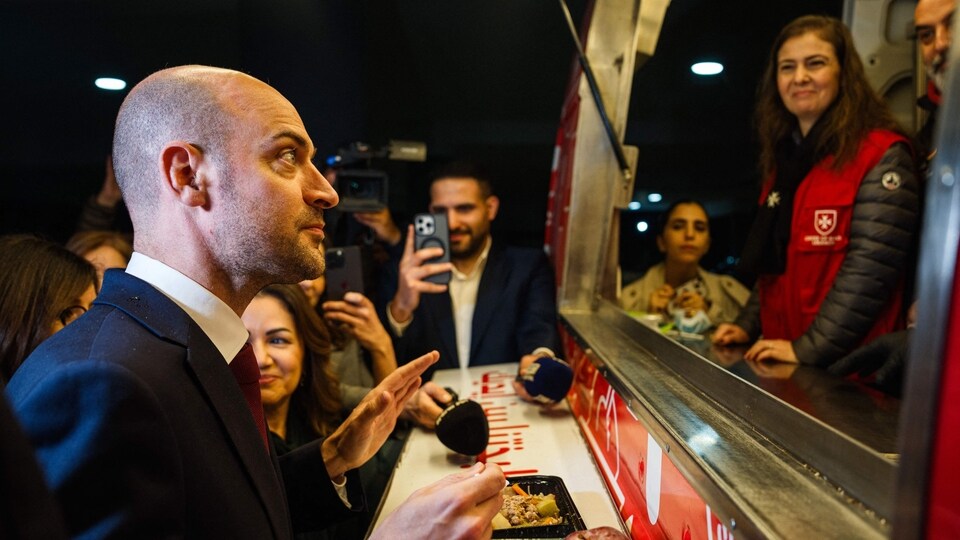
France's foreign minister Jean-Noel Barrot tastes food at a school sheltering displaced families in Beirut, Lebanon, on March 19, 2026. Lebanon was drawn into the West Asia war on March 2 after militant group Hezbollah allegedly launched rockets towards Israel to avenge the killing of Iran's supreme leader. Israel responded with intense strikes on Lebanon that have killed at least 968 people and displaced over a million, according to local authorities, and by launching ground operations in the south. Barrot later also visited Tel Aviv, Israel. (AFP Photo)

“There is no obvious short-term way out of the ongoing regional escalation, which has in some ways been unfolding since October 7, 2023,” Barrot told reporters after meeting with Israeli counterpart Gideon Saar in Tel Aviv on Thursday. "But this must in no way serve as a pretext for inaction," he added.

He was referring to the 2023 attack inside Israel by Palestinian group Hamas that killed 1,200 people. Israel's military action over a period of more than two years after that has killed around 70,000 people, most of them civilians, in the occupied territory of Gaza in Palestine.

At present, while a main conflict rages in Iran and its neighbourhood after the US and Israel launched an attack on Tehran on February 28, Israel has also intensified its operations inside Lebanon, statedly against militant group Hezbollah. Some buildings have been flattened in Beirut, and there are reports of use of the banned white phosphorus bombs by the Israelis over Lebanon's villages near the border.

Barrot had also visited Lebanon on Thursday, after which he said he had outlined his country's “reservations” about a possible Israeli ground operation in southern Lebanon. He added, though, that the Lebanese army must “do everything possible” to disarm Iran-backed group Hezbollah.

His measured comments were reported after France's President Emmanuel Macron spoke with Indian Prime Minister Narendra Modi as part of ongoing efforts towards de-escalation.

Also read | 'Surprise coming,' top Iran Guard official warned US-Israel; he was killed hours later

In a post on X, PM Modi wrote: “Spoke with my dear friend, President Emmanuel Macron, on the situation in West Asia and the urgent need for de-escalation, as well as a return to dialogue and diplomacy. We look forward to continuing our close coordination to advance peace and stability in the region and beyond.”

Macron wrote in response: “Thank you, my dear friend. India and France are working closely together to reduce tensions in the region and to keep diplomacy at the heart of our efforts for peace.”

Iran has, meanwhile, stepped up its attacks on oil and gas facilities across the Gulf on Thursday in retaliation to an Israeli strike on South Pars, the Iranian section of the world’s largest gas field, located offshore in the Persian Gulf and shared with Qatar.

Around 80% of Iran’s electricity comes from natural gas, according to the International Energy Agency.

US President Donald Trump warned that America would “massively blow up the entirety” of Iran’s gas field if it continues attacking its neighbours.

Israeli PM Benjamin Netanyahu said later on Thursday that Iran can no longer enrich uranium or produce ballistic missiles.

Iran has vowed to continue attacking US bases in the Gulf.

  • Aarish Chhabra
    ABOUT THE AUTHOR
    Aarish Chhabra

    Aarish Chhabra is an Associate Editor with the Hindustan Times online team, writing news reports and explanatory articles, besides overseeing coverage for the website. His career spans nearly two decades across India's most respected newsrooms in print, digital, and broadcast. He has reported, written, and edited across formats — from breaking news and live election coverage, to analytical long-reads and cultural commentary — building a body of work that reflects both editorial rigour and a deep curiosity about the society he writes for. Aarish studied English literature, sociology and history, besides journalism, at Panjab University, Chandigarh, and started his career in that city, eventually moving to Delhi. He is also the author of ‘The Big Small Town: How Life Looks from Chandigarh’, a collection of critical essays originally serialised as a weekly column in the Hindustan Times, examining the culture and politics of a city that is far more than its famous architecture — and, in doing so, holding up a mirror to modern India. In stints at the BBC, The Indian Express, NDTV, and Jagran New Media, he worked across formats and languages; mainly English, also Hindi and Punjabi. He was part of the crack team for the BBC Explainer project replicated across the world by the broadcaster. At Jagran, he developed editorial guides and trained journalists on integrity and content quality. He has also worked at the intersection of journalism and education. At the Indian School of Business (ISB), Hyderabad, he developed a website that simplified academic research in management. At Bennett University's Times School of Media in Noida, he taught students the craft of digital journalism: from newsgathering and writing, to social media strategy and video storytelling. Having moved from a small town to a bigger town to a mega city for education and work, his intellectual passions lie at the intersection of society, politics, and popular culture — a perspective that informs both his writing and his view of the world. When not working, he is constantly reading long-form journalism or watching brainrot content, sometimes both at the same time.Read More

Get the latest World News, breaking headlines and global updates from the US, UK, Pakistan, Bangladesh, Russia and other countries. Follow major international events on Hindustan Times.