
 E-Paper



Nobel Prize in Chemistry 2024: David Baker, Demis Hassabis, and John Jumper awarded for protein innovations
Nobel Prize in Chemistry 2024: David Baker, Demis Hassabis, and John Jumper awarded for protein innovations

 Prefer HTon Google


The Royal Swedish Academy of Sciences on Wednesday announced that the 2024 Nobel Prize in Chemistry will be awarded with one half going to David Baker, and the other half jointly to Demis Hassabis and John M. Jumper, for their groundbreaking contributions to protein science.
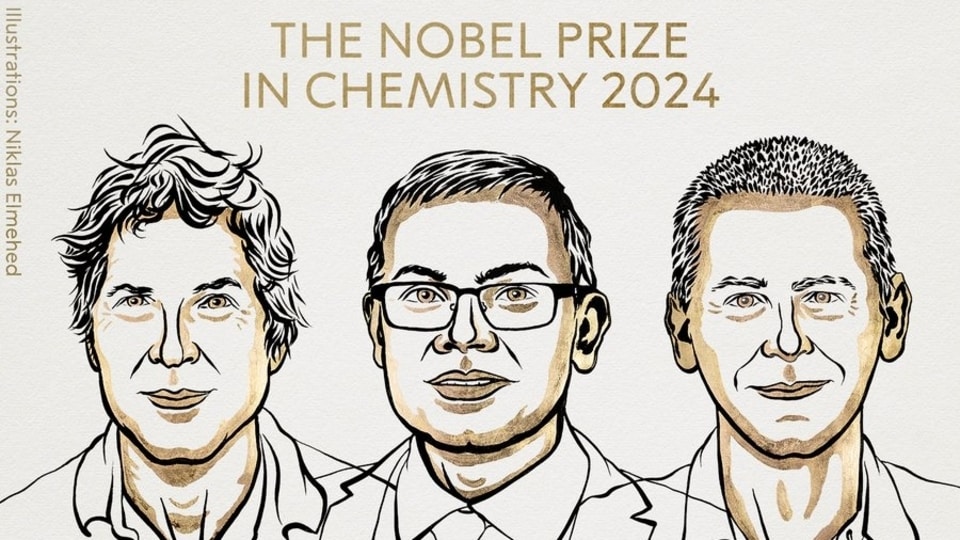
David Baker of the University of Washington, Seattle, USA, was awarded the prestigious Nobel Prize in Chemistry "for computational protein design," while Demis Hassabis and John M. Jumper of Google DeepMind, London, UK, were awarded "for protein structure prediction."
“One of the discoveries being recognised this year concerns the construction of spectacular proteins. The other is about fulfilling a 50-year-old dream: predicting protein structures from their amino acid sequences. Both of these discoveries open up vast possibilities,” said Heiner Linke, chair of the Nobel Committee for Chemistry.
Also Read | AI pioneers Geoffrey Hinton, John Hopfield win 2024 Nobel Prize in Physics
David Baker has achieved the extraordinary feat of designing entirely new proteins, while Demis Hassabis and John Jumper have developed an artificial intelligence (AI) model to solve a 50-year-old challenge: predicting the complex three-dimensional structures of proteins.
In 2003, Baker successfully designed a new protein from scratch. His research group has since created a range of innovative proteins that have applications in pharmaceuticals, vaccines, nanomaterials, and sensors.
Meanwhile, the AI-based breakthrough from Hassabis and Jumper came in 2020 with the introduction of AlphaFold2. Their model can predict the structure of nearly all 200 million proteins identified by researchers, a feat previously thought impossible.
Also Read | Nobel winner John Hopfield warns of ‘catastrophe’ if AI advances are not ‘controlled’
AlphaFold2 has been used by millions of scientists globally to address issues such as antibiotic resistance and plastic degradation.
“Life could not exist without proteins. That we can now predict protein structures and design our own proteins confers the greatest benefit to humankind,” The Royal Swedish Academy of Sciences said in a statement.
The Nobel Prize will be formally awarded in Stockholm on December 10.


