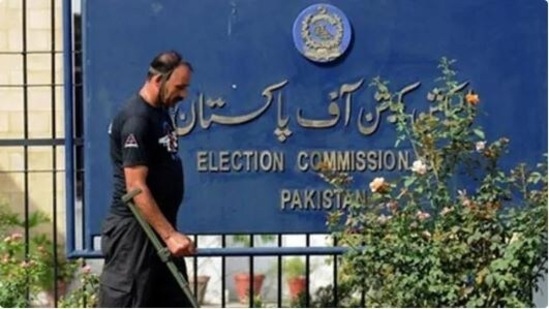
The Pakistan election commission on Tuesday expressed inability to hold general elections within three months, citing legal, constitutional and logistical challenges, news agency PTI quoted Pakistan daily Dawn. A senior election commission official said the preparation for elections would require some six months as due to delimitation of constituencies particularly in Khyber-Pakhtunkhwa province, the seats were increased and updating the electoral rolls as per districts and constituencies were major challenges. “Delimitation is a time-consuming exercise where the law provides for one month’s time just to invite objections,” the Pakistan EC official told the newspaper. According to the official, procurement of election material, arrangement for ballot papers as well as the appointment and training of polling staff were other challenges.
“Under the law, ballot papers with watermark are to be used which are not available in the country and hence they would have to be imported. The EC had proposed to amend the law to provide for ballot papers with ‘security features’, instead of water mark,” the official added.
The official said inviting bids and scrutinising financial and technical quotations would also require some time and some 20 lakh stamp pads would be required for around one lakh polling stations.ALSO READ: Neighbourhood in turmoil as Pakistan, Sri Lanka politics on edge
The EC official said the law requiring use of EVMs (electronic voting machines) and giving overseas Pakistanis voting rights also held the field and had to be repealed.
The Free and Fair Election Network (Fafen), an independent non-government body, has identified multiple constitutional, legal and operational challenges to the conduct of an early election.
{{/usCountry}}The Free and Fair Election Network (Fafen), an independent non-government body, has identified multiple constitutional, legal and operational challenges to the conduct of an early election.
{{/usCountry}}“Public confusion and political divisions that have already arisen as a result can potentially translate into violent expression. Political parties have a great responsibility to manage their workers and make sure that political disagreements do not turn into violence, especially ahead of an early election,” the organisation said in a statement.Pakistan president Arif Alvi on Sunday dissolved the national assembly on prime minister Imran Khan's advice. The move came after the national assembly rejected the no-confidence motion against the ruling Pakistan Tehreek-i-Insaaf (PTI) ruling alliance. The Supreme Court is hearing a petition moved by the opposition challenging the rejection of no-confidence motion and dissolution of the national assembly.