The Pakistani embassy in Russia said on Friday that the two countries have signed a “protocol to restore and Pakistan Steel Mills (PSM) in Karachi", in what it called was a “reaffirmation” of their "long-standing industrial partnership".
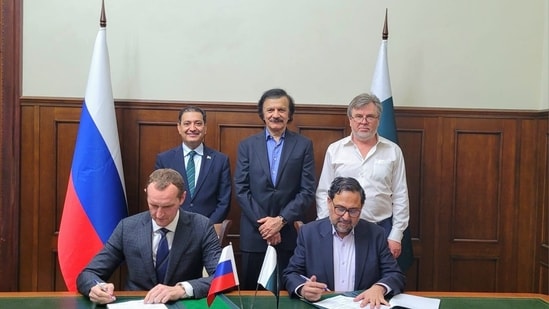
The agreement was signed at the Pakistan embassy in Moscow by Pakistan's secretary of industries and production Saif Anjum and Vadim Velichko, general director of industrial engineering LLC from the Russian side.
SAPM Haroon Akhtar Khan and Pakistan's ambassador to the Russian federation Muhammad Khalid Jamali were also present.
The project seeks to restart and expand steel production.
“Reviving PSM with Russia’s support reflects our shared history and commitment to a stronger industrial future,” said Khan.
Originally built with Soviet assistance in 1973, PSM remains a lasting symbol of Pakistan-Russia ties, according to the Pakistani embassy in Russia.
Pakistan, Russia to expand road, rail connectivity
Pakistan and Russia have earlier this month also agreed to collaborate on establishing a robust rail and road network to link the South Asian country with Central Asia and Russia, providing landlocked states direct access to warm waters, a media report said on Friday.
Federal minister for communications Abdul Aleem Khan and Russian deputy minister of transport Andrey Sergeyevich Nikitin, on the sidelines of the Shanghai Cooperation Organisation (SCO) ministerial conference in Tianjin, China, agreed to accelerate infrastructure development across the region to facilitate trade and economic integration.
The initiative aims to transform Pakistan into a strategic transit hub by enhancing trade corridors and logistical routes extending to Russia and Central Asia, Geo News reported.
{{/usCountry}}The initiative aims to transform Pakistan into a strategic transit hub by enhancing trade corridors and logistical routes extending to Russia and Central Asia, Geo News reported.
{{/usCountry}}On Pakistan’s modernisation efforts, Khan said the country was digitising its transport infrastructure, introducing barrier-free motorways, mandatory e-tagging, and comprehensive CCTV surveillance, according to PTI news agency.
He said the reforms were part of Pakistan’s broader goal to optimise regional connectivity and cross-border trade.
Meanwhile, Pakistan and Afghanistan last month agreed to advance the Uzbekistan-Afghanistan-Pakistan (UAP) rail project.
Deputy Prime Minister and Foreign Minister Ishaq Dar and Afghanistan’s Acting Foreign Minister Amir Khan Muttaqi, in a telephonic conversation, agreed to work for an early finalisation of the framework agreement.