The Philippines’ top envoy to China said Manila is committed to dialogue with Beijing despite their ongoing bitter territorial dispute, leaning into diplomacy before President Ferdinand Marcos Jr. travels to China later this week.
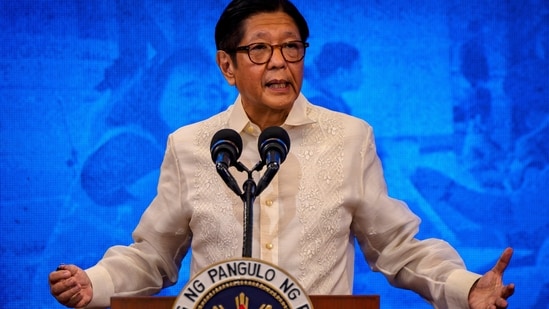
“We remain determined to resort to diplomacy and dialogue,” Ambassador Jaime FlorCruz said in an interview with Bloomberg Television’s David Ingles and Yvonne Man on Monday. “We wish to seek what we call a new equilibrium.”
Bilateral relations between the nations have deteriorated sharply in recent years, as the Philippines, backed by the US, asserted its claims over disputed areas of the South China Sea. FlorCruz’s comments contrast with more hawkish officials, particularly Defense Secretary Gilberto Teodoro.
Deep Dive
Why is the Philippines seeking a “new equilibrium” with China despite their South China Sea dispute?
What does the Philippines hope to discuss with China during President Marcos’s visit to Shenzhen?
Would the South China Sea Code of Conduct resolve the Philippines-China territorial dispute?
“We do have differences. But we also believe that we need to engage when we can, cooperate when we can,” FlorCruz said, citing directive from Marcos.
Also Read: India and ASEAN share strategic trust
{{/usCountry}}Also Read: India and ASEAN share strategic trust
{{/usCountry}}The emphasis on diplomacy comes as Marcos will travel to Shenzhen later this week for Asia-Pacific Economic Cooperation meeting. In Manila, Marcos, who chairs the Association of Southeast Asian Nations this year, met with Chinese Premier Li Qiang during the Asean-China Summit on Monday.
FlorCruz added that Marcos has said “we will not give up any inch of our territory” but at the same time “we seek to maintain a stable and constructive, pragmatic relations with China.”
The Philippines, which is facing slowing economic growth, needs to push other aspects of its relationship with China, including on infrastructure, agriculture and renewable energy.
Also Read: Quad Leaders’ Summit to take place in Manila next month, says US Secy of State Marco Rubio
Asean and China have “substantially completed” the Code of Conduct in the South China Sea, although remaining issues such as on whether it would be a legally binding still to be resolved, Philippine Foreign Affairs Secretary Ma. Theresa Lazaro said on Sunday.
“The Philippines wants the document to be legally binding,” said FlorCruz, who was named envoy to Beijing in 2022 after a long career as a journalist in the country.
In 2016, Beijing lost, and has since ignored, a ruling by an international tribunal that rejected its sweeping claims over the South China Sea.
“The COC is meant to be a guide of behavior of states, and not a way to resolve territorial disputes,” FlorCruz said.