A sudden change in the colour of the Bosphorus Strait that divides the continents of Europe and Asia in Turkey’s largest city Istanbul has surprised residents, with scientists putting it down to a surge in a species of plankton across the Black Sea.
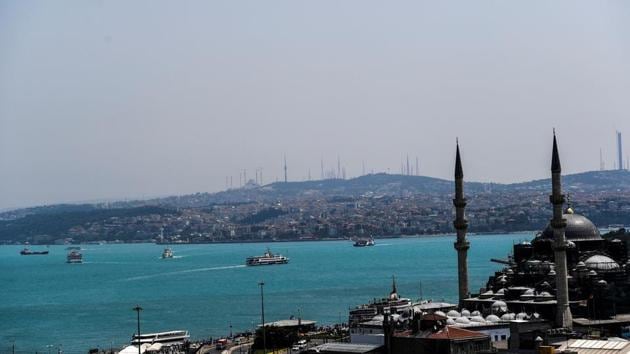
The sudden transformation of the usually blue waters of the Bosphorus to a milky turquoise since the weekend had alarmed some residents.
Some took to social media to express fears that there had been a pollution spill while others even suggested it could be linked to an earthquake that rocked the Aegean region on Monday afternoon.
But scientists said there was no mystery behind the colour change, which was accompanied by a sharper smell.
Ahmet Cemal Saydam, professor of environmental science at Hacettepe University, told the Dogan news agency that the cause was a surge in numbers of the micro-organism Emiliania huxleyi, also known as Ehux.
{{/usCountry}}Ahmet Cemal Saydam, professor of environmental science at Hacettepe University, told the Dogan news agency that the cause was a surge in numbers of the micro-organism Emiliania huxleyi, also known as Ehux.
{{/usCountry}}“This has nothing to do with pollution,” he said, adding it was particularly good for the numbers of anchovies, a popular supper in Istanbul.
“Across the Black Sea there is an explosion of Emiliania huxleyi. This is a blessing for the Black Sea,” he said.
One of the most successful life-forms on the planet, Emiliania huxleyi is a single-celled organism visible only under a microscope. Its astonishing adaptability enables it to thrive in waters from the equator to the sub-Arctic.
The changing colour across the Black Sea was also captured in an image taken from Nasa’s Terra satellite.
Nasa said the milky colouration is “likely due to the growth of a particular phytoplankton called a coccolithophore”. Emiliania huxleyi is a species of coccolithophore.
“This particular organism is plated with white calcium carbonate and, when present in large numbers, tend to turn the water a milky sheen,” Nasa said.