The Russian space agency said Wednesday it will insist its international partners pay it in rubles, after President Vladimir Putin said Russia will only accept ruble payments for gas deliveries to "unfriendly countries".
"We will also conclude all our external agreements in rubles," the Roscosmos space agency head Dmitry Rogozin was quoted as saying by the official Tass news agency.
Hours earlier Putin announced that only rubles will be accepted in payment for gas deliveries to "unfriendly countries", which include all EU members.
The Russian leader also hinted that other Russian exports may be affected.
{{/usCountry}}The Russian leader also hinted that other Russian exports may be affected.
{{/usCountry}}"It is clear that delivering our goods to the European Union, the United States and receiving dollars, euros, other currencies no longer makes sense to us," Putin said, reacting to the freezing of Russian assets in the West because of its offensive in Ukraine.
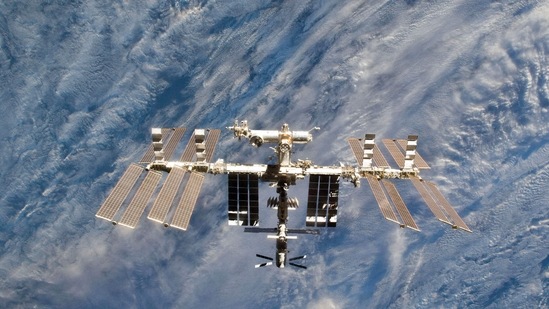
Last week Rogozin warned that the Western sanctions could cause the International Space Station (ISS) to crash, by disrupting the operation of spacecraft vital to keeping the platform in orbit.
The ISS, a collaboration among the US, Canada, Japan, the European Space Agency and Russia, is split into two sections: the US Orbital Segment, and the Russian Orbital Segment.
At present, the ISS depends on a Russian propulsion system to maintain its orbit, some 250 miles (400 kilometres) above sea level, with the US segment responsible for electricity and life support systems -- interdependencies that were woven into the project from its inception in the 1990s.
Until recently, space cooperation between Russia and Western nations was one of the few areas not to suffer too much from the sanctions imposed on Moscow after Russia annexed the Ukrainian peninsula of Crimea in 2014.
On March 30, an American astronaut, Mark Vande Hei, and Russian cosmonauts Anton Chkaplerov and Pyotr Dubrov, are scheduled to return to Earth from the ISS aboard a Soyuz spacecraft.