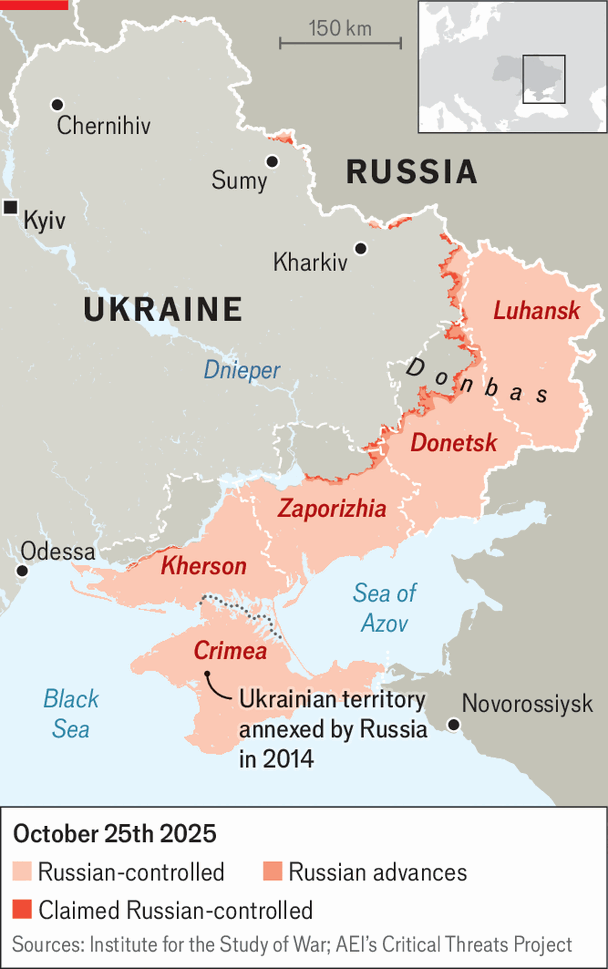
WHEN DONALD TRUMP met Volodymyr Zelensky on October 17th he was reported to have urged Ukraine to pull back from the Donbas and to have relayed threats from Vladimir Putin that Kyiv could be destroyed within days. Since then Mr Trump has U-turned again, imposing sanctions on Russian oil firms. As the White House prevaricates Mr Putin is escalating the air war. This year he has lost hundreds of thousands of soldiers in exchange for less than 1% of Ukrainian territory. Instead of conquering Ukraine he wants to destroy it, with air attacks on the power grid and central heating and gas infrastructure as winter nears. The aim is to make swathes of the country’s east uninhabitable, undermining industry and encouraging mass emigration and panic.
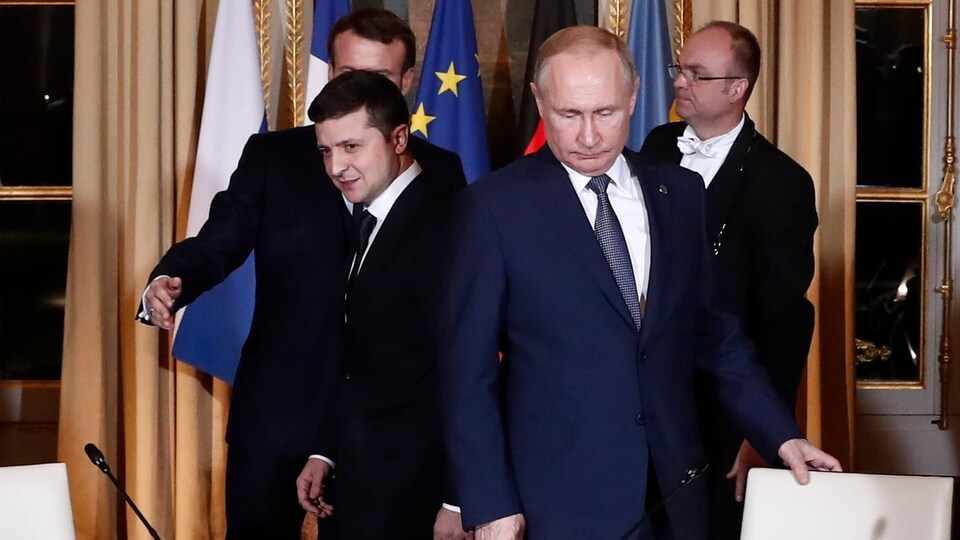
Russian President Vladimir Putin, right, and Ukrainian President Volodymyr Zelenskyy at the Elysee Palace, Dec. 9, 2019, in Paris.(AP / File)
The Kremlin is acting yet more clinically and more cynically than it has before. Days before Mr Trump and Mr Zelensky met, missiles and drones had cut off the Ukrainian capital’s water supply. For the first time, the Kyiv metro went dark. Attacks on front-line areas like Sumy and Chernihiv have left parts of those regions without power for days.
The aerial battle has evolved. Ukraine has dramatically improved its air defences—both missile interception and electronic warfare around sensitive sites. It is scaling up new interceptor drone technology, a remarkable development. But Russian capabilities and tactics are evolving faster. In previous years the Kremlin used expensive and often inexact missiles in scattergun attacks across Ukraine. Now it focuses on specific regions, attacking in waves using the latest iterations of inexpensive Shahed drones.
Chart.
The drones are much faster and more precise than the first prototypes delivered by Iran in 2022. The most advanced Shahed-like drones now travel three times as fast, in excess of 300kph, and use artificial intelligence in their last-mile automation, to overcome Ukrainian jamming as they near their targets. The drones also attack in a different way, approaching from near-vertical positions, above the range of machine guns, much as a missile would. And there are now many more of them. A year ago 150 drones in a night was considered a serious attack. Now Ukraine frequently faces 600 or 700. In these combined attacks, several dozen drones arrive at a target almost simultaneously. Using air defence to protect every target is an impossible task.
Approximately 60% of Ukraine’s power is produced by nuclear reactors, with most of the rest provided by hydropower and thermal (coal or gas) power plants. Nuclear provides constant power; thermal plants balance supply and demand, which is vital to keeping the system stable. Russia is focusing its attacks on both elements of the balancing equation: generation and distribution. In the space of three weeks, Russia has taken offline several thermal power plants and perhaps half of Ukraine’s upstream gas production, an important part of the balancing capacity. Besides the cost of the infrastructure damage, the latest attacks have unexpectedly forced Ukraine to spend an astonishing $1.9bn on imported gas.
Russia’s focus beyond the capital has been on the border regions of Sumy, Chernihiv and Kharkiv. The aim appears to be to cut Ukraine in two: detaching the industrial east, where consumption has always been higher, from energy production in the west, and weakening lines of transmission to eventually paralyse the flow from west to east. “They want to turn the power off on the eastern bank first, not the whole country,” says a government insider.
Ukraine’s transmission grid rests on about 90 crucial substations. These convert the 750-kilovolt current from power stations into the lower voltages (330kV or 110kV) that feed regional networks. Russia is striking these substations one by one, working its way through the system and finding weaknesses. On paper, the most critical nodes were supposed to be protected with systems of passive defence: reinforced concrete structures and wire mesh. In reality many were not, or not to the necessary standards.
Part of the reason is a scarcity of resources. Since Russia’s full-scale invasion in 2022 Ukraine’s government has been in a state of emergency, with only a limited number of experienced managers to organise the response. When the pressing energy crises and blackouts in 2022 and 2023 passed, attention turned elsewhere. The lack of systemic thinking has been compounded by government rivalries and by overcentralisation in the presidential office. In 2024 two of the officials most responsible for building defences—Oleksandr Kubrakov, then deputy prime minister, and Volodymyr Kudrytskyi, then head of Ukrenergo, the transmission-system operator—were forced out. After America’s presidential transition aid dried up. In the chaos, construction became a tick-box exercise. “The protective systems weren’t built simultaneously across all sites,” says one contractor. “Had the companies responsible worked swiftly, efficiently and with proper financial oversight, much more could have been accomplished in time.”
Ongoing infighting undermines efforts to protect what remains of the grid. On the morning of October 21st, just hours after Russian strikes had taken out much of the power supply to Chernihiv and Sumy regions, news broke that law-enforcement officers were raiding the home of Mr Kudrytskyi. The searches were ostensibly linked to alleged corruption, but the timing was hard to ignore. The former energy manager, who denies all the allegations, says the pressure was connected to his media activity and links to Western partners. “It looked political, I’m afraid,” he says. The episode will not bolster the confidence of Western backers, at a moment when Ukraine needs extra funds to repair and defend its power system.
The mood in the sector is downbeat, but not defeatist. Ukraine has dealt with difficult challenges before. It has some spare transformers that it can use for repairs. An achievable aim might be to slow Russian destruction enough for replacement to keep up. The country is creating hundreds of new military units combining air defence with drones to protect the most essential facilities. But this winter looks like it will test resilience like no other. Prolonged blackouts across many regions are a real prospect. Some may experience blackouts of both electric power and gas. Mr Putin, scenting blood, is unlikely to stop. In previous years his attacks have only stiffened Ukrainian resolve. This time around they may be more effective.
Get the latest World News, breaking headlines and global updates from the US, UK, Pakistan, Bangladesh, Russia and other countries. Follow major international events on Hindustan Times.
Home/World News/The Kremlin’s Blitz To Make Ukraine “go Dark”

 E-Paper