
 E-Paper



The meaning of America’s vast military build-up off Venezuela
In recent weeks the United States has mounted a steadily intensifying campaign of air strikes against boats allegedly linked to drug smugglers.


 Prefer HTon Google


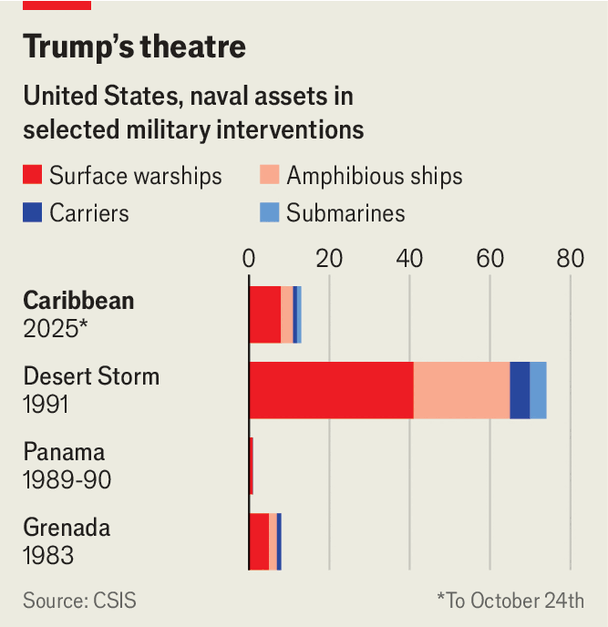
ON OCTOBER 26th the USS Gerald Ford, the largest aircraft-carrier in the United States navy, indeed anywhere in the world, slipped out of the Croatian port of Split. Days earlier the Pentagon’s boss, Pete Hegseth, had ordered her to sail to the Caribbean, part of a vast and unexplained military build-up in the region. By early October, more than ten percent of all deployed American naval assets were located in the area controlled by the Pentagon’s Southern Command (SOUTHCOM), which oversees operations in Central and South America. Is the United States preparing to go to war with the regime of Nicolás Maduro in Venezuela?
In recent weeks the United States has mounted a steadily intensifying campaign of air strikes against boats allegedly linked to drug smugglers. The latest, which killed six people, came on October 24th. The ten strikes so far, in both the Caribbean and the Pacific, have killed an estimated 43 people. Legal experts say they are illegal, because the Trump administration’s claim that it is in an “armed conflict” with drug traffickers is groundless. Neither Congress nor military commanders have shown much sign of resistance, though Admiral Alvin Holsey, the commander of SOUTHCOM, said recently that he would leave his post in December. Admiral Holsey is reported to have disagreed with Mr Hegseth over the strikes.
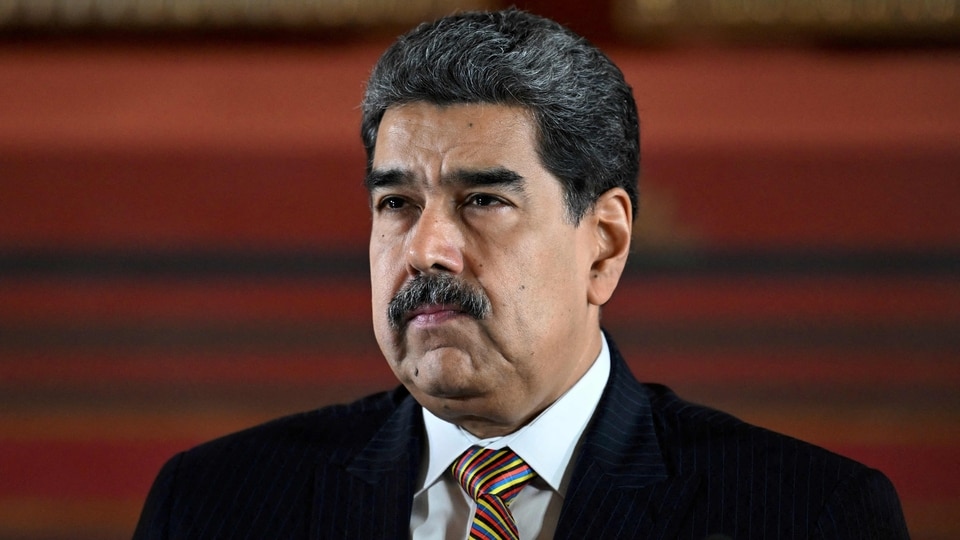
The military build-up is partly directed at Nicolás Maduro, Venezuela’s leader, who lost the 2024 election but remained in power nonetheless, and whom the United States accuses of secretly being a drug-gang kingpin, a claim viewed with scepticism by most experts. Mr Trump has openly hinted vaguely at the prospect of military strikes. “We have a lot of drugs coming in from Venezuela,” he claimed, adding: “we’re going to stop them by land also…The land is going to be next.”
There is already plenty of firepower in place. The build-up is the largest accumulation of ships in the region since the Cuban missile crisis, notes the Atlantic, a magazine. The three destroyers accompanying the Ford could collectively launch around 180 Tomahawk cruise missiles, estimate Mark Cancian and Chris Park of the CSIS think-tank in Washington. B-1 and B-52 bombers, as well as helicopters belonging to United States special forces, have been flying missions near Venezuela’s coast. That could be an effort to rattle Mr Maduro, or to map out his air defences, of which he has recently been boasting, or both. On October 26th an American destroyer docked in Trinidad and Tobago, an island nation just 11km (7 miles) from Venezuela, as part of what the United States called a training exercise involving the US Marine Corps. That could serve as cover for moving naval assets closer inshore. Mr Hegseth has announced a new Counternarcotics Task Force that will be led by one of the marines’ three expeditionary forces.
The aim of this gunboat diplomacy remains unclear. Different advisers within the Trump administration have taken divergent approaches to Venezuela to this point. One possibility is that Mr Trump seeks to overthrow Mr Maduro, perhaps with a special forces operation. (The use of wider air strikes or a ground invasion against the regime remains unlikely.) Mr Trump has publicly acknowledged authorising a covert CIA campaign against Mr Maduro, which is reported to allow the agency to conduct lethal operations in Venezuela. It is also possible that the goal is to heap so much pressure on Mr Maduro that someone in his inner circle or the security forces turns on him. The $50m reward that the United States has offered for information leading to Mr Maduro’s capture has not yet turned anyone. But the regime is undoubtedly rattled. It has raised militia, heightened security measures and paved the way for a state of emergency.
Instead of attacking Mr Maduro and his regime, Mr Trump could continue carrying out his broader stated aims and conduct limited strikes on sites in Venezuela that are associated with drug traffickers. That would do little to alleviate the drug problem (though it might let the Trump administration declare victory and move on). The fentanyl that enters the United States is mostly produced in Mexico, not Venezuela. Any strikes on land would be an extraordinary escalation in the Americas, pulling the attention of the armed forces of the United States away from both Europe and the Pacific. That would be despite the insistence among many in the Pentagon that the department’s “pacing threat” is China.
In a lecture to American generals and admirals last month, Mr Hegseth praised the Gulf war of 1991 as a model “limited mission with overwhelming forces and a clear end state” and criticised the “mission creep” in Vietnam. Pinprick air strikes could be ineffective; a large ground war could become a quagmire. And even if Mr Maduro were unseated, and the man who won the elections last year, Edmundo González, put in power, it is unclear what would follow. “The risks of violence in any post-Maduro scenario should not be downplayed,” notes the International Crisis Group, an NGO. “Many senior military officers could resist regime change.”
In any case, the clock is now ticking. The Ford is a “use or lose asset”, notes CSIS, because the Pentagon will be reluctant to keep one of the navy’s most important warships in Latin America for a prolonged period unless it is needed. It will take at least a week or more to get to the Caribbean. That depends on her speed of sailing and that of her escorts. The deployment to the Caribbean is one of two indicators for “attack and invasion” identified by CSIS. The second would be the creation of “tent cities” in Puerto Rico, a United States territory in the Caribbean, which could house large numbers of troops. Those have not appeared.


