
 E-Paper


In Trump’s Second Term, a Bolder President Charges Ahead Unchecked
Trump is frequently riffing on authoritarianism and is ignoring caution from his advisers.


 Prefer HTon Google


Some aides to Donald Trump warned the president that building a ballroom at the White House would force them to tear down part of the East Wing and disrupt daily operations and tours, according to people familiar with the discussions. Trump said he would build it anyway, and the contract was given to builders chosen by the White House.
In his first term, administration officials regularly curbed Trump’s impulses on matters big and small, including on tariffs, immigration and controlling the Federal Reserve.
In his second, Trump has been surrounded by fewer people who try to dissuade him, according to White House officials, Trump allies and observers of the presidency.
“I think he’s learned there is not much that can really stop him from what he wants,” said Marc Short, who was Trump’s director of legislative affairs in his first term.
In recent days, Trump renewed a call to end mail-in voting, announced a new policy of coercing local governments into abandoning cashless-bail polices, threatened to send the military to Baltimore and said he’d like to send it to New York and Chicago as well, all of which pushes the bounds of his authority.
In one of the most aggressive steps yet in that direction, he tried to remove Federal Reserve governor Lisa Cook from her post on Monday, setting up a conflict with the Supreme Court, which has recently suggested that the central bank is protected from direct political manipulation. Some of his new directives are encouraged by advisers, while others appear to come from Trump himself.
Seven months into his second term, Trump has also taken to riffing more frequently about authoritarianism, after positing during the campaign he would be a dictator only on “day one” of his presidency. The comment drew outrage from Democrats, who built their losing campaign around Trump as a threat to democracy.
In the Oval Office on Monday, Trump praised his own tough-on-crime policies in Washington, D.C., by returning to the theme. “A lot of people are saying, ‘Maybe we like a dictator,’” he said. “I don’t like a dictator. I’m not a dictator,” he then added.
It’s Trump’s latest flirtation with a type of government that the U.S. shed at its founding, flexing federal muscle and busting through the norms that constrained other presidents.
Trump is in the weeds of the government in a way he wasn’t during the first term, urging firings and hirings at agencies and giving ideas, administration officials said.
Since taking office in January, Trump has threatened and extracted expansive settlements from top universities, law firms, tech and media companies. He sent U.S. Marines to Los Angeles over the objection of local elected officials, and took over Washington’s police force, ordering thousands of troops and federal officers into the streets. He fired the economics official who produced a monthly jobs report that irked him; ordered the firing of career officials at agencies; and even sought to fire officials at institutions he technically doesn’t run, including the National Portrait Gallery. Few aides have pushed back on any of the moves, and he has often been cheered on.
One rare area Trump has wavered this year: tariffs. He has pulled back several times amid concerns about the reaction of financial markets.
Trump is motivated by “having control over all American institutions,” said Douglas Brinkley, a presidential historian at Rice University. “He seems to want to grab everyone by the neck and say ‘I’m in charge.’”
Trump has also pushed the optics of the presidency in a monarchical direction, holding a military parade in June for the Army’s 250th birthday. Officials had thwarted a similar one in his first term by arguing it would look like a third-world spectacle. After the Washington parade, Trump told aides he was disappointed with the marching, and the U.S. Navy is trying to plan a bigger celebration this fall, hoping for a shimmering spectacle with seacraft, administration officials said.
As he remakes the contours of the presidency, he’s also physically refashioning symbols of American power. Trump has covered the Oval Office with gold flourishes reminiscent of Gulf state palaces, over the objection of some advisers, telling them he gets compliments from world leaders and visitors. He installed two new flagpoles on lawns in the front and back of the White House.
The president gives away campaign-style baseball hats to visitors emblazoned with the phrase “Trump 2028”—even though the Constitution bars him from running for another term—and keeps them in a White House office.
American history includes examples of presidents who’ve changed the office they occupy. Andrew Jackson took on elites and brought populism to the highest office. Abraham Lincoln suspended habeas corpus (later ratified by Congress) and eventually ended slavery. Franklin D. Roosevelt built a social safety net.
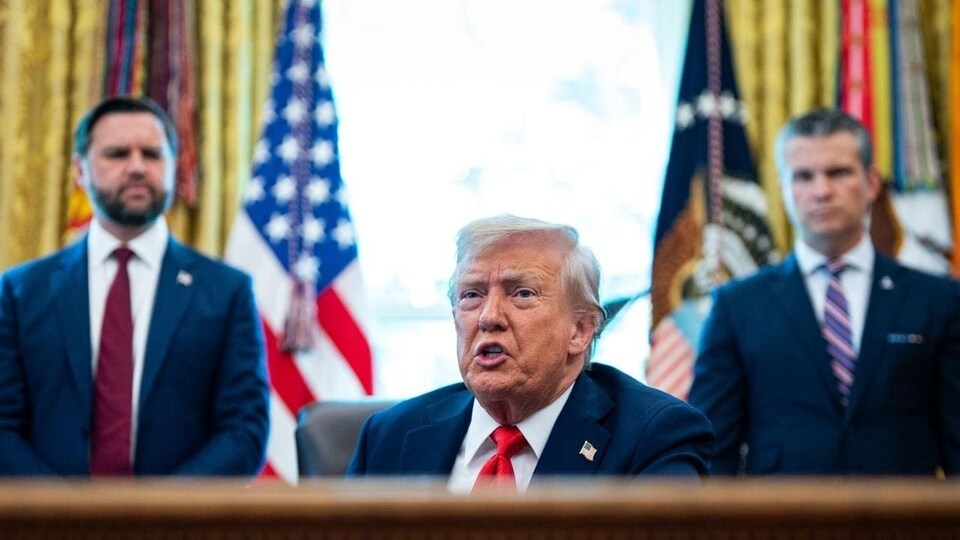
The Trump era is marked by concentrating federal power in the Oval Office. “I have the right to do anything I want to do,” Trump said Monday.
A spokeswoman for Trump, Karoline Leavitt, said the president was in office “because of his unmatched political instincts and his uncanny ability to understand what the American people want. Everyone knows President Trump is the decision maker and he has put together a phenomenal team,” she said
Some officials appear shocked at the sharp departure from Trump’s first term. The official who produced the jobs report at the time, William Beach, said he often talked to Trump’s aides at the time and had a respectful relationship with them. “There was never any political interference,” he said. “I was very surprised.”
Then-chief of staff John F. Kelly and others regularly tried to contain Trump, and stopped Trump from sending immigrants back to third countries, for example, former officials said. Former economic adviser Gary Cohn argued against tariffs for a year; former White House Counsel Donald McGahn warned against trying to influence Justice Department investigations; and former Treasury Secretary Steven Mnuchin spoke out about efforts to strip the Federal Reserve of its independence.
Bryan Lanza, a lobbyist and Trump ally, said “there is no longer anyone standing behind Trump waving off what he’s saying.” Lanza said the staff in this White House wants to follow what Trump says, not try and change him. “There were lots of debates in Trump 1.0 about what he should do and what he couldn’t do,” Lanza said. “He’s just executing this time.”
Trump wants to be at the White House more frequently this term, blaring music with doors of the Oval Office open, working later into the evening and telling his advisers that he is having fun. He has regaled aides with tales of how miserable he was during parts of the first term, as he battled with staff members and faced investigations.
At the time, he complained often about the Kennedy Center, the Federal Reserve, the National Security Council, and the Defense and Justice departments, but did little to actually shape them, former administration officials said, and seemed to accept there were limits on his power. He then showed little interest in taking on universities and law firms who were perceived as liberal, the officials said.
Trump also responded to criticism then, former administration officials said. Trump often wanted to hold world summits at his properties but didn’t for fear of the backlash it would provoke, they said. He wanted to stay involved in his businesses but was regularly told he couldn’t, former advisers said.
When advisers told him earlier this year he couldn’t attend a cryptocurrency dinner because it would look like a conflict of interest, he disregarded their advice. The advisers just stayed away themselves.
Then in May, some Trump aides were dubious of a video Trump wanted to show the South African president alleging “white genocide” was occurring in his country, but they knew better than to try to intervene, people familiar with the episode said.
His current chief of staff, Susie Wiles hasn’t tried to rein in his personal cellphone use or regularly dissuade him from making decisions. Wiles has told others her job is to manage the staff, not the president. Trump’s cabinet members are also on board this time with his vision for the presidency.
“I do believe we’re in a revolution,” Agriculture Secretary Brooke Rollins said at a cabinet meeting on Tuesday, comparing the changes to the country under Trump’s leadership to the 1776 birth of the nation and the Civil War. “This is the third with Donald Trump leading the way.”
Write to Josh Dawsey at Joshua.Dawsey@WSJ.com and Annie Linskey at annie.linskey@wsj.com


