E-Paper


Rising Risk for the U.S. Economy: A Job Market That Is Just ‘Meh’
Employers are holding on to workers but have slowed hiring to a crawl, creating a fragile labor market.


 Prefer HTon Google


The labor market has moved front and center for the Federal Reserve, highlighting its fragility and risk to the economy.

The good news is that unemployment remains low, and employers haven’t been all that interested in laying people off. The bad news is that companies haven’t been all that interested in hiring, either.
This precarious situation means even a relatively small increase in layoffs could lead the economy to start shedding jobs—a process that can be difficult to reverse once it starts.
Worries about this possibility have come to the fore at the Fed, especially after revisions included in the July employment report showed much weaker job growth in recent months than previously thought. This is why, while inflation is above the Fed’s 2% target, Fed Chair Jerome Powell on Friday signaled the central bank’s policymakers could cut rates when they meet next month.
Powell characterized the labor market environment as “curious,” with the shrunken supply of workers because of immigration restrictions counteracting the effects of reduced demand, and leaving unemployment relatively low as a result. But within that uneasy balance, Powell said the risks of a deteriorating jobs market are rising.
“And if those risks materialize, they can do so quickly in the form of sharply higher layoffs and rising unemployment,” he said.
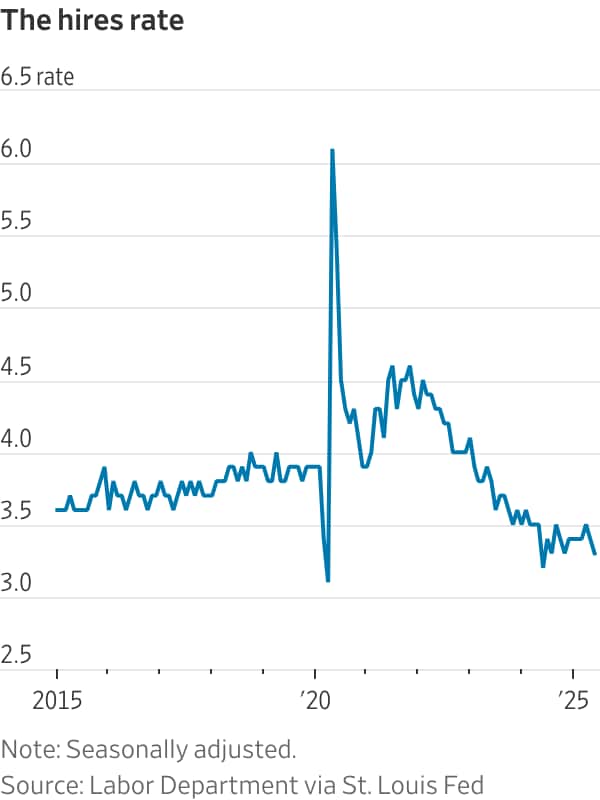
The pace of hiring has slowed markedly. In June, the hires rate—the number of hires as a share of overall U.S. employment—was just 3.3%, according to the Labor Department. That was below its level of 3.9% in February 2020, on the cusp of the Covid-19 pandemic. And much less than the 4.6% registered in November 2021, when the job market was surging back.
Sluggish hiring might in part reflect uncertainty over President Trump’s tariffs, which have made it hard for some businesses to plan. As one executive responded to the Dallas Fed’s monthly manufacturing survey in July: “Tariff changes require a sit back and watch attitude. There is no way to forecast.”
But companies were already adding new employees at a slower pace when Trump came back into office. The sharp increase in interest rates the Fed implemented in its efforts to cool the economy probably played a role. And in their zeal to bring on workers as the economy surged back from the pandemic, some employers might have overhired.
For now at least, employers aren’t laying off many workers. Layoffs as a share of total employment came to just 1% in June, not far from the record low of just under 0.9% reached during the robust job market of 2021. Initial claims for unemployment insurance—another indicator of layoff activity—have drifted higher over the past year, but remain quite low.
Economists call this reluctance to let workers go during uncertain times “labor hoarding.” This has always happened to some degree. As the economist Arthur Okun explained in 1963, “it pays to stockpile underemployed labor rather than run the risk of having to hire untrained men when business conditions improve.” Okun also noted it mattered for morale—a fickle employer might have a harder time attracting and keeping workers than a steady one.
Job seekers are having to spend more time searching.
The hoarding impulse has been stronger in recent years than in the past. That is because many businesses learned hard lessons when they struggled to find workers to replace all the employees they fired when the pandemic first struck.
But this current low-hire, low-fire dynamic has hurt some Americans’ job prospects. Younger people are having a harder time breaking into the job market, while wage growth among poorer workers, who more frequently switch jobs, has markedly cooled. More people are spending more time looking for jobs, enduring unemployment stretches of at least half a year.
The change in jobs each month comes down to how many workers were hired minus how many left their jobs—mainly because they were laid off, quit or retired. The risk is that, with hiring so low, even a modest increase in layoffs could lead to job loss in the U.S.
There were about 1.6 million layoffs in June, when the layoff rate was about 1%. Nudge that rate up to 1.3%—the historically modest level it was at in February 2020, just before the pandemic—and the number of layoffs would rise above two million. Absent an increase in hiring, those layoffs would be hard for the economy to absorb.
Conversely, a further drop in hiring could also lead to outright job losses. This past week the Conference Board reported that one in five U.S. employers it surveyed plans to slow hiring in the second half of 2025, almost twice the rate of companies that anticipated bringing on fewer people at this time last year.
The low-hire, low-fire job environment doesn’t mean the job market is predestined to fall apart—this has persisted, after all, for over a year. But the low level of job growth in recent months is enough to make the Fed uncomfortable.
“When you’re close to the edge of job losses, it doesn’t take much to get you into a situation where things can spiral downward,” said Jon Faust, a fellow at the Center for Financial Economics at Johns Hopkins. He was a senior adviser to Powell for his first six years as Fed chair.
Moreover, when the economy starts losing jobs, the process can feed on itself, leading businesses and consumers to pull back, layoffs to pile up and the country to slip into a recession. When that happens, the Fed needs to cut rates by a lot—rather than just a little—to right things.
Write to Justin Lahart at Justin.Lahart@wsj.com