
 E-Paper


US loses key E-3 Sentry after Iran targets base in Saudi: Top points on $300 million AWACS aircraft
The E-3 Sentry is an American airborne early warning and control aircraft developed by Boeing and is also used by UK, Saudi Arabia and France.

 Prefer HTon Google


The United States recorded another major loss after Iran launched a missile attack on Prince Sultan Air Base in Saudi Arabia earlier this week. As per media reports, an E-3 Sentry aircraft, which is worth roughly $300 million, was destroyed.
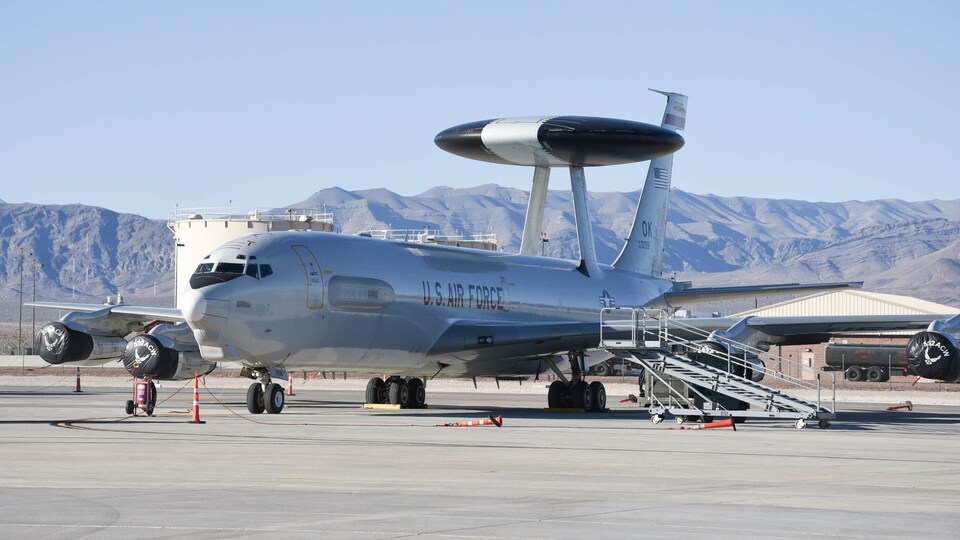
The incident, which was first reported by Air & Space Forces Magazine, said that at least 10 service members were injured in the Iranian attack, which took place on March 27.
While a statement from US Central Command is awaited, Air & Space Forces Magazine reported the incident, citing people familiar with the matter. Unverified images of the alleged missile strike have also been circulated on social media, which show the Boeing E-3 rendered unusable.

About the E-3 Sentry
The E-3 Sentry is an American airborne early warning and control aircraft developed by Boeing. E-3 aircraft are also commonly known as AWACS - Airborne Warning and Control System.
As per Bloomberg, the plane has a rotating radar disc mounted above its fuselage, which is used to spot distant threats and direct other combat aircraft. The sentry also provides a powerful advantage during combat.
“As an air defense system, E-3s can detect, identify and track airborne enemy forces far from the boundaries of the United States or NATO countries. It can direct fighter-interceptor aircraft to these enemy targets," says the official US Air Force website.
The E-3 sentry is one of the most widely used AWACS aircraft and has also been exported to the UK, Saudi Arabia and France.
“The loss of this E-3 is incredibly problematic, given how crucial these battle managers are to everything from airspace deconfliction, aircraft deconfliction, targeting, and providing other lethal effects that the entire force needs for the battle space,” Heather Penney, a former F-16 pilot and director of studies and research at AFA’s Mitchell Institute for Aerospace Studies told Air & Space Forces Magazine.
Peter Layton, a former Royal Australian Air Force officer and a visiting fellow at the Griffith Asia Institute, also stated that the loss of an E-3 Sentry is a "big deal".
“It highlights that large aircraft are vulnerable on the ground and need active defense. That is hard to do all the time, sometimes it fails," Layton told Bloomberg.


