
 E-Paper





Follow the latest breaking news, major developments and agenda-setting stories from India and around the world with the newsdesk at Hindustan Times. Operating round the clock, the desk brings together experienced editors, reporters and correspondents to deliver fast, accurate and contextual reporting across subjects that influence public policy, governance, business, society and international affairs. The HT News Desk covers politics, elections, government policies, the economy, business and markets, science and technology, the environment, law and order, infrastructure, education, climate issues and geopolitics, while closely tracking developments across states, institutions and global capitals. The team also leads coverage of major breaking news events, policy announcements, court proceedings, natural disasters, public emergencies and significant international developments. Reports published by the newsdesk are based on information gathered from reporters on the ground, official statements, government agencies, court records, regulatory filings, recognised institutions and other authoritative sources. Stories undergo editorial scrutiny and verification processes to ensure accuracy, fairness and relevance, and are updated as events evolve and additional information becomes available. Whether covering a key political decision in New Delhi, an economic policy shift affecting millions, a landmark court ruling or a major global event, the HT News Desk aims to provide readers with reliable, fact-based journalism that delivers not only the latest developments but also the context and analysis needed to understand their wider implications.
 Trending News
US rejects Chinese claims in South China Sea in new escalation
China has claimed between 85% and 90% of the South China Sea hemmed in by the so-called “Nine-Dashed Line” that extends 2,000 km from the Chinese mainland, up to a few hundred kilometres from the Philippines, Vietnam and Malaysia.


The United States on Monday categorically rejected all of China’s maritime claims in the South China Sea in a hardening of its position on a long festering regional dispute that reflected worsening of relations between the two countries in recent months.
“We are strengthening US policy in a vital, contentious part of that region, the South China Sea,” Secretary of State Michael R Pompeo said in a statement. “We are making clear Beijing’s claims to offshore resources across most of the South China Sea are completely unlawful, as is its campaign of bullying to control them.”
The United States was “aligning” itself, Pompeo added, with a 2016 order of the Arbitral Tribunal constituted under the 1982 Law of the Sea Convention that had rejected China’s maritime claims in the South China Sea.
China has claimed between 85% and 90% of the South China Sea hemmed in by the so-called “Nine-Dashed Line” - a Chinese cartographic inscription from 1947 and modified to its present form in 1952 - that extends 2,000 km (1,243 miles) from the Chinese mainland, up to a few hundred kilometres from the Philippines, Vietnam and Malaysia. The tribunal rejected its claims in 2016.
Washington DC had welcomed the decision then but had not embraced it so forcefully until now, inserting itself into the multi-nation dispute, involving on the other side, the Philippines, Malaysia, Brunei and Vietnam.
The hardening of the US position came amidst a recent spike in tensions between the two countries triggered by the Covid-19 epidemic, which started in Chia but hit the United States the hardest. The Trump administration has sought to blame China for it in a bid to shift some of the blame for its own mishandling of the outbreak.
President Donald Trump said last week the relationship with China has been “severely damaged” by its handling of the coronavirus epidemic.
The United States has announced sanctions against Chinese government agencies and officials over the persecution of Uighur Muslims, travel restrictions to Tibet, increasing Beijing role in Hong Kong and curtailed visa duration for some Chinese journalists posted in the US.
In the India-China border conflagration that started and worsened in coinciding weeks, the Trump administration, and the US Congress sided unequivocally with New Delhi. Both Trump and Pompeo have blamed Chinese “aggression” for the tensions, as a reflection of the country’s and the ruling communist party’s aggressive intent around the world.
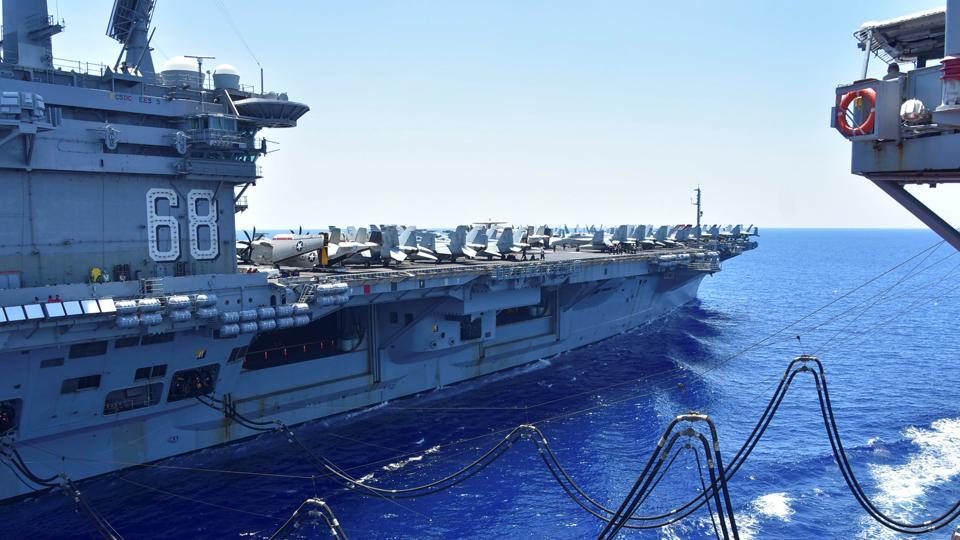
Though the Monday statement came around the fourth anniversary of the 2016 decision of the tribunal, the Trump administration had signaled its new aggressive posture in the region deploying two aircraft carriers into the region for exercises for the first time in many years in the South China Sea, at the same time when the Chinese were conducting theirs.
“The world will not allow Beijing to treat the South China Sea as its maritime empire,” Pompeo said, adding “America stands with our Southeast Asian allies and partners in protecting their sovereign rights to offshore resources, consistent with their rights and obligations under international law.”


