
 E-Paper



Vanishing Voices: Balochistan’s crisis of enforced disappearances in 2025
People are taken from their homes during night raids, seized at checkpoints, or abducted from public spaces such as markets and roads.

 Prefer HTon Google


In 2025, enforced disappearances in Balochistan reached a grim and unprecedented scale, exposing the deep human cost of Pakistan’s security-driven approach to dissent and governance in the resource-rich but long-marginalised province.
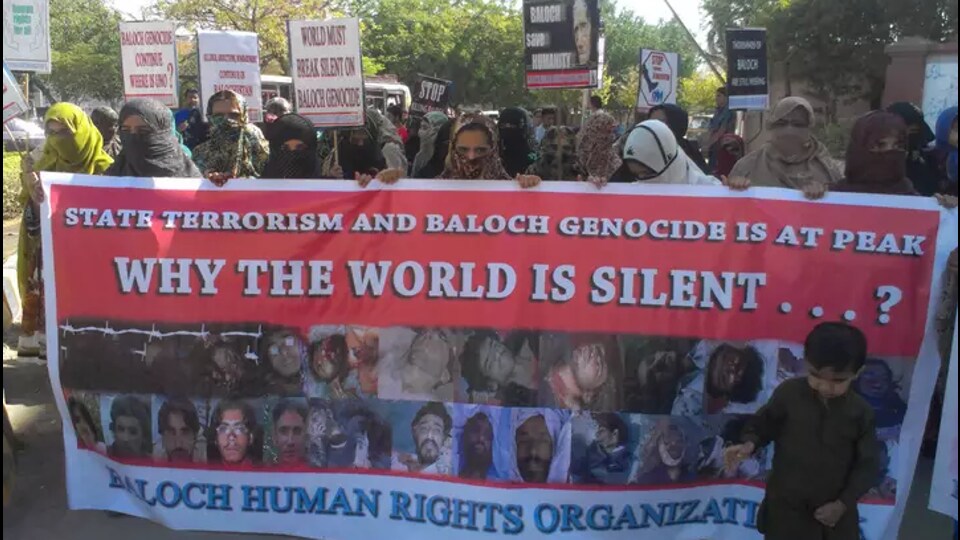
At least 1,455 cases were documented this year alone — a staggering 75 percent increase from 2024 — marking a sharp deterioration in an already dire human rights landscape. Behind each statistic is a family suspended in anguish, stripped of legal remedies, and denied even the certainty of knowing whether a loved one is alive.
Enforced disappearance is defined under international law as the arrest or abduction of a person by state agents followed by a refusal to acknowledge their fate or whereabouts; it is among the gravest human rights violations. It removes victims from the protection of law and places families in a cruel limbo.
In Balochistan, this practice has become a routine feature of Pakistan’s counter-insurgency strategy. People are taken from their homes during night raids, seized at checkpoints, or abducted from public spaces such as markets and roads. Many are held incommunicado for weeks or months; others resurface only as bodies, reported killed in alleged “encounters” that local communities and rights groups describe as a systematic “kill-and-dump” policy.
The data from 2025 documented by the HR Council of Balochistan paints a chilling picture. Of the 1,455 documented cases, 1,443 victims were men and 12 were women. More than 1,052 individuals remain missing, 317 were later released, 83 were reportedly killed in custody, and only three were transferred to jail through any formal legal process.
Students were the most targeted group, accounting for 295 cases, followed by labourers, drivers, shopkeepers, and farmers — underscoring that enforced disappearances are not limited to armed actors, but increasingly affect ordinary civilians and youth seeking education or livelihoods.
Geographically, the crisis is widespread. Kech district recorded the highest number of cases (318), followed by Quetta (172), Gwadar (164), Awaran (140), Dera Bugti (114), and Panjgur (105). These regions are not only centres of political unrest but also key to major infrastructure, port, and mineral projects — raising serious questions about whether “security” is being used to suppress legitimate local grievances tied to land, resources, and representation.
Responsibility for these disappearances is consistently attributed to state-linked forces. In 2025, the Frontier Corps was named in 889 cases, intelligence agencies in 288, and the Counter Terrorism Department (CTD) in 233. Smaller numbers involved alleged death squads, Rangers, and Coast Guards.
House raids accounted for the vast majority of abductions, highlighting the normalisation of collective punishment and fear as tools of control. Alarmingly, the data also shows repeated targeting: 41 individuals were abducted for a second time and five for a third, demonstrating complete impunity for perpetrators.
Pakistan’s legal framework enables this abuse. Authorities routinely invoke the Anti-Terrorism Act of 1997 and broad public-order laws to detain protesters, students, and human rights defenders without charge. These laws, combined with the secrecy surrounding intelligence operations, allow the military and the Inter-Services Intelligence (ISI) to shield enforced disappearances from judicial scrutiny.
Even when families approach courts or commissions, they are often met with silence, delays, or intimidation. International concern is not new. U.N. Special Rapporteurs and working groups have repeatedly warned Pakistan about the “unrelenting use of enforced disappearances” in Balochistan, urging the state to criminalise the practice, conduct independent investigations, and ratify the International Convention for the Protection of All Persons from Enforced Disappearance.
Yet these warnings remain largely symbolic. U.N. mechanisms can issue letters and recommendations, but without political or economic consequences, compliance is rare and reform elusive. What makes the silence more troubling is that enforced disappearances in Balochistan are not occurring in isolation from global interests. The province is central to major economic and strategic projects involving ports, minerals, and energy infrastructure. Under the U.N. Guiding Principles on Business and Human Rights, states must not hide behind “security” to facilitate extraction at the expense of fundamental rights.
Companies operating in such environments have a responsibility to conduct rigorous human rights due diligence and to suspend operations where abuses are severe and cannot be mitigated. Likewise, foreign governments — particularly those pursuing trade or strategic partnerships with Pakistan — should condition economic engagement on measurable human rights improvements in affected regions.
The scale of the tragedy is long-standing. Pakistan’s own Commission of Inquiry on Enforced Disappearances has acknowledged that around 3,000 people have gone missing in Balochistan since 2011. Independent monitors recorded 601 disappearances and 525 killings in 2023, followed by 830 disappearances and 480 killings in 2024, many involving unidentified bodies — evidence of the severe barriers to investigation and accountability. The figures for 2025 suggest that instead of reform, the crisis is accelerating.
This is the price paid by thousands of Baloch families: years of protest camps, photographs of the missing clutched in trembling hands, children growing up without parents, and mothers aging in uncertainty. Oppressive security laws and secret detentions are being used to silence people who have asked not for separation or violence, but for dignity, fair treatment, and a meaningful say over their own land. Until enforced disappearances carry real legal and political consequences — domestically and internationally — Balochistan’s voices will continue to vanish, and with them, the promise of justice.


