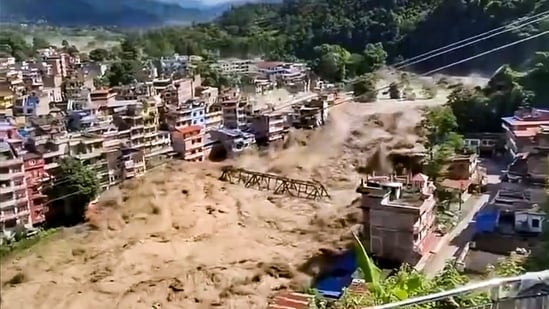
Massive flash floods in a border area of Nepal and China killed at least 160 people and left hundreds of tourists, workers, and others missing, including 133 Indians, on Thursday after a flash flood swept through communities along Nepal's Bhote Koshi River near the Tibet border.
The US Geological Survey initially reported a magnitude 4.4 earthquake early Wednesday, about 66 kilometres (41 miles) north of Kathmandu near the border. It later revised its assessment, saying the seismic event was a magnitude 5.2 glacial collapse that sent debris downstream and caused catastrophic flooding. The USGS said its conclusion was based on data from nearby seismic stations, long-period seismic waves and satellite imagery, and that no earthquake had occurred.
The devastating floods in Nepal's Rasuwa district bordering Tibet swept through villages and damaged critical infrastructure on Wednesday.
Track Nepal floods live updates
Rijan Bhakta Kayastha, a professor at Kathmandu University and climate researcher, said a preliminary assessment said that an ice avalanche may have blocked the Lhende River, causing water to accumulate before the blockage gave way and sent a sudden surge downstream into the Bhotekoshi River, according to a report by Kathmandu Post.
Deep Dive
What triggered the recent flash floods in Nepal?
How did the flash floods affect communities near the Bhotekoshi River?
Why are experts linking the floods to climate-related events?
‘Warming Himalaya'
“The Lhende Khola has flooded twice in 14 months, this time triggered by an ice rock avalanche from a glacier on the Nepal side that blocked the river and released a sudden surge downstream,” Saswata Sanyal, a disaster risk reduction specialist at the climate research group was quoted as saying by news agency Associated Press (AP).
{{/usCountry}}“The Lhende Khola has flooded twice in 14 months, this time triggered by an ice rock avalanche from a glacier on the Nepal side that blocked the river and released a sudden surge downstream,” Saswata Sanyal, a disaster risk reduction specialist at the climate research group was quoted as saying by news agency Associated Press (AP).
{{/usCountry}}Sanyal stressed the importance of early warning systems in “a warming Himalaya.”
The region experienced a similar flash flood in August last year after a glacial lake in Tibet overflowed amid high temperatures. Nine people were killed and key infrastructure, including a bridge linking Nepal and China, was damaged.
Also Read | PM Modi speaks to Nepal's Balen Shah over deadly floods, assures ‘all possible humanitarian assistance’
Indians missing
Officials in Nepal said 403 people, including 341 foreigners, have been reported missing following the flash floods. Tourism Board spokesperson Sunil Sharma told news agency AP that 133 of those missing were Indians travelling on a pilgrimage to Mount Kailash in Tibet, a sacred site for Hindus.
The missing foreign nationals also include 47 Americans, 34 Australians, 33 Britons and 24 Canadians. The US State Department said it was aware of Americans affected by the disaster.
Also Read | Terrifying videos capture Nepal floods fury: Huge waves come crashing; buildings, people vanish in seconds
At least 62 Nepali citizens were also reported missing after hundreds of locals gathered to trek in the Gosaikunda Lake area of Rasuwa district, which borders Tibet’s Gyirong, during the local Janai Purnima festival on Friday, Sharma said.
While Nepal’s monsoon season is generally considered unsuitable for trekking, it is a major period for Kailash pilgrims, whose route passes through Rasuwa district.
The Indian embassy in Nepal has provided emergency numbers for assistance and information related to Indian nationals that have been affected by the flash floods in Nepal. The following numbers may be contacted:
+977 985 131 6807
+977 970 910 7500
(Both emergency numbers can also be contacted through WhatsApp)
(With inputs from agencies)