
 E-Paper



Who was Qasem Soleimani, top Iranian general once considered second most powerful in Iran after Khamenei?
Soleimani, an Iranian military officer, served in the Islamic Revolutionary Guard Corps (IRGC) from 1998 until his assassination by the U.S. in 2020.

 Prefer HTon Google


Two rapid explosions near the burial site of Iranian General Qasem Soleimani resulted in the death of at least 103 individuals. The incident unfolded as Iran commemorated the anniversary of Soleimani's killing in a US drone strike.
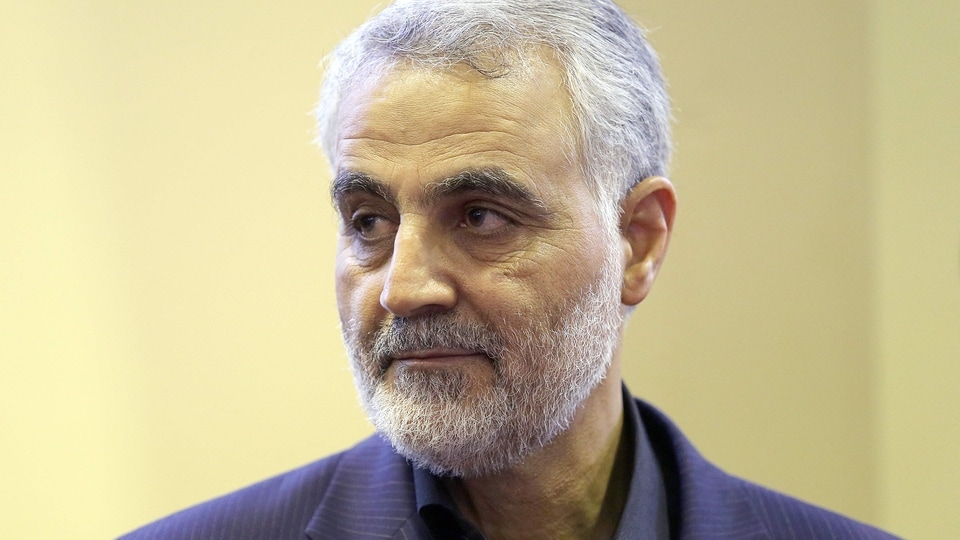
Iranian state TV confirmed that the explosions occurred in the vicinity of Qasem Soleimani's grave but provided no specifics regarding the cause of the blasts.
Who was Qasem Soleimani?
Qasem Soleimani, a top Iranian general, helmed the Islamic Revolutionary Guard Corps (IRGC) from 1998 until his assassination by the U.S. in 2020.
He held the position of commander of the Quds Force, an IRGC division primarily tasked with extraterritorial and covert military operations. In his later years, some analysts considered him the right-hand man of Iran's Supreme Leader Ali Khamenei, and regarded him as the second-most powerful figure in Iran behind Khamenei.
Throughout the Iraq War, the Quds Force was responsible for overseeing the production and large-scale smuggling of improvised explosively formed penetrator (EFP) roadside bombs into Iraq. According to US estimates, these EFPs were utilised by the Iraqi insurgency, resulting in 500 deaths and over 21,000 injuries to American soldiers. Furthermore, the Quds Force played a coordinating role in Hezbollah's defense against Israel in the 2006 Lebanon War, with Soleimani personally involved in these operations.
Soleimani, Iran's ‘shadow commander’
Referred to as Iran's ‘shadow commander,’ Soleimani, had been at the helm of the Quds Force since 1998, and had served as the architect behind Iranian military operations in Iraq and Syria.
The US had been actively pursuing him for many years, as his operations within Iraq since 2003 were disclosed by the US State Department to have resulted in the deaths of over 600 American personnel.
After the September 11 attacks in the US in 2001, he directed Iranian diplomats to cooperate with US forces in Afghanistan against the Taliban, India Today reported.
Soleimani supported Hezbollah in Lebanon and assisted Kurdish Peshmerga and Shia militia forces in Iraq following the rise of the Islamic State in 2014. Iranians credited him with the intervention in Iraq against the Islamic State.
In 2012, amid the Syrian Civil War, Soleimani had aided the Syrian government and President Bashar al-Assad, playing a key role in Iran's operations and organizing the Russian military intervention in Syria, Time magazine reports.
During the 2010s, Soleimani and the Quds Force contributed significantly to Iraq's government defeating the Islamic State (2014-17) and assisted Assad's Syrian government in major victories in the Syrian Civil War. He played a crucial role in securing Russian intervention in Syria in 2015 and led a commando operation rescuing a Russian pilot.
Senior Hamas officials credited Soleimani, along with Hezbollah's Imad Mughniyeh, with masterminding the creation and maintenance of Hamas' extensive tunnel warfare network in the Gaza Strip.
(With inputs from AP)


