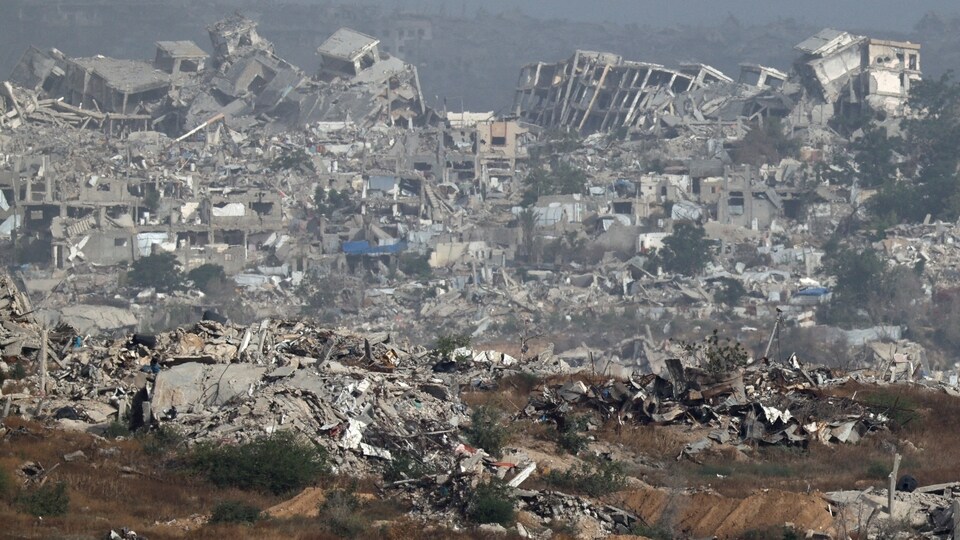
ON MAY 14TH 1948, in its Declaration of Independence, Israel embraced universal human rights “irrespective of religion, race or sex”. This belief in individual human dignity is also enshrined in the Geneva Conventions, submitted to governments that same month. Today the founding vision of Israel and the laws of war are under attack in Gaza. In its bombed and barren landscape the fate of both lies in the balance.
Israel’s just war against the terrorists who massacred its people on October 7th 2023 has turned into death and destruction on a biblical scale. (Reuters)
From the beginning, the world has struggled to live up to the high ideals of 1948. Israel was born in violence and ever since it has wrestled with the tension between upholding universal rights and being the home of a people in a contested land. The cold war was a stand-off between two systems that too often treated humanitarian law as inconvenient. Even so, the decades after the fall of the Soviet Union gave rise to aspirations that law-breaking leaders could be held to account.
Gaza shows how this vision is failing. The laws of war are being broken and the system for upholding them is not working. However, that failure does not exonerate Israel from having to answer for its actions in Gaza, including war crimes and crimes against humanity. Indeed, its foundations as a liberal democracy demand that it must.
Something has gone very wrong in Gaza. Israel’s just war against the terrorists who massacred its people on October 7th 2023 has turned into death and destruction on a biblical scale. Most of Gaza lies in ruins, millions of civilians are displaced and tens of thousands have been killed. And still, Israel’s prime minister, Binyamin Netanyahu, cannot stop himself. This week it emerged that he wants to occupy all of Gaza. But Hamas is no longer a military threat, so the war no longer has a strategy and fighting on is no longer just.
Worse, Israel’s government, despite its duties as an occupying power, has used the distribution of food to civilians as a weapon against Hamas. It continued even when, as predicted, that led to starvation and the death of desperate people queuing for survival rations. By corralling civilians in pockets as it systematically bulldozes their homes, Israel is also practising ethnic cleansing.
Gaza is not alone. Civilians are being slaughtered and driven from their homes in the Democratic Republic of Congo, Myanmar, Sudan, Ukraine and pretty much every other warzone today. Hamas, don’t forget, started the current Gaza conflict 22 months ago with an orgy of hostage-taking and crimes against humanity. Instead of seeking peace, it has gorged on the misery of its own people. It recently described the recognition of a Palestinian state promised by Britain, Canada and France as the “fruits” of October 7th.
Yet Hamas’s crimes do not excuse Israel. The Jewish state is a democracy. It should hold itself to higher standards than terrorists, warlords and dictators.
At the same time as the laws of war are being broken, the system that enshrines them is failing. The Geneva Conventions sought to spare civilians. However, they were drawn up for wars between states. Most conflicts today involve at least one militia, which makes separating fighters from civilians hard. Under Geneva’s code, the high ratio of civilian to military casualties in Gaza is not proof of crimes. Israel has loosened its rules of engagement, but the strip is crowded; Hamas knowingly shelters among civilians. In such circumstances many civilians die, as America once learned in the Iraqi cities of Mosul and Fallujah.
The International Criminal Court is becoming activist, issuing warrants for the arrest of Mr Netanyahu and his then defence minister before the Israeli system had time to act. The courts have also become tools in ongoing “lawfare”. South Africa accused Israel of genocide at the International Court of Justice just 12 weeks after October 7th, allowing activists to bolster their campaigns demanding boycotts of Israel by the West long before a judgment is reached.
Activists dream that the courts will impose their notion of virtue on a world that does not share their values. They are doomed to fail. The big powers, including America and China, do not recognise the courts. International law takes a long time to issue final judgments. It has limited powers of enforcement. A case brought today may one day be a deterrent, but it is a poor tool for stopping war crimes as they unfold.
That sounds like a counsel of despair, but it is not. And the reason goes back to 1948. The laws of war were not just a cudgel with which to beat militarists and Nazis. They were also the latest example in a long history of some belligerents imposing restraints on themselves. The question therefore is whether Israel, founded as a democratic, universalist state, still cleaves to that tradition.
In the past Israel has managed to investigate wars and hold some political and military leaders responsible. It is comparable to other countries at investigating atrocities by soldiers, albeit slowly and with a focus on the lower ranks—as with a lethal strike on the staff from the World Central Kitchen in 2024. However, as we report, higher-level accountability is lacking. The Supreme Court and the attorney-general are caught up in a domestic power struggle with Mr Netanyahu. When it comes to criticising the government over Gaza they have been missing in action.
Tried and tested
It is not too late. The urgent test is whether Israel floods Gaza with food and medicine in order to stop the incipient famine. It should also agree on a ceasefire, which will enable it to recover its hostages. The second, longer-term test will be whether it sets up a truly independent commission of inquiry after the war ends, probably under a new prime minister.
The outside world and especially the United States have a role in making this happen. No American president in recent times has been less likely to respect international law than Donald Trump. But peace in Gaza would help him stabilise a volatile region and reset relations between Israel and Saudi Arabia. America has repeatedly intervened to stop Israel’s wars in the past. This week roughly 600 former Israeli security officials urged Mr Trump to act again today.
Those officials understand that Israel has an interest in the law, too. Some Israelis calculate that they can do what they like now and patch up relations with the West later. But views of Israel are bleak in Europe and are changing in America among Democrats and the MAGA right. If Israel becomes an ethno-nationalist state that annexes the West Bank and crushes its people, the violence will not cease.
You might argue that, after suffering the worst attack in its history, Israel will have no appetite for prosecuting its own leaders. However, the penetrating insight which emerges from the Geneva Conventions is that countries which break the laws of war without shame or recourse do not just harm their victims: they also harm themselves.
Israel has an existential interest in seeing justice done. If instead it glorifies those who orchestrate famine and ethnic cleansing in Gaza, its politics and society will lurch towards demagoguery and authoritarianism. The young, idealistic country that was born in May 1948 will have been eclipsed.
For subscribers only: to see how we design each week’s cover, sign up to our weekly Cover Story newsletter.
Get the latest World News, breaking headlines and global updates from the US, UK, Pakistan, Bangladesh, Russia and other countries. Follow major international events on Hindustan Times.

 E-Paper