
 E-Paper



Ukraine needs the EU to force it to reform
The government is shirking the work required for membership


 Prefer HTon Google


THE BAROQUE stucco of Kyiv’s Mariinsky Palace is aquamarine blue, and the blue folders handed over to Volodymyr Zelensky and Ursula von der Leyen, the president of the European Commission, were just a few shades darker. The signing ceremony on July 15th marked the launch of a new deal that will provide €10bn ($11.5bn) for joint production of drones and long-range missiles. The financing is part of the European Union’s €90bn Ukraine Support Loan.
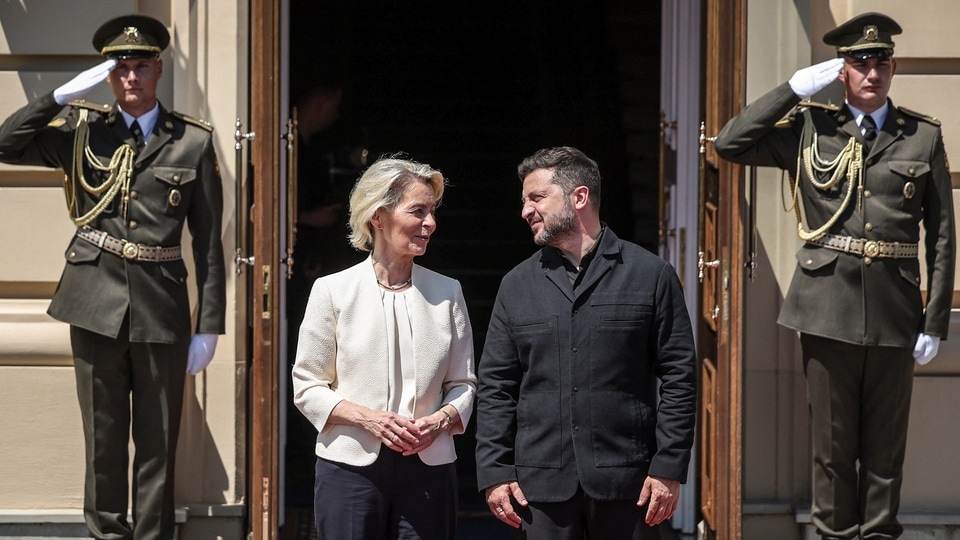
But the leaders’ smiles concealed an awkward fact: although Ukraine’s ultimate ambition is membership in the EU, it is dragging its feet on the reforms required. Negotiations on an initial “fundamentals cluster”, including provisions on the rule of law, democracy, corruption-fighting and public administration, formally opened in June. But Ukraine was supposed to have started passing the necessary legislation six months earlier, under a much-trumpeted ten-point plan signed last December by the EU’s enlargement commissioner and Ukraine’s minister for European integration. Instead only four bills have so far been put forward by the government, and just two have been passed by parliament. One of those, watchdogs complain, is riddled with loopholes. A scorecard published by a coalition of Ukrainian NGOs rates the progress at 15 out of 100.
Lack of progress on the judicial system is especially worrying. Scandals are routine. In early July a district court tried to ban publication of a report by anti-corruption media outfits that touched on the director of the State Bureau of Investigation, which investigates crimes by public officials. (The director’s brother allegedly acquired property at prices far below market value; both deny any wrongdoing.)
On June 9th Ukraine’s parliament passed a bill that reformers call a backward step, making it easier for judges to hide their assets. There has been little movement on laws to reform the Supreme Court, whose former president was recently sentenced to five years in jail for bribe-taking, and the prosecutor-general’s office, which was involved in an attempt last summer to hobble anti-corruption bodies. Polls show that foreign investors say that the rule of law is their biggest concern, ahead even of defence and security. Another recent poll found that three in four Ukrainians do not trust the courts.
The EU is preoccupied with Ukraine’s effort to defend itself and Europe, and is turning a blind eye to these issues. Judicial reform is supposed to be a core condition of continued financial support, yet on June 8th a seventh loan tranche, amounting to €2.8bn, was disbursed despite the absence of progress. Ukraine is learning that it can get away with it, says Jakub Parusinski, a political consultant in Kyiv: “The approach is: What’s the least we can do? What’s good enough?”
Mykhailo Zhernakov, a former judge who runs the Dejure Foundation, one of the think-tanks behind the reform scorecard, says that long lists of demands paradoxically make it easier to evade the important stuff. “You can say, ‘we’ve done digitisation of court decisions—hooray!’ Never mind that we’ve done nothing about the Supreme Court.” The arguments for going easy on Ukraine are skilfully deployed by the government’s business-as-usual faction: that reforms are unconstitutional, violate sovereignty, are impossible in wartime, cost too much, or are impossible to get through parliament. “We call it anti-reform bullshit bingo.”
Mr Zelensky has lost his majority in parliament, and these days has to cut deals with the conservatives bill by bill. But he can pull together a majority when he wants to, as he did during a ministerial reshuffle last month. Much of the opposition to quicker reform comes from within his own administration. Hoping to shame the government into action, a group of reformist MPs has put forward four draft reform bills of its own. Still, Taras Kachka, the outgoing minister for European integration, scoffs that drafting a new law code is not like ordering from McDonald’s. He calls Mr Zhernakov “a Don Quixote”.
For the EU, calling out Ukraine is difficult. Pressure is being exerted behind the scenes, says a spokeswoman for the commission. But such diplomatic restraint may mean that no genuine progress is made. Within the Ukrainian government, says an MP, “there’s a perception that the benchmarks will be renegotiated, taken off the agenda.” By accepting the flawed law on judges’ asset declarations, the EU has “opened a Pandora’s box. This will now happen with every sensitive bill.” Parliament may feel it can get away with a similarly watered-down law on reforming the notoriously politicised State Bureau of Investigation.
Polls still show that a large majority of Ukrainians want EU membership, and want foreign allies to keep up the pressure for change. But there is no prospect of elections while the war continues, so ordinary people have little sway over the government. To be sure, Mr Zelensky’s dismissal of Mykhailo Fedorov, a popular reformist, as defence minister in mid-July led to big protests, including a thousands-strong march through central Kyiv on July 31st. The uproar persuaded the president to replace Oleksandr Syrsky, Mr Fedorov’s chief rival, as commander-in-chief. But the nitty-gritty of judicial appointment procedures is unlikely to bring people onto the streets in the same way.
Regular Ukrainians are more worried about the next Russian missile attack, says Ihor Lachenkov, a 27-year-old political commentator whose Telegram channel has over 1.5m followers. “They’re tired, they spend 80% of their income on food. They’re not very interested in how reforms are going.” All the more reason, says Mr Zhernakov, for Europe to throw its weight about. “The only way to make things move ahead is to say ‘This is what’s needed,’ and then hold the line.”


