E-Paper



World is on the cusp of new clean energy era: UN chief
UN secretary-general Antonio Guterres called on all countries to upgrade their nationally determined contributions (NDCs) ahead of COP30 in Brazil

 Prefer HTon Google


New Delhi: Fossil fuels are on the verge of “running out of the road” and the world is on the cusp of a new clean energy era, Antonio Guterres, UN secretary-general said on Tuesday in a special address. Guterres highlighted that this transition is being seen in India among other leading economies.
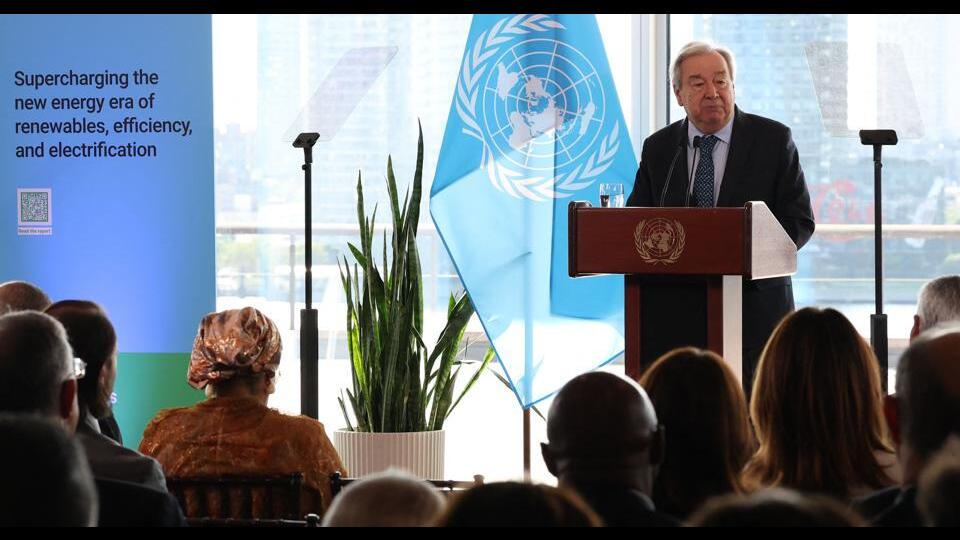
“Now, we are on the cusp of a new era. Fossil fuels are running out of road. The sun is rising in a clean energy age,” Guterres said in a special address at UN Headquarters in New York. He cited surging clean energy investment and plunging solar and wind costs that now outcompete fossil fuels.
He said this while calling on all countries to upgrade their nationally determined contributions (NDCs) ahead of COP30 in Brazil. “Ahead of COP30 in Brazil this November, they must submit new plans. I invite leaders to present their new NDCs at an event I will host in September, during General Assembly High-level week. These must: Cover all emissions, across the entire economy. Align with the 1.5 degree Celsius limit. Integrate energy, climate and sustainable development priorities into one coherent vision,” Guterres said while stressing that they must also deliver on global promises: to double energy efficiency and triple renewables capacity by 2030; to accelerate the transition away from fossil fuels. “These plans must be backed by long-term roadmaps for a just transition to net-zero energy systems – in line with global net-zero by 2050. And they must be underpinned by policies that show that the clean energy future is not just inevitable – but investable,” he said.
He said there are three reasons why he believes the fossil fuel era will end soon –1. market economics; 2. renewables providing energy security and 3. easy access.
“For decades, emissions and economic growth rose together. No more. In many advanced economies, emissions have peaked, but growth continues. In 2023 alone, clean energy sectors drove 10% of global GDP growth. In India, 5%. The United States, 6%. China – a leader in the energy transition – 20%. And in the European Union, nearly 33%. And clean energy sector jobs now outnumber fossil fuel jobs – employing almost 35 million people worldwide,” he said.
Even Texas – the heart of the American fossil fuel industry – now leads the US in renewables. Why? Because it makes economic sense, Guterres stressed while cautioning that fossil fuels still enjoy a 9 to 1 advantage in consumption subsidies globally – a clear market distortion.
“Add to that the unaccounted costs of climate damages on people and planet – and the distortion is even greater. Countries that cling to fossil fuels are not protecting their economies – they are sabotaging them,” he warned.
Follow the money
Guterres asked countries to follow the money – $2 trillion went into clean energy last year – that’s $800 billion more than fossil fuels, and up almost 70% in ten years. “And new data released today from the International Renewable Energy Agency shows that solar [power] – not so long ago four times the cost of fossil fuels – is now 41% cheaper. Offshore wind – 53%. And over 90% of new renewables worldwide produced electricity for less than the cheapest new fossil fuel alternative,” he said.
The greatest threat to energy security today is in fossil fuels.They leave economies and people at the mercy of price shocks, supply disruptions, and geopolitical turmoil, he said giving the example of Russia’s invasion of Ukraine. “A war in Europe led to a global energy crisis. Oil and gas prices soared. Electricity and food bills followed,” he said.
The third reason for definite energy transition is easy access, he said. “You can’t build a coal plant in someone’s backyard. But you can deliver solar panels to the most remote village on earth. Solar and wind can be deployed faster, cheaper and more flexibly than fossil fuels ever could. And while nuclear will be part of the global energy mix, it can never fill the access gaps,” he said.
OECD countries and China account for 80% of renewable power capacity installed worldwide. Brazil and India make up nearly 10%. Africa – just 1.5%, Guterres said while warning that the climate crisis is laying waste to lives and livelihoods. Climate disasters in small island states have wiped out over 100% of GDP. In the United States, they are pushing insurance premiums through the roof. “And the 1.5 degree Celsius limit is in unprecedented peril,” he said.
India on track to meet NDC goals
India has achieved one of its nationally determined contributions under the Paris Agreement, five years in advance, the Union Cabinet announced last week.
India has crossed its target of installing 50% of its power capacity from non-fossil sources. According to India’s updated NDCs under the Paris Agreement submitted in August 2022, the country aims to reduce emissions intensity of its GDP to 45% by 2030 from the 2005 level; increase the share of non-fossil fuel-based energy resources to 50% of its installed power generation capacity by 2030 and create an additional carbon sink of 2.5 to 3 billion tonnes of CO2 equivalent through additional forest and tree cover by 2030.
As on June 30, India’s total capacity was 484.8 GW with 242.04 GW (49.92%) from thermal/coal; 8.78 GW (1.81%) from nuclear and 234.00 GW (48.27%) from renewable sources including large hydro according to data with Ministry of New and Renewable Energy.
Further, the Cabinet also noted that India is on track to fulfil its commitments under COP26 held in Glasgow. At COP26, during his address to over 120 heads of countries, Indian Prime Minister Narendra Modi said India will increase its non-fossil fuel energy capacity to 500 GW by 2030; fulfil 50% of its energy requirements from renewable energy sources by 2030; reduce its total projected carbon emissions by 1 billion tonnes between now and 2020; reduce the carbon intensity of its economy by 45% by 2030; and achieve the target of net zero emissions by 2070.