French experts reexamining evidence have confirmed their earlier conclusion that the 2004 death of Palestinian leader Yasser Arafat was not the result of poisoning, a prosecutor told AFP Monday.
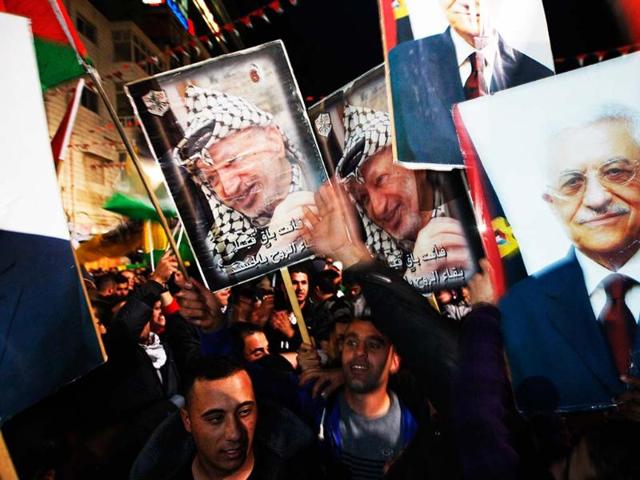
The prosecutor for the western Paris suburb of Nanterre said the experts found there was no foul play in Arafat's death, which sparked immediate and enduring conspiracy rumours.
A centre in the Swiss city of Lausanne had tested biological samples taken from Arafat's personal belongings given to his widow after his death, and found "abnormal levels of polonium" -- an extremely radioactive toxin, but stopped short of saying that he had been poisoned by polonium.
French experts "maintain that the polonium-210 and lead-210 found in Arafat's grave and in the samples are of an environmental nature," Nanterre prosecutor Catherine Denis said.
The reevaluation of earlier data "disproves the hypothesis of an acute ingestion of polonium-210 in the days preceeding the appearance of symptoms," she said.
This confirmed French findings from 2013, which also matched those of a Russian team. However, a Swiss probe has said that the poisoning theory is "more consistent" with its test results.
Arafat died aged 75 on November 11, 2004 at the Percy de Clamart hospital, close to Paris. He had been admitted there at the end of October that year after developing stomach pains while at his headquarters in the West Bank city of Ramallah, where he had lived since December 2001, surrounded by the Israeli army.
{{/usCountry}}Arafat died aged 75 on November 11, 2004 at the Percy de Clamart hospital, close to Paris. He had been admitted there at the end of October that year after developing stomach pains while at his headquarters in the West Bank city of Ramallah, where he had lived since December 2001, surrounded by the Israeli army.
{{/usCountry}}Arafat's widow Suha lodged a complaint at a court in Nanterre in 2012, claiming that her husband was assassinated, sparking an inquiry.
The same year, Arafat's tomb in Ramallah was opened for a few hours allowing three teams of French, Swiss and Russian investigators to collect around 60 samples.
Many Palestinians believe that the Israelis poisoned Arafat with the complicity of some people in his entourage.
Polonium-210 became famous in 2006 when a fugitive Russian intelligence officer turned opponent of President Vladimir Putin, Alexander Litvinenko, was killed in London by a strong dose of the hard-to-get radioactive isotope. Two Russian agents were the chief suspects for British police, but Moscow refused their extradition.