Rich nations are seeking introduction of a new layer of emerging economies between the existing two worlds --- developed and developing --- to turn countries like India and China from receiver of climate aid to donors.
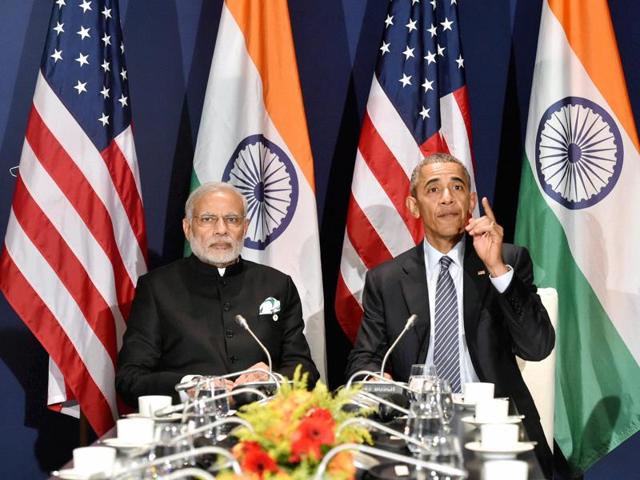
President Barack Obama delivers remarks during the COP21, United Nations Climate Change Conference, in Le Bourget, outside Paris. (AP Photo)
{{^htLoading}} {{/htLoading}}
The proposal on the climate finance process led by United States, if accepted, could undermine the United Nations climate convention without re-writing it and will have a Paris agreement running parallel to the convention.
The narrative at the discussion on climate finance by rich nations was that the “world has changed since UN’s climate convention was adopted in 1992” due to dramatic economic gains of some countries (read India and China) and it should be reflected in the Paris agreement.
They (United States, Japan and Canada) want the pool of so-called “donors of climate aid” to expand and those eligible for receiving support to shrink to the “poorest of poor”.
In simpler terms, it would mean that countries like India and China will not receive any money from the promised US $ 100 billion climate fund and will have to contribute instead though lesser than the developed world.
The proposal being pushed for the draft Paris agreement to be submitted on Friday for discussion by ministers from 196 nations next week also re-defines the existing differentiation between the developed and the developing world creating the third category of so-called emerging economies.
The 130 country strong block of the developing world called G-77 plus China strongly rejected the move saying this “narrative serves narrow national interests of the developed countries”.
The biggest group in climate talks also posed a question to rich nations: “If the world has really changed so much, we ask why it is that after all these decades all our members remain developing countries with little or no voice in global decision-making processes and institutions?.”
{{^htLoading}} {{/htLoading}}
Ajay Mathur, spokesperson of India’s climate team, said defended the present differentiation saying nothing had changed since 1992 as even today there are more than 300 people without electricity in India which was also highly vulnerable to impact of climate change as evident from flooding in southern India.
Seeking to retain the existing differentiation between the developed and the developing world, the statement said the specific outcomes on finance must also not impose on” sovereignty” of countries in the G-77 plus China block and should not override or displace the “zero poverty goals” target of the developing world.
{{^htLoading}} {{/htLoading}}
“The financial mechanism of the Convention must serve as the financial mechanism of the legal agreement. The related funds established under the Kyoto Protocol and under the financial mechanism of the Convention must also serve as instruments of the legal agreement,” the statement read, reiterating its stand that it will not agree to any attempt to undermine the convention.
Climate finance is the biggest sticking point at Paris climate talks and no agreement on it can derail the negotiations. As of now, converging on finance appears to be a distant goal.
Chetan Chauhan is the National Affairs Editor looking into all aspects of news and features from across India. A Chevening scholar with over three decades of experience in reporting and news management, Chetan has extensively covered all important aspects of the social sector, political economy, environment and climate change nationally and internationally. He did a journalism course at the Reuters Institute of Journalism in Oxford and Digital Media training at Nanyang Technological University in Singapore. He started as a reporter with The Statesman in 1996 and joined the Hindustan Times in 2000 in the metro bureau covering environment, crime and Delhi politics. He covered hot local news, from the Jessica Lal murder case to the rebellion of Delhi Congress MLAs against then Chief Minister Sheila Dikshit, to the replacement of toxic vehicle fuel with cleaner compressed natural gas (CNG) in the national capital. Some of his stories on air pollution became part of the Supreme Court’s landmark MC Mehta versus Government of India case in the National Capital Region (NCR), forcing the government to take corrective measures. As part of the national political bureau since 2004, he covered important central sectors such as environment, education, social justice, labour, rural development, water resources, renewable energy, agriculture, broadcasting and the Planning Commission for more than a decade producing several exclusive and investigative breaking stories. His specialisation is the environment, having covered at least a dozen United Nations global conferences on climate change, biodiversity and wildlife including climate summits in Paris, Copenhagen and Bali. He also covered India’s two five-year plans ---11th and 12th and reported on drafting and execution of right based laws such as Right to Education, Right to Information and rural job guarantee law, MG-NREGA, now being introduced in new format as VG-RAM-G Act. He has in-depth knowledge of social sector issues. He was one of the first to report on tigers vanishing from Sariska and Panna wildlife reserves in 2004 and 2008, respectively, leading to the setting up of the National Tiger Conservation Authority (NTCA) and the introduction of stringent penal provisions for poaching. He has written extensively on the rising human-animal conflict in India and the degradation of India’s biodiversity hotspots because of mining and other activities. Since 2004, Chetan has covered Parliament comprehensively and participated in training on the nuanced coverage of Parliament proceedings. He has travelled extensively across India to cover national and provincial elections since 1998, especially in the Hindi heartland states, considered India’s road to power. He writes a regular column for Hindustan Times, Ecostani, on important national politics, economy, Himalayan ecology and environmental issues. His other responsibilities include providing inputs for edits and edit page articles for the publication, apart from managing news flow from across India.
Get the latest headlines from US news and global updates from Pakistan, Nepal, UK, Bangladesh, Russia and US Iran war Live, get all the latest headlines in one place on Hindustan Times.
Get the latest headlines from US news and global updates from Pakistan, Nepal, UK, Bangladesh, Russia and US Iran war Live, get all the latest headlines in one place on Hindustan Times.