
 E-Paper



Bengaluru's water crisis: The geography of the problem
In the short term, the water table and lakes will fill up and the taps will flow again. But the city, situated on an elevation, needs effective urban planning

 Prefer HTon Google


Bengaluru had been in the news for the last few years because of flooding and stagnation. It has been in the news again this year for drought and water scarcity. This transition between extremes is not unique to Bengaluru — every city in India is vulnerable. The problem is the lack of understanding about the geography of our cities, and an unregulated growth pattern accompanied by our inability to conserve resources.

Bengaluru is unofficially a hill station which is located almost a kilometre (~900m) above the mean sea level. Nearly 98% of India’s population lives at an elevation lesser than Bengaluru’s, and no other city of this size is situated at this elevation in South Asia. This elevation has been a boon and a bane for the city as it brings a mild weather that has helped in making it an attractive destination but on the other hand, resources such as water have to be pumped from lower elevation making it a costly exercise to bring water to the city.
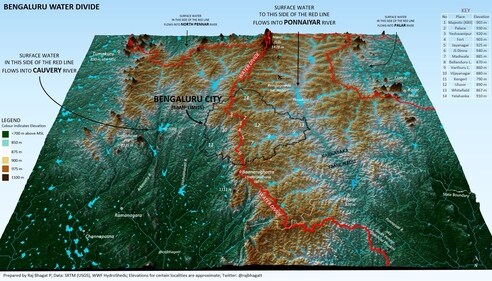
The city is placed on the top of a ridge between the Cauvery and the Dakshina Pinakini (also known as Ponnaiyar) watersheds, which means that the rainwater that falls on the city flows into the Cauvery river or the Ponnaiyar river through smaller rivers and streams creating the valley system (Figure 1). Nearly two-thirds of the city is in the Dakshina Pinakini watershed. The rest is in the Cauvery watershed. This is important because it was a point of contention between the states of Tamil Nadu and Karnataka on how much water can be allotted to Bengaluru as part of the Cauvery tribunal, since only a part of the city fell in the Cauvery watershed.
Though we have a tendency to report annual average rainfall while describing cities, which is around 900 mm for Bengaluru, the rainfall oscillates between the years. As any Bengaluru resident knows, the second half of the day often receives rainfall in the pre-monsoon season (April-May), as thunderstorms arise out of convection. The watershed also receives rainfall from the advancing monsoon and the retreating monsoon.
To utilise this seasonal rainfall for irrigation, bunds were built across the valleys creating lakes that stored the water. These lakes eventually began supplying water to the command area downstream, while also recharging the groundwater in the nearby region. Also called tank irrigation, this method is widespread across Karnataka and Tamil Nadu too. As Bengaluru began growing, the city needed to provide resources for residents as well as agriculture.
A problem long in the making
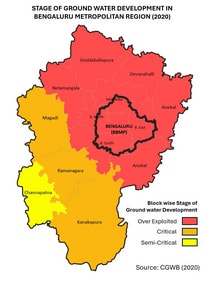
Like many South Indian rivers, Cauvery and Dakshina Pinakini watersheds are heavily exploited. The water from these rivers rarely meets the sea as they are consumed in their course. Only in rare years of exceptional flooding do the rivers make it to the sea. The water is used for agriculture, followed by domestic and industrial demands. Besides surface water, groundwater is also heavily exploited. All the blocks in the Bengaluru Urban and Bengaluru Rural districts are classified as overexploited by the Central Ground Water Board (Figure 2).
Historically, Bengaluru has been dependent on groundwater and lake water for its needs. However due to increasing demand, water was pumped to the city initially from Hesarghatta lake (1894), then from the Thippagondanahalli reservoir on the Arkavathy river (1933) and finally the Cauvery water scheme, which began pumping water from above Shivanasamudra falls in Cauvery River. Water is currently pumped for a distance of a hundred kilometres and for an elevation of a thousand feet. This water, however, is not supplied for the entire city currently. Particularly there is a shortfall in supplying water to the 110 villages that were merged with the city in 2008.
Like many cities, Bengaluru also faces the lag between urbanisation, municipalization, and service provisioning. Even though there could be supply shortfalls within the cities also, water stress is typically more acute in the peripheries of the cities. When cities grow beyond the city limits, they are usually not covered by services like water supply, sewer pipelines etc. And after a while, these villages get merged with the cities and they enter into municipal governance without any basic services.
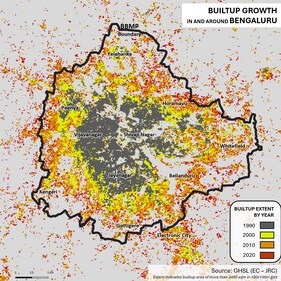
Bengaluru, one of the fastest growing cities in the world, is an example of such a lag between urbanisation and service provision growth. It is not just that these places don’t have the services, but there are no plans, designs or road maps for these regions as they are growing. In the past, the BBMP Restructuring Committee had recommended methods for municipalization so that the transition happens smoothly — but the recommendations have not yet been implemented (Figure 3).
When 110 villages were merged in 2008 and entered the BBMP, even the 2011 census recorded the lack of provisioning. We can notice the stark difference between the water supply within the old corporation limits and the newer areas that were added. Even though the number of houses getting drinking water through the pipeline would have increased between 2011 and 2024, these areas continue to rely on groundwater, tankers and bottled water as primary sources. The lack of regulation in self-provisioned water makes it difficult to estimate the usage and the patterns. For a city which is reliant on non-perennial water sources, the conservation of rainwater and reuse of recycled water is low.
These long-term issues of water use practices and governance related to growth had been brewing for a while. Since Bengaluru had received higher rainfall for the last few years, the issue of water stress had been largely forgotten. But in 2023, the failure of the monsoons, water stress has resurfaced in 2024 and the stress is widely felt in areas which are heavily dependent on groundwater (directly or indirectly through water tankers and bottled water).
We don’t have well defined procedures and protocols on how to act in drought years. Even though the water availability related warning existed when the monsoons failed in the second part of 2023, the consumption was largely following a business-as-usual scenario without conservation, judicious use, or regulation. Only when the news began circulating in February 2024 did people sit up and take notice. In situations where cities face stress due to lack of water or flood or any other environmental issue, the elected representatives to the urban local bodies play a big role. Yet, the BBMP elections were delayed, and this too has aggravated the issue.
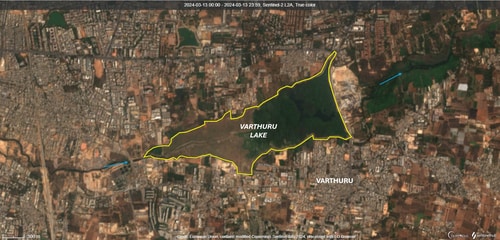
The de-siltation works in some lakes like Varthuru would have reduced the groundwater recharge and would have compounded the issue this year as seen in satellite image from March 13, 2024 (Figure 4).
Short-term problem likely to ease soon
This year, the BBMP elections are expected to be held and the next stage of the Cauvery pipeline is expected to provide water by late May. Then there are the pre-monsoon showers that are expected to add water to the lakes in May. The water stress hence is likely to continue till May and though these events and measures can provide certain relief beyond May.
However, in the long term, the city would face the same issue once again if the business-as-usual scenario continues.
Bengaluru’s water issues shouldn’t be imagined to be a problem of the city alone and the entire region should be accounted for. Watershed management plans for Cauvery and Dakshina Pinakini should be drawn up while incorporating the needs of a growing Bengaluru. These plans should have provisions and regulations for water usage during lean periods, operating procedures for lakes.
Considering the relatively high use of water for agriculture in the region, choice of crops, crop cycles, crop water productivity have to be reworked. The city should hire experts on hydrology, geology, and allied streams to study the city and prepare in detail a water budget. Rainwater harvesting and conservation need more focus.
Though water to some extent is treated and some of it is pumped to Kolar, effective procedures of reuse of water within the city should be practised. As a larger state, Karnataka should focus on diversifying growth to other cities. As part of Brand Bengaluru plan, the BBMP Restructuring reports from 2017 should be revisited and the recommendations on urban growth regulation, planning, governance, and management should be implemented. A city like Bengaluru would face episodes of drought or flooding if the status quo remains and if it isn’t aware of its own geography.
Raj Bhagat Palanichamy is a geographic information science and remote sensing expert, who is currently working with WRI India. The views expressed are personal.


