
 E-Paper



Ecostani | New resolve to help 10 million homes aim for the sun needs new incentives, reduced financial burden
250 million houses with solar rooftops can deploy 637 GW — even a third of this is enough to meet India’s electricity demand from the residential sector

 Prefer HTon Google


The day after the Prana Pratishtha ceremony at the Ram Temple in Ayodhya, prime minister Narendra Modi launched a scheme to install 10 million solar rooftops in the country.
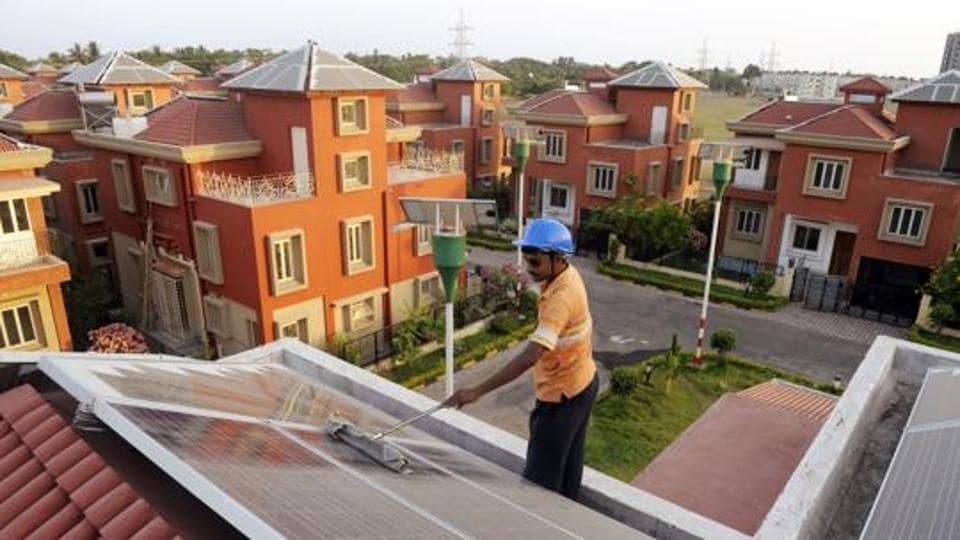
“On the auspicious occasion of the consecration in Ayodhya, my resolve has been further strengthened that the people of India should have their own solar rooftop system on the roof of their houses,” Modi said, announcing the Pradhan Mantri Suryodaya Yojana.
He added that the scheme will not only reduce the electricity bills of the poor and middle classes, it will also make India self-reliant in the energy sector.
To be sure, the Central government’s intention is over a decade old — India has been trying to harness its solar potential for the last three decades — but the 10 million target has been specified for the first time. There was no timeline proffered, however.
What is the status of solar generated electricity in the country? Of the total 11,078 MW of installed capacity of rooftop solar till December 31, 2023, only 2,735 MW is in the residential sector. The data shows that India has not made much progress in solar rooftops for homes because of the cumbersome process to get the solar panels installed, poor net metering system and high upfront capital.
The PM’s announcement could well be the boost for solar power in the country — in 2014, he had announced that India will install 100 GW of solar power by 2022, a five-fold increase from the installed capacity at that time. Forty percent of this was supposed to come from grid-connected solar rooftop integrated systems.
One gigawatt is 1000 megawatts; India has clearly missed its target by a long mark. By the end of 2022, the total installed solar capacity was 73.3 GW (73,000 MW) and rooftops was about 11 GW (11,000 MW). Even though the government claimed that it failed to meet the target due to Covid inducted economic slow-down, data shows that the growth trajectory in the pre-Covid period was not enough to meet the target.
As per the new estimate by the ministry of renewable energy, the 40 GW (40,000 MW) for roof tops would be achieved by 2026. However, the majority of rooftops are on commercial and government buildings; the share of residential being less than 10%.
A recent report by the public policy think tank Council on Energy, Environment and Water (CEEW) showed that the residential sector currently accounts for just 20% of rooftop solar installations. The bulk of the current installations are in commercial and industrial sectors.
"Since 2016, the rooftop solar (RTS) capacity in India has grown to 2.7 GW. MNRE [The ministry] rolled out Rooftop Solar Programme Phase-II in 2019 with an aim to achieve 40 GW of rooftop solar. With the launch of Pradhan Mantri Suryodaya Yojana (PMSY), we expect an accelerated adoption of solar energy,” Vikas Agarwal, co-founder and Chief Business Officer of Credit Fair, a consumer lending fintech start-up that offers personal loans to set up rooftop solar panels, said.
The new scheme is slightly different, as it targets individual households instead of installed capacity. The above quoted CEEW report said nearly 250 million households across the country have the potential to deploy 637 GW of solar energy on rooftops, and just a third of this is enough to meet India’s entire demand for electricity from the residential sector. India can easily tap one-third of this potential, the report said.
According to government officials, the objective of the scheme is to ensure energy security, cause transition to non-fossil sources of energy, improve energy access and meet the net zero target by 2070.
Under the Paris Agreement, India has already committed that 50% of its installed capacity of electricity generation will come from non-fossil fuel based energy sources, which has already reached 43% by 2023. Solar would be a small but important contributor for the transition with India investing hugely in other non-fossil fuel sources such as nuclear or hydro.
For the scheme to succeed, experts point out that the government may have to incorporate a new company for residential solar penetration for seamless empowerment of the electricity distribution companies without any additional financial burden on them. They also said new incentives need to be provided to individuals for installing solar panels on rooftops, which could include easier loan options on low interest rates and better net metering system, which measures generated electricity provided to the grid.
But, achieving the target of 10 million homes is easier said than done. The United States took almost two decades to have a million solar-powered homes.
Chetan Chauhan is National Affairs Editor. A journalist for over two decades, he has written extensively on social sector and politics with special focus on environment and political economy.


