
 E-Paper



Eye on the Middle East | The politics and geopolitics of Ismail Haniyeh’s death
Haniyeh was more than the public face of Hamas, supplementing former political chief Khaled Mishal whose assassination the Mossad infamously botched in 1997.

 Prefer HTon Google


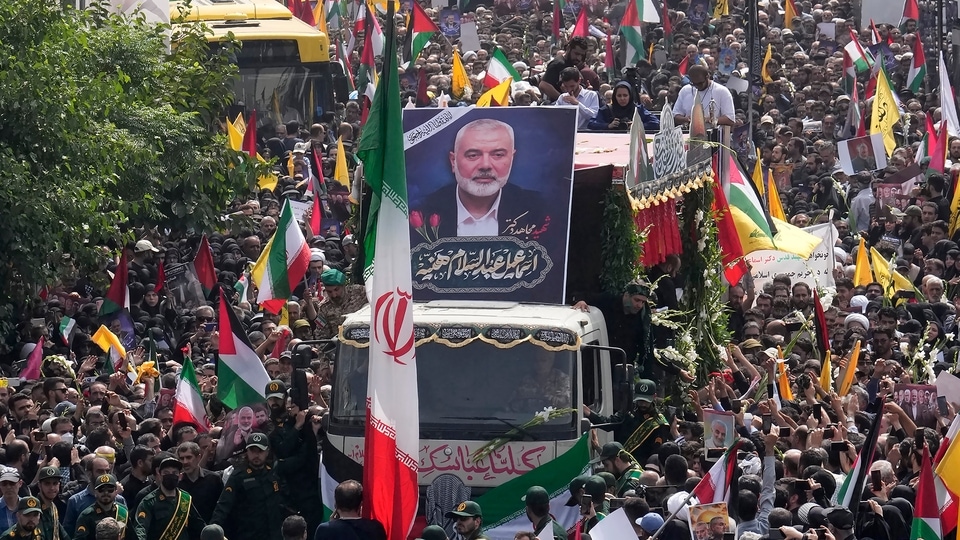
In the early hours of July 31, Hamas’ political chief Ismail Haniyeh was killed in an airstrike in Tehran, a day after another airstrike killed Hezbollah’s deputy commander in their stronghold of South Lebanon. While Israel has stuck to its practice of not publicly claiming targeted killings, for these groups at least and for most commentators, the strike was presumed to have been by Israel, bolstered further by statements of praise by Israeli leaders. While numerous profiles on the veteran Hamas leader have already captured the mediascape, two aspects must be highlighted – the political effects of his loss within Palestine, and the geopolitical effects of where he was killed.
On his death
Haniyeh was more than the public face of Hamas, supplementing former political chief Khaled Mishal (whose assassination the Mossad infamously botched in 1997). He personified the group’s steady expansion of bases of support, especially within Palestine. In the period surrounding the 2006 Palestinian legislative election where Hamas trounced the PA, Haniyeh (as Prime Minister-designate) and Mahmoud Abbas (as President) were at each other’s throats, with foot soldiers of both groups engaging in intense clashes, even as Hamas reconciled with the new responsibility of taking all Palestinians along, regardless of radical/moderate ideology.
That effort failed, with the cavernous rift between Fatah and Hamas defining the internal rupture of the Palestinian Authority, physically characterised by the separation between Gaza and the West Bank. Six years since their last (failed) reconciliation effort, Abbas and Haniyeh met in Algeria in 2022 — with the Algerians touting their handshake as historic. The new effort seemingly stuck as they met again in Turkey in 2023 after which senior Hamas officials more proactively highlighted the brotherhood between Fatah and Hamas — much before Israel’s current war on Gaza catalysed their formal reconciliation in Beijing this July.
Haniyeh’s death and Israel’s perceived responsibility only help the glue holding Fatah and Hamas dry faster. Despite having buried the hatchet, Abbas has essentially lost a long-time rival, injecting greater comfort in Fatah to carry a relatively weakened Hamas along. Note that in its statement outlining President Abbas’ condemnation of Haniyeh’s killing and a declaration of a day of mourning, the State of Palestine refrained from calling Haniyeh the former Prime Minister.
However, there is little reason to believe that Fatah will now hunker down and tread a moderate path of the old kind, as the more radical Hamas loses one of its vital heads. Rather, there is enough rationale for Fatah to adopt a more hardline position – a necessity created in any case due to fierce Palestinian resentment against Israel across the last nine months. Haniyeh’s killing then, offers little resistance to a river of change that had already reached its basin in July.
Additionally, Haniyeh’s death takes away a crucial actor for ceasefire negotiations which have progressed through fits and starts thus far – the Qatari PM said as he asked how one negotiates by killing the negotiator? There is no greater reason for Israel to accept a ceasefire since the deaths of two top military opponents give some military victory to a force that has struggled to define its operational conflict-terminating objective and is facing global outrage (and a genocide charge) for killing over 40,000 civilians in Gaza.
However, there is also greater reason for Hamas to decline a ceasefire and hostage release. The political cushion provided by the deal with Fatah pairs with an awareness of the inevitable mortality of its own leaders to inject a greater sense of resolve in a group that has been defined lifelong by violent resistance to Israel. Simply put, it has even less to lose in what is turning into a bloody battle of attrition.
On his death, in Tehran
Haniyeh was killed while visiting Tehran during newly elected President Masoud Pezeshkian’s inauguration ceremony – for which Indian leader Nitin Gadkari was also present. In Tehran, the mood is tense. Israel’s strike exchange with Hezbollah closed the immediate escalation loop, with Hezbollah’s ghastly strike in Majdal Shams inviting the Israeli strike that killed Fuad Shukr. However, the fact that Haniyeh was killed in Iran (especially when the Islamic Republic was hosting global leaders), does not close a crisis loop but rather forces Iran into new commitment traps under a newly elected (relatively) reformist President. While the room for more direct escalation between Iran and Israel remains open with Khamenei reportedly ordering preparations for an attack, Iran’s proxies can at least be assured of greater support.
More broadly for the region, it is the site of the incident that spells greater uncertainty for Arab states. With Arab leaders already unsettled by Israel’s actions in Gaza, the death of a Palestinian leader (even if Hamas) in Tehran only gives Iran greater rationale for disrupting any post-conflict regional stability. Israel’s hardened position against Palestinian sovereignty (and its actions in Gaza) is already testing the ability of Arab states party to the Abraham Accords to stay on the Israeli side of the metaphorical Rubicon and is increasingly pushing away potential crossers such as Saudi Arabia.
In the 24 hours since Haniyeh’s death, negotiators Qatar and Egypt criticised Israel, and Turkey and Jordan condemned the strike, but heavyweights like Riyadh and Abu Dhabi maintained a studied silence. Indeed, these states would rather take time to measure their stance before an official reaction, given the stain of October 7 on Hamas. However, for a state such as Saudi Arabia which showed an ability to absorb the risk of overtly criticising Hamas (along with Israel) in October 2023, Israel’s strike killing Haniyeh only increases its discomfort, come August 2024 – Riyadh cannot be seen as giving Israel a carte blanche, especially with the Gaza death toll still mounting. Like most recent developments, this too only increases the Arab need to press for a ceasefire.
Presently, among the more prominent of the group’s current leaders, only Yahya Sinwar as Hamas’ Gaza chief remains. However, Sinwar should not be misread as being less or more radical/moderate than Haniyeh given his presumably direct involvement with planning the October 7 attacks.
Sinwar’s more hands-on role for Hamas does not dilute his experience dealing with other states — he prioritised reconciliation with Egypt immediately after being elected in 2013 and spearheaded Hamas’ 2017 white paper that partially recognised the 1967 borders of the Palestinian state. Now, with Haniyeh dead and Al Qassam Chief Mohammad Deif’s status uncertain, Sinwar becomes even more crucial to ceasefire negotiations than he already was.
Bashir Ali Abbas is a research associate at the Council for Strategic and Defense Research, New Delhi, and a South Asia Visiting Fellow at the Stimson Center, Washington DC. The views expressed are personal.


