
Sign in

Paris climate talks: Why India is a key player

India can be one the biggest beneficiaries as it has capability and mechanism to adopt investment for clean energy.

Updated on: Dec 12, 2015, 15:08:06 IST
Hindustan Times | By , Paris
Share
Share via
  • facebook
  • twitter
  • linkedin
  • whatsapp
Copy link
  • copy link

Paris would create history on Saturday when it adopts a comprehensive climate change deal that will give a major boost to clean energy business like never before.
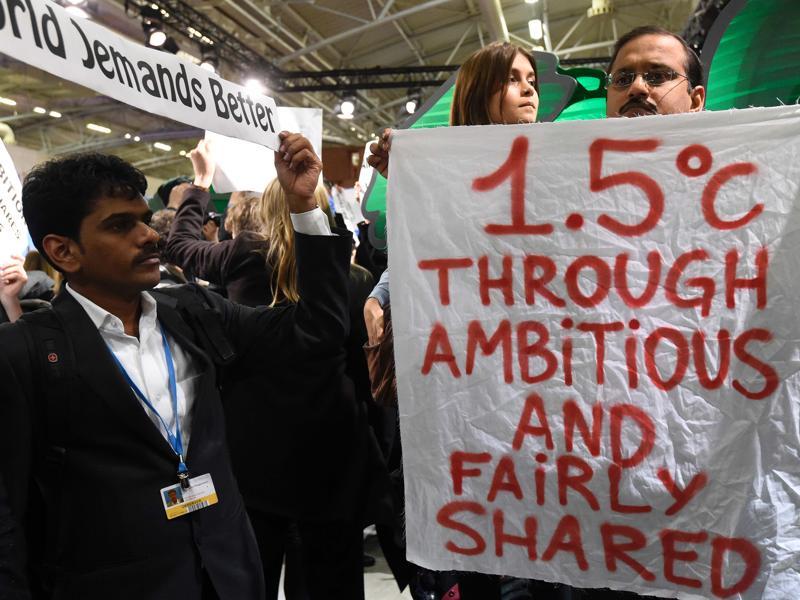
Members of a non-governmental organization (NGO)demonstrate during the COP 21 United Nations conference on climate change at Le Bourget, on the outskirts of Paris. (AFP)

The deal will have a lot in store for economies in transition like India with trillions of dollars expected in green investment in the next decade. This would enable such countries to adopt a low carbon green pathway.

“India can be one the biggest beneficiaries as it has capability and mechanism to adopt investment for clean energy,” said Damandeep Singh, Director of Carbon Disclosure Report, India.

India has already declared a target of setting 175 Gegawatts capacity of renewable energy by 2020 and Prime Minister Narendra Modi had expressed optimism that it could be scaled up to 350 GW by 2030.

“Estimates by industry leaders show that trillions of dollars would be available for investment from companies in Europe and America. You just need the right policies,” Singh said.

Over 200 big Indian companies shared a green transition road-map in Paris in tune with global business leaders for the shift that Paris deal will usher. The deal would also push India to adopt more environment-friendly policies to attract green investment.

The officials in the office French Foreign Minister Laurent Fabius said the final text agreed by 196 countries - 18 hours after the Paris summit was scheduled to close — has something for every country to cheer about. “We have a text and conditions have never been better for strong and ambitious deal,” Fabius said, as he got ready to present the text for final adoption by the conference.

However, analysts expect some fireworks as the deal could leave some countries disappointed. And if that happens, the Paris summit may be stretched further till Sunday morning. Developing countries like India expect enhanced finance from the rich world for post 2020 when the deal comes into force. The $ 100 billion is the floor for 2020 and a “substantial” increase leading to doubling the money by 2025 is the expectation of the developing countries for “real” implementation of the Paris Outcome.

For India, continuation of the existing firewall between the rich and the developing world in Paris agreement is a must to get necessary clean technologies to meet its renewable energy goals and escape additional financial burden.

The deal would be historic as it will change the pattern of economic growth of countries this century. It will see emergence of renewable energy, especially solar, as mainstay of energy needs and India has taken a lead by announcing a global solar alliance. India aims to become the global hub for solar technologies.

The deal would be a win-win for all as it would provide new business avenues to rich countries and assistance to the developing world for transition. The deal, however, would not provide the pace for change as promised by head of states on the first day of the summit because the “compromise” would have watered down the “high ambition” of the deal to accommodate all nations.

  • Chetan Chauhan
    ABOUT THE AUTHOR
    Chetan Chauhan

    Chetan Chauhan is the National Affairs Editor looking into all aspects of news and features from across India. A Chevening scholar with over three decades of experience in reporting and news management, Chetan has extensively covered all important aspects of the social sector, political economy, environment and climate change nationally and internationally. He did a journalism course at the Reuters Institute of Journalism in Oxford and Digital Media training at Nanyang Technological University in Singapore. He started as a reporter with The Statesman in 1996 and joined the Hindustan Times in 2000 in the metro bureau covering environment, crime and Delhi politics. He covered hot local news, from the Jessica Lal murder case to the rebellion of Delhi Congress MLAs against then Chief Minister Sheila Dikshit, to the replacement of toxic vehicle fuel with cleaner compressed natural gas (CNG) in the national capital. Some of his stories on air pollution became part of the Supreme Court’s landmark MC Mehta versus Government of India case in the National Capital Region (NCR), forcing the government to take corrective measures. As part of the national political bureau since 2004, he covered important central sectors such as environment, education, social justice, labour, rural development, water resources, renewable energy, agriculture, broadcasting and the Planning Commission for more than a decade producing several exclusive and investigative breaking stories. His specialisation is the environment, having covered at least a dozen United Nations global conferences on climate change, biodiversity and wildlife including climate summits in Paris, Copenhagen and Bali. He also covered India’s two five-year plans ---11th and 12th and reported on drafting and execution of right based laws such as Right to Education, Right to Information and rural job guarantee law, MG-NREGA, now being introduced in new format as VG-RAM-G Act. He has in-depth knowledge of social sector issues. He was one of the first to report on tigers vanishing from Sariska and Panna wildlife reserves in 2004 and 2008, respectively, leading to the setting up of the National Tiger Conservation Authority (NTCA) and the introduction of stringent penal provisions for poaching. He has written extensively on the rising human-animal conflict in India and the degradation of India’s biodiversity hotspots because of mining and other activities. Since 2004, Chetan has covered Parliament comprehensively and participated in training on the nuanced coverage of Parliament proceedings. He has travelled extensively across India to cover national and provincial elections since 1998, especially in the Hindi heartland states, considered India’s road to power. He writes a regular column for Hindustan Times, Ecostani, on important national politics, economy, Himalayan ecology and environmental issues. His other responsibilities include providing inputs for edits and edit page articles for the publication, apart from managing news flow from across India.Read More