
 E-Paper



Kejriwal, Mayawati’s EVM tampering claim questions the integrity of poll staff
Arvind Kejriwal and Mayawati’s charge of EVMs being tampered with questions the integrity of thousands of poll staff


Delhi chief minister Arvind Kejriwal, BSP chief Mayawati and outgoing Uttarakhand CM Harish Rawat are well within their rights to question the efficacy of electronic voting machines but doubting the integrity of thousands of poll staff is not acceptable.
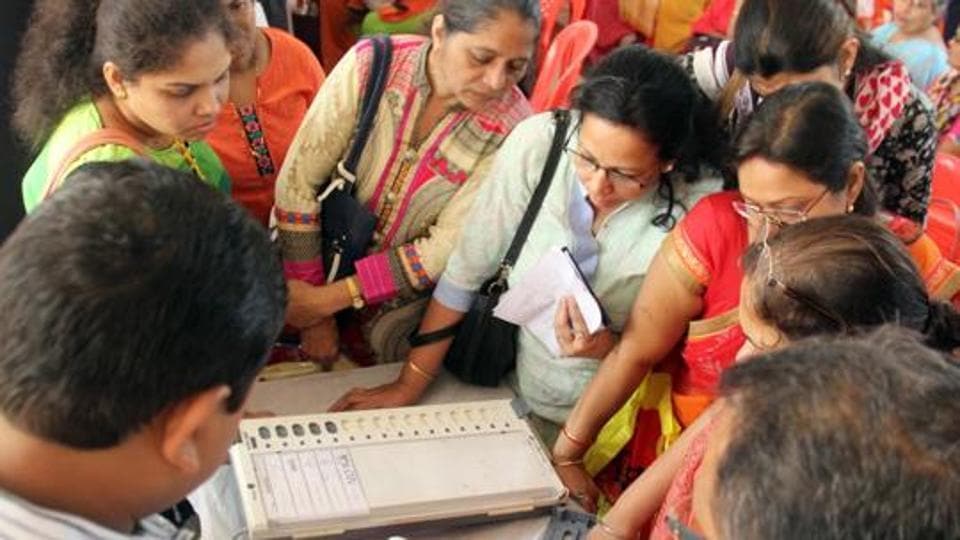
Tampering of EVMS – as claimed by these leaders who took a beating in the recently concluded state elections – at such a scale cannot happen without the involvement of thousands of poll personnel.
For, every machine will have to be tinkered with individually and that is an enormous task.
More than 150,000 EVMs were used in Uttar Pradesh, around 40,000 in Punjab and 11,000 in Uttarakhand.
The number rises to about 2.4 million for the Lok Sabha election.
First introduced on pilot basis in 1982, EVMs fast-tracked India’s electoral process. Counting that used to take days is now a matter of hours.
All states had switched to EVMs by 2000. The 2004 poll was the first general election in which EVMs, manufactured by government-owned Bharat Heavy Electricals and Electronic Corporation of India, were used.
An EVM can record a maximum of 3,840 votes and typically, the number of electors in a polling station doesn’t exceed 1,500, the Election Commission website says.
Even if a fourth of the machines used in the three states were to be tampered with, around 100,000 people ranging from poll staff, security personnel to representatives of contesting political parties will have to be in it together, which is highly improbable.
Kejriwal on Wednesday alleged that a fourth of his Aam Aadmi Party (AAP) votes were diverted to the ruling Shiromani Akali Dal in Punjab.
AAP’s national ambitions took a knock after it finished second with 20 seats in Punjab, where it was hoping to topple the SAD that ended third. The Congress stormed to power with 77 seats in a 117-member House.
Mayawati, whose Bahujan Samaj Party was decimated in Uttar Pradesh, said results showed that Muslims votes went to the BJP. The BJP won 312 seats in a 403-member UP assembly.
Responding to Mayawati’s call for a fresh election, the Election Commission said EVMs couldn’t be tampered with. “Various preventive and precautionary measures have been put in place by the commission for the operation, maintenance and storage of the EVMs,” the EC said.
The BJP, too, is dismissive of her charges.
“When you win, EVMs are right. When you lose, EVMs are wrong. This shows that there are some defects in you (Mayawati),” Union Minister M Venkaiah said on Wednesday.
Professor J Alax Haldarman of Michigan University had in 2010 released a video showing that an EVM allowed him to change results by sending a message from a mobile phone.
But, that was made possible after a chip, which Haldarman’s research associate Hari Prasad stole from a collector’s office in Mumbai, was inserted in the EVM that directed all the votes to one candidate.
For that to happen, the device has to be opened by an engineer with the connivance of a poll official and security personnel entrusted with the EVM.
The chip needs to be inserted in the circuit to re-direct the votes and it could take up to an hour, a paper released by Haldarman said.
The Election Commission’s rigorous EVM drill doesn’t allow a hacker enough time. They have a two-day window between the mandatory mock drill, held in the presence of candidates’ representatives, and the polling day.
But an hour before voting opens, poll officers recheck the machines in front of the candidates’ representatives. Tampering is not possible without the involvement of top poll functionaries.
An EC panel of senior scientists had rejected Haldarman’s claims.
The poll watchdog, however, introduced verifiable paper trail, or VVPAT, on the directions of the Supreme Court.
The paper is a printout that allows a voter to see if the vote has gone to the candidate it is intended for.
Having said that, the poll panel needs to address concerns, not allegations, of Kejriwal, Mayawati, Rawat and several other leaders.
As around 2% of the polling booths in the five states used machines with paper trails, VVPATs should be counted in the presence of these leaders, a move that will re-enforce people’s faith in the EVMs.


