To understand why BSP remains a force to reckon with in UP’s politics, travel to the Jhansi bus stop.
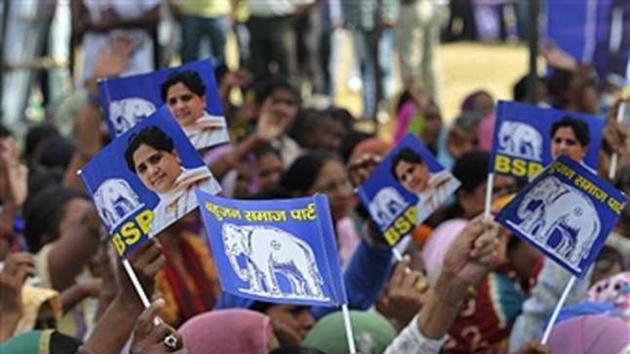
And meet Jeevan Lal.
Lal was studying mass communication in Jhansi, when he had to drop out of college. He could not find a job, and eventually decided to do what other young, fellow Dalits of his neighbourhood had done - set up a roadside stall at the bus stop, to cater to the passengers heading in and out of Bundelkhand’s biggest city. The region has 19 seats and goes to polls on 23rd.
Sitting with a group of Dalit, Thakur and Muslims at the bus stop, Lal says, “Our biggest issue is unemployment. We just need factories and jobs. Everyone from here has to migrate out.” Brajesh Kumar, a Dalit entrepreneur in the construction sector, chips in, “Business will only increase when Bundelkhand becomes a separate state. And only Behenji has promised us that.”
Lal was skeptical whether Mayawati could indeed create a state. “BJP is at the Centre. Only they can do it.... We are not BSP’s bonded labour, but even if we vote SP and BJP, they will never believe we voted for them. So it is best to stick to our party,” he says, with a laugh. With over 50,000 Dalits, the seat is a substantial base for the BSP to start with.
The Jhansi Nagar seat is representative of both BSP’s core strength, but also the manner in which it stitches wider caste coalitions. In an election that has become a seat-by-seat phenomena, the contest here also reveals the limits of the BJP’s strategy to woo non-Yadav OBCs. It also shows how local arithmetic is shaping Muslim preferences.
{{/usCountry}}The Jhansi Nagar seat is representative of both BSP’s core strength, but also the manner in which it stitches wider caste coalitions. In an election that has become a seat-by-seat phenomena, the contest here also reveals the limits of the BJP’s strategy to woo non-Yadav OBCs. It also shows how local arithmetic is shaping Muslim preferences.
{{/usCountry}}‘She taught us to live’
Back at the bus stop, Umesh Kumar says he had voted for Narendra Modi in 2014. “I am not happy with notebandi. We had to suffer a lot. People did not have change to buy even chai. But I think I will vote for him again in Lok Sabha. He is honest.”
And who will he vote for this time? “Behenji. She has taught us to live. Babasaheb and Mayawati made us what we are today. That is why you are sitting with us.”
In general seats, Mayawati relies on the candidate to bring in his own votes. Here in Jhansi, the BSP candidate is Sitaram Kushwaha - who came a respectable second in the last election.
It is in seats like this that the BJP’s strategy to woo non-Yadav OBCs hits a roadblock. Its own candidate is Ravi Sharma, a Brahman. BJP hopes to get its traditional voters from the upper castes - though it remains open if Banias would vote for the party with the same enthusiasm post demonetisation. BSP has both its core Dalit base and the Kushwaha votes.
Muslim preference
Muslims - over 50,000 - are seriously considering the BSP as an option. At the bus stop, joining the Dalit men, Aslam says he would vote BSP. Why? “The Congress candidate from the alliance is weak. And BSP is strong.” Anis Khan says Mayawati would be good for Muslims too. “SP sarkar has so much goondai. Anyone can do anything. We want order.”
At the Ambedkar Nagar market, Hafeez runs a furniture shop. He says BJP will make it. Why? “We are getting divided. Some like Akhilesh. Others want Mayawati for her law and order. So if we split, it will help BJP.” Does that worry him? “Not really. They want to keep us out of power but they won’t do anything bad. Modi hasn’t allowed riots since he became PM.”
The Jhansi seat reflects the deep penetration of BSP among Dalits. It also reflects the importance of candidate selection and building wider alliances between castes. And it reveals the careful calculation of Muslims on a seat- by-seat basis in a complex poll.