E-Paper



Idol immersion in Bhopal: Green tribunal guidelines ignored
Idol immersions in Bhopal, which began on Sunday and continued in water bodies of the city on Monday, paid little heed to guidelines issued by Central Pollution Control Board.


Idol immersions in Bhopal, which began on Sunday and continued in water bodies of the city on Monday, paid little heed to guidelines issued by Central Pollution Control Board.
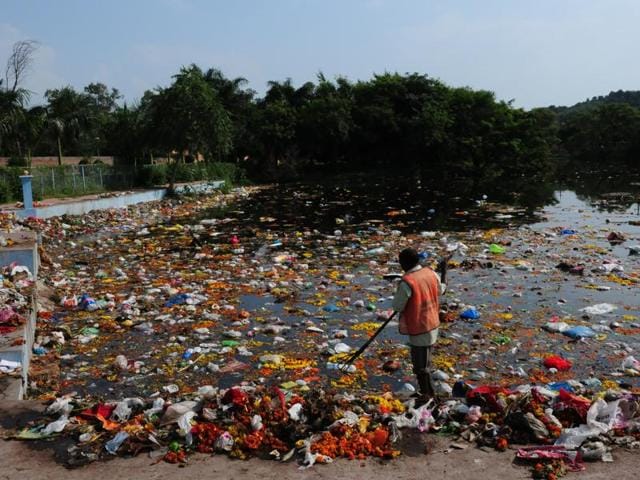
The CPCB guidelines specify that idols should be made from natural materials as described in the holy scripts and traditional clay should be used for idol making rather than baked clay, Plaster of Paris (PoP) etc.
HT, however found eco-friendly idols a minority at immersion grounds, where most of the idols were made of Plaster of Paris and painted with synthetic colours.
The guidelines suggest biodegradable materials to be collected separately for recycling or composting and non-biodegradable materials to be collected separately for disposal in sanitary landfills. But both biodegradable and non-biodegradable materials made their way into the water bodies.
Flowers, leaves and artificial ornaments of idols should be removed and idols should be immersed into a corner of a pond or a lake using removable synthetic liners in the bottom.
But gross violation of rules were evident from the conditions of Lower lake, Upper lake and a pond at Shahpura, where flowers and other religious offerings floated on the water surface, littering the banks.
These violations happened even after National Green Tribunal (NGT) had directed the MP government on August 18 to send instructions to collectors for identification and consequent destruction of idols made of pop in their respective areas.
Though MP State Pollution Control Board (MPSPCB) conducted an eco-friendly idol making workshop few weeks back, it didn’t bring any significant change.
Bhopal Municipal Corporation had also set aside artificial ponds and plastic water tanks in many parts of the city for idol immersion, but the alternative sites found few takers as they couldn’t accommodate thousands of small and large idols.
MPSPCB regional officer Bhopal PS Bundela, however, said there was a comparative change as many people followed eco-friendly measures this year, as compared to the last year. He said a lot needs to be done to change the mindset of people.
“This time, when we started the awareness drive following the NGT order, large idols had already been constructed, Next year we will tell the idol makers not to make big idols as they add more pollutants to the water bodies,” he said.
The celebration is a sensitive religious issue and it is really difficult to push people to change their rituals beyond a certain level of acceptance, the officer said.
COURT ORDER
In response to guidelines issued by the Bombay high court for idol immersion, Central Pollution Control Board (CPCB) had set up a committee to frame national guidelines for immersion of idols in February, 2009.
Subsequently, in June 2010, CPCB came up with a set of guidelines on this issue.