E-Paper



Students in Bhopal brave noontime heat, measure earth’s circumference
Over a dozen Madhya Pradesh students on Wednesday braved the noontime sun to measure the earth’s circumference by using a two millennia-old technique for the first time in Bhopal.


Over a dozen Madhya Pradesh students on Wednesday braved the noontime sun to measure the earth’s circumference by using a two millennia-old technique for the first time in Bhopal.
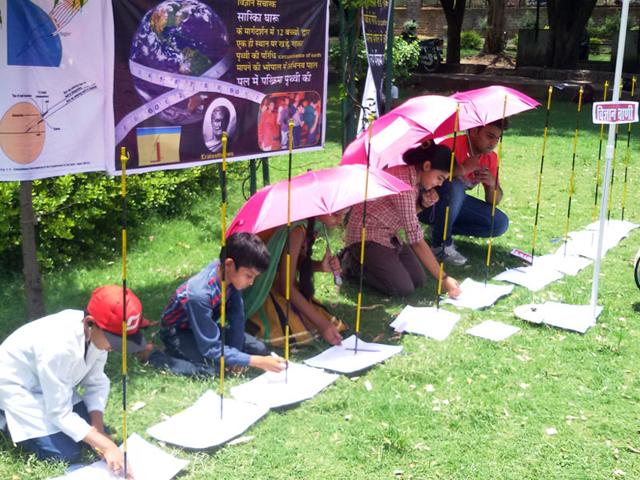
Believe it or not! They calculated the earth’s circumference at around 40,000 kilometres in Bhopal's Chinar Park, which is not different from the exact figure of 40,075 kilometres.
They will submit their experiment reports to science and technology secretary Hariranjan Rao, said Itarsi-based government science teacher Sarika Gharu, under whose guidance the event was organised.
Gharu, who claims to have been holding such science popularity events using her own resources, explained Wednesday was a zero shadow day (when sunrays fall perpendicularly, casting no shadow) in the northern area of Nagpur, which is around 300 kms from Bhopal.
All that the students did was post 12 four feet rods in the park and measured the average angle of the shortest rod shadows to around 2.7 degrees between 11.30 am and 12.30 pm.
“As the earth is spherical, this angle helps us calculate the circumference of the earth by taking into account the distance from the 'zero shadow point', which is north of Nagpur today. When we divide 360 degrees by the angle cast, which is 2.7 degrees, and multiply the result with 300 kms (distance between Bhopal and North Nagpur), we get the result of 40,000 kms, which is roughly the earth's circumference".
Gharu said the technique was first used by Greek mathematician and geographer Eratosthenes in 240 BC.
"Youngsters felt a special connection with Eratosthenes, about whom they knew nothing earlier", she said.
Anju Raikwar, the first year graduate student who studies biology, was so curious that she reached the park to witness the experiment.
"Though it is very hot today, I decided to come here to know this (watch the event).”
She said it had been a wonderful experience for her as the result of the experiment was the closest to the exact count of the earth’s circumference.
Another science student from Gitanjali College Ashi Chouhan said it first seemed to be a magical trick as it was about measuring the earth with the help of a few rods!
"But science teacher Sarika Gharu made us understand the basic concepts behind this experiment, and we were able to take the measurements under her guidance. It was a wonderful feeling when we got the final result of 40000 kms," she said.
Gharu explained that the zero shadow day meant that the rays of the sun moving from the Tropic of Capricorn to the Tropic of Cancer would fall exactly perpendicularly to the earth giving the world a shadowless moment of the day.