E-Paper



Surya namaskar will divide schoolkids on religious lines: MP's minority leaders
The MP government’s decision to hold a surya namaskar (sun worshipping) programme at schools has raised concerns among Christian and Muslim religious leaders, who say it could divide students along religious lines.


The Madhya Pradesh government’s decision to hold a surya namaskar programme across the state’s schools on January 12 has raised concerns among Christian and Muslim religious leaders, who say it could divide students along religious lines.
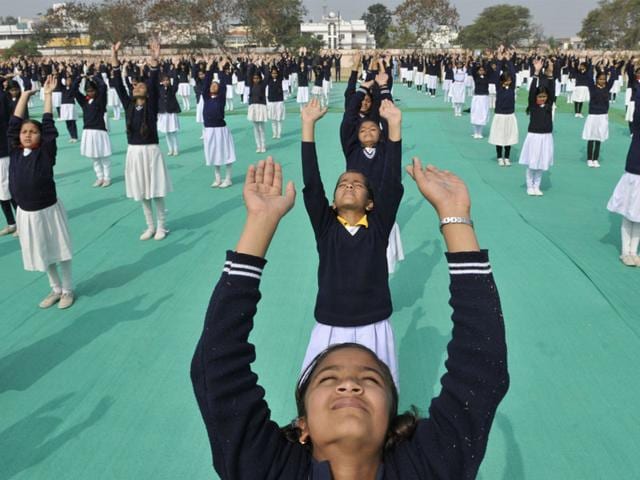
The mass programme is optional for students, and chief minister Shivraj Singh Chouhan said in a statement that the event was important as it was on the lines of Prime Minister Narendra Modi’s initiative to declare International Yoga Day.
“In this perspective, surya namaskar has assumed greater significance. Enthusiastic participation of children and youths in it should be ensured,” he said.
However, the move has not gone down well with Christian and Muslim leaders, amid fears of increasing communal polarisation across the country since the BJP came to power.
“Though the government claims it (surya namaskar) has been made optional, students from all communities will feel pressured to take part in it. And even when it is optional, it will create a rift between the students on religious,” said Masood Ahmed Khan, secretary of the Coordination Committee for Indian Muslims in Madhya Pradesh.
The naib qazi of Bhopal, Sayeed Babar Hussain, said the state government was indirectly teaching students about communal differences instead of teaching them secular values.
Christian religious leaders echoed the thought.
“Education should be kept away from religion. Mixing the two will be disastrous in the long run for communal harmony in schools. It is sad that the government is pushing it with such religious zeal,” said Father Anand Muttungal, coordinator of the Rashtriya Isai Mahasangh Madhya Pradesh.
Some like Anil Martin, president of the Protestant Clergy Fellowship of Bhopal were more forthright.
“Bowing before the sun is un-Islamic and idolatrous, with top clerics in Bhopal having issued a fatwa against it in 2012. We Christians also don’t worship the sun like this. The fact is that government is softly saffronising education in the state and they are trying different tricks in their bag,” he said.
Educationist and Guardians' Guild president Prof Zamiruddin has written to the chief minister expressing his concerns.
“Since it would be observed only by the majority community students, the other students of the schools not doing the surya namaskar, will clearly stand isolated and singled out… it would not augur well for the nation if youth, who should stand united in the interest of the motherland, stand divided at such an early stage on religious lines,” he wrote in his letter.