
 E-Paper



Anumeha Yadav: “The Adivasi way of life can teach us a lot ”
The author of Our Rice Tastes Of Spring, offers a counterpoint to our extractive world and shows what is being done to our rich food diversity

 Prefer HTon Google


How did you simplify seed sovereignty, a pressing and political issue, for children?
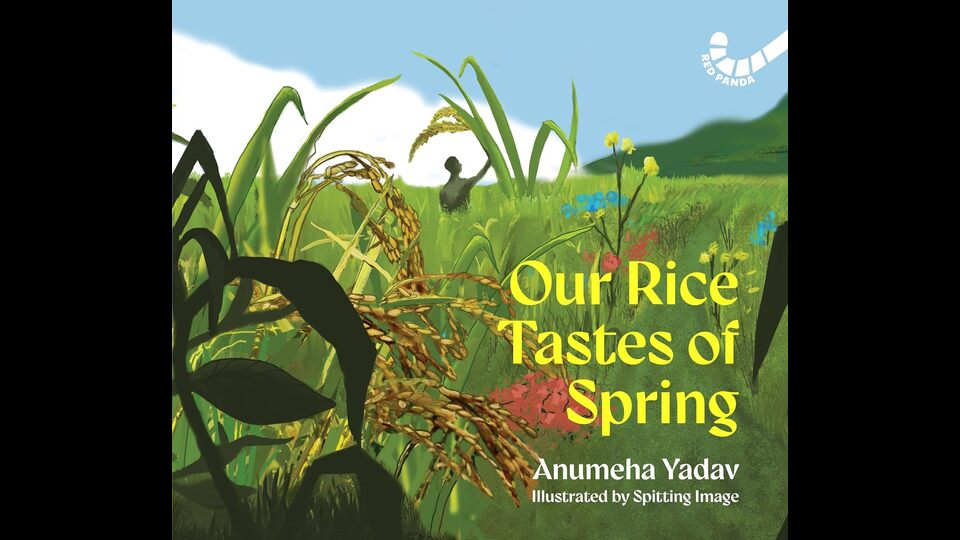
We wanted to tell a story in a format that transcends age and the barriers of literacy. As a news reporter, I investigated policies to address malnutrition and anaemia through artificially fortifying rations of rice and grains with nutrients. India produces enough food, yet many go to bed hungry. This is a symptom of persistent social disparities and inequalities. At the same time, even as India produces more cereals, because of indiscriminate use of fertilizers and pesticides, our soils have become barren. Instead of ‘tech fixes’ such as factory fortification, I wanted to bring the attention back to address the root causes – what are we doing to our rich food diversity, our seeds?
The story is set in a fictitious village of Sohar in Jharkhand. Sandhya Visvanathan and members of Bengaluru design collective Spitting Image illustrated the story based on photographs I took over six years in a Jharkhand hamlet – the elders, the village assembly, ancient trees, forests, shrubs, fields, cultural gatherings, and festivals. They recreated life and people as they are on the Netarhat plateau.

In describing the rice varieties and the food, besides the hamlet in Latehar, I relied on my conversations in East Singhbhum, and in northern Odisha. In just two villages in East Singhbhum, Adivasi farmers shared memories of cultivating so many rice varieties with lyrical names: Chandra Kanthi, Lolaat, Joradhaan, Maanjhi, Makarkanthi, Kaankri, Nohaachi-dhaan. This treasure trove of rice varieties are being lost in the switch to modern hybrid varieties. We used illustrations and imagined an alternative future where we as a society and a species, preserve these rice varieties, where these seeds will live on, instead of perishing or going extinct.
You document layers of erasures: food, knowledge, seed, autonomy, biodiversity. Which one is the most urgent and important to fix?
I believe if we respect and value autonomy, of indigenous cultures, regions, different ways of eating, of belief, languages, a lot will fall into place. Right now, one mode of thinking, of excessive competition, of mindless over-production dominates. It is ultimately about how we think, what we value as a society before it translates into a law, policy, the gazette, a project.
Do you think the model of resistance here can be replicated elsewhere?
In the particular village on the plateau that I lived in, the lesser well-off among the Adivasi farmers grew Ranikajal, Goda-dhan, Chosaarh and Kalamdaani rice. They had not all switched to hybrid crops. It was common to eat porridge of desi rice and makai corn ground in the dheki, a wooden pounder, and they ate several kinds of dried small fish sold at the weekly haat (marketplace) and grew or gathered berries, yams, gourds, saag(greens). At the time of transplanting and work on the small farms, the Adivasi farmers here sit together and decide how they will work in one person’s fields one day, and the next another day, and what they will pay each other. It is the same way of building their houses. Distinct from urban cultures, there is still a social way of equality which enables mutual aid and support and being distinct but being together.
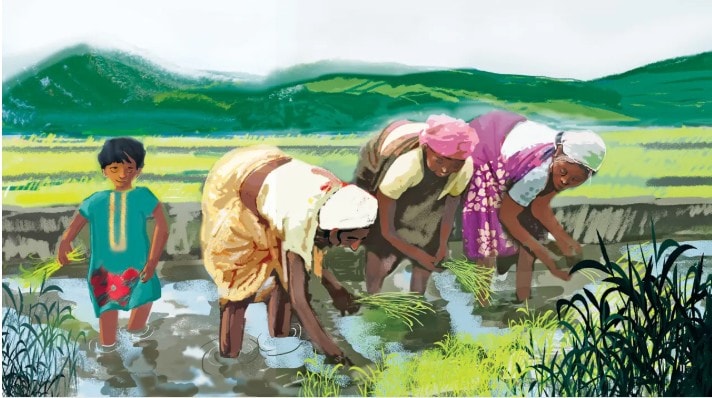
What I wanted to capture and highlight was this Adivasi ecology and society, a way of thinking that still values egalitarianism, mutual help, cooperating, and even leisure time. By their very being, they often create alternates to dominant production and belief systems. The Adivasi way of life and its production too is under strain and pressure. But it can teach us a lot about re-imagining our own plates, own our way of life for the future.
How do you see the tensions between capitalistic aspirations and traditional livelihoods?
An elder paddy farmer in Latehar once told me that he believed the State and the companies want them to vacate the land because they grew food only for themselves, not for the market. This is just one way in which capitalistic systems and values reduce individuals and societies to – that is, what is their immediate use to the market?
Under the capitalistic mode of production, even as India produces more cereals, because of indiscriminate use of chemicals sold to farmers, soils are dying, water is depleted. Government studies show nutrients in rice and wheat we grow have fallen significantly. At the same time, we witness the ‘social death’ of small landholders, peasants, artisans. We see this manifest both in farmers’ suicides as well as in recurring farmers’ demonstrations.
It shows we really need different cultures around measuring productivity, what is socially useful and ecological sound, and how we value diverse foods, our long-term health, and even what we think makes a good life.
Aparna Karthikeyan is an independent journalist and author based in Chennai.


